

Reported by: Ijeoma G | Edited by: Oravbiere Osayomore Promise.
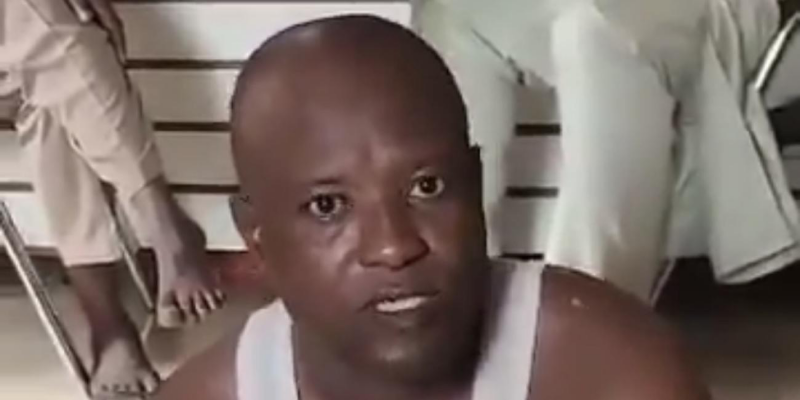
A man identified as Alhaji Ibrahim has been arrested after allegedly devising a disturbing scheme to extort money and valuables from families of people abducted by bandits by falsely claiming that their relatives were in his custody. The suspect, from Babana in Niger State, was seen sitting on the floor while being interrogated in Hausa in a video posted online by conflict reporter Bakatsine. During the interrogation, Ibrahim admitted that he contacted a man identified as Isiya and told him that a relative had been abducted and was in their custody.
"I called Isiya. I told him that it was me. The person we picked up, his relative, on the road. Yes. By God, we will help him; leave him and bring him home. We are not harming him. But he should buy a motorcycle. I will release him," Ibrahim said in the video. When questioned whether he had told Isiya that the victim was in his custody, Ibrahim replied in the affirmative. "That's what I told him. That's what I told him, that he is with us," he said. According to him, he instructed Isiya to purchase a motorcycle worth N2.5 million as a condition for the purported release of his relative. He also confirmed that the victim's relative had been told that he would be released that morning, claiming he had spent the night in the bush rather than going to work.
When asked how many other people he had approached using the same method, Ibrahim said there were two. "I have two people: Alhaji Sani," he said. The interrogators subsequently asked who Alhaji Sani was and how much he had been asked to provide. Ibrahim said Sani was also told to provide a motorcycle. "He too was told to give us a motorcycle," he said. The interrogation also revealed that Ibrahim contacted the mother of one of the purported victims. When asked whether he had called the victim's mother, he said, "I contacted her too." Asked what he told her, Ibrahim said he informed the woman that her son was with them and asked her to persuade him to provide money for his release. "She was told, 'Your son, call him. We are at the place with him. And he doesn't want to listen to us, and we want you to tell him to give us money, so that we can release him.' That is what I told her," he said.
Ibrahim was then asked to recount the message he sent to the victim. He said he introduced himself and appealed to the person to cooperate with him. "I told him, 'Salam, salam alaikum. It is me, Alhaji Ibrahim, from Babana. I want to help you, if you want. If you do justice to us, I will do justice to you,'" he said. According to Ibrahim, he told the victim that they had his relative but insisted that a motorcycle must be provided before the person would be released. "If he does what is right, we are here with your relative. But we still need the motorcycle. We'll release him once you give us the motorcycle. I told him everything," he said. The interrogators also asked Ibrahim whether he disclosed the location of the purported victim. "I told him he was in the bush," he replied. When asked who held the victim captive, Ibrahim said the person was in the hands of "the Fulani." However, when the interrogators reminded him that he had earlier told the victim that the relative was in his own custody, Ibrahim again confirmed this. "Yes, that is what I told him," he replied.
Ibrahim further explained that the demand was not necessarily cash but a motorcycle. "I said his relative was in our custody. If you give us money, if you give us only the motorcycle, that is enough. I will release your relative," he said. "That is what I told him," he added. Explaining further, Bakatsine said, "This man had a disturbing way of making money. Whenever bandits abducted someone, he would get the victim's relatives phone number, call them using a disguised voice, claim their relative was in his custody, and demand ransom. This was not the first time he had been arrested over similar crime. But as they say, let's hear the story from the horse's mouth."
The case has once again exposed the layers of criminality that surround kidnapping in Nigeria's North-West, where armed groups have built a brutal economy around the abduction of innocent citizens. But beyond the bandits themselves, there are opportunists who exploit the anguish of victims' families for personal gain. Ibrahim's alleged scheme was designed to profit from the fear and desperation of people whose loved ones were already in captivity. He did not need to abduct anyone himself. He simply needed a phone, a disguised voice, and the phone number of a terrified relative. The families, already traumatised by the abduction of their loved ones, were presented with a choice that no parent or sibling should ever have to face: pay a stranger who claims to hold their relative's life in his hands, or risk never seeing them again.
The scale of the problem is staggering. Across Nigeria's North-West, kidnapping has become a multimillion-naira industry. More than N7.8 billion was paid in ransom between July 2025 and June 2026, with 7,825 victims recorded across 1,713 incidents. The North accounted for 93.7 per cent of all abductions, with Zamfara, Katsina and Sokoto states recording the highest numbers of victims. The criminals who carry out these abductions are often members of organised gangs operating from forest hideouts. But the extortion of families does not always end with the kidnappers themselves. Fraudsters like Ibrahim allegedly operate in the shadows, feeding on the misery of others. They monitor reports of abductions, obtain phone numbers of relatives through corrupt contacts, informants or chance, and make demands that exploit the victims' desperation.
The arrest of Ibrahim highlights the need for stronger intelligence-gathering and community vigilance. While the police and military continue to conduct operations against bandit groups, the networks that support and exploit kidnapping remain active. The suspects who operate in the shadows are harder to track than the gunmen in the bush. They do not carry AK-47s. They carry phones. They do not hide in forests. They hide in plain sight. They are neighbours, acquaintances, or strangers who have obtained information that should never have reached them.
For the families of the abducted, the arrest of Ibrahim is a small measure of justice, but it does not bring back their loved ones or erase the trauma of being targeted by yet another predator. The suspect is in custody, and the investigation is ongoing. But the questions remain: how many other Ibrahims are out there, how many grieving families have already fallen victim to their schemes, and what will it take to dismantle the entire ecosystem of crime that has grown around kidnapping in Nigeria's North-West? The answers, for now, remain elusive. The gunmen continue to operate. The fraudsters continue to call. And the families continue to wait, pray and pay, hoping that the next call will bring news that their loved one is coming home.
📩 Stone Reporters News | 🌍 stonereportersnews.com
✉️ info@stonereportersnews.com | 📘 Facebook: Stone Reporters News | 🐦 X (Twitter): @StoneReportNew | 📸 Instagram: @stonereportersnews
Add comment
Comments