

Reported by Ariajegbe Sylvia Esezobor
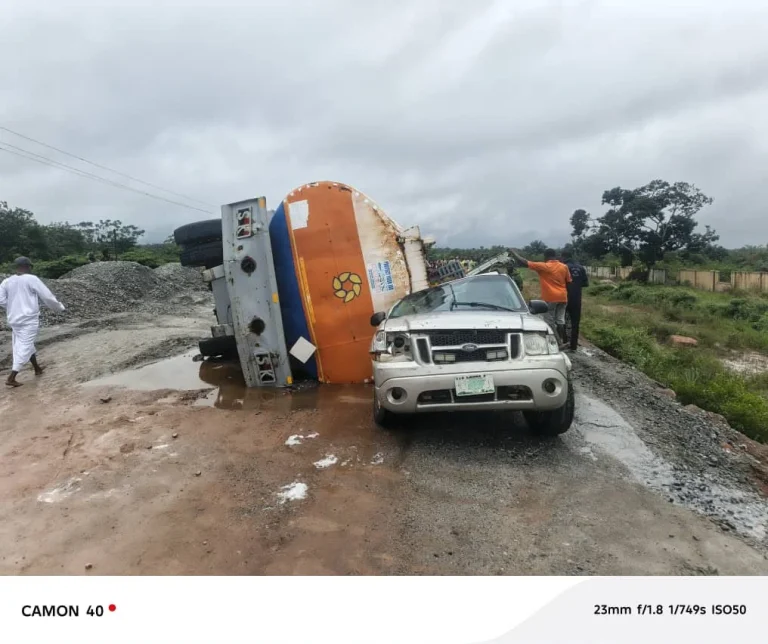
A tanker loaded with 45,000 litres of Premium Motor Spirit overturned at Isimi, Epe, Lagos State, on Thursday, spilling its highly inflammable contents onto the roadway and triggering a rapid multi-agency emergency response that authorities say prevented what could have been a major disaster. The Lagos State Emergency Management Agency disclosed the incident in a statement signed by its Permanent Secretary, Olufemi Oke-Osanyintolu. The agency confirmed that no life was lost and no injury was recorded. The incident occurred when the tanker, with registration number T-18212LA, collided with a stationary Ford pickup van marked KJA-13FJ that had developed a mechanical fault along the carriageway. According to LASEMA, preliminary investigation revealed that the tanker, while attempting to manoeuvre past the disabled pickup van, had one of its rear tyres slip into a pit, causing it to overturn and fall onto the pickup van, leading to the spillage of its contents onto the road.
LASEMA said it received a distress call at 10:19 a.m. and immediately activated its LRT Beta Whales Team stationed at Epe. Upon arrival, responders observed a tanker laden with 45,000 litres of PMS involved in an accident with a Ford pickup van loaded with animal feed. The agency activated its multi-agency incident management protocol, with the LRT working alongside the Lagos State Fire and Rescue Service, the Lagos State Traffic Management Authority, the Lagos State Neighbourhood Safety Corps, the Federal Road Safety Corps and the Nigeria Police Force. The agencies promptly secured the incident perimeter, implemented traffic control and diversion measures, and deployed safety protocols to prevent a secondary incident. The Lagos State Fire and Rescue Service blanketed the fallen tanker and its immediate surroundings with chemical foam to mitigate the risk of a fire outbreak. The affected section of the road was temporarily closed to vehicular movement to ensure public safety.
The operation was delicate and required precise coordination. LASEMA said the remaining PMS was successfully transferred from the damaged tanker to an empty tanker. Through seamless coordination and professional execution, the transloading of the remaining PMS from the accidented tanker to an empty tanker was successfully completed without incident. Both vehicles were subsequently removed from the roadway with the aid of a private tow truck and taken to Ketu Police Station. The road has since been reopened and is now free for vehicular activities. Oke-Osanyintolu commended the emergency responders for their intervention, saying the swift response and synergy of all emergency responders, whose professionalism averted what could have resulted in a major disaster, was commendable. He appealed to motorists, particularly drivers of heavy-duty vehicles and tankers conveying combustible products, to ensure their vehicles are in good mechanical condition, adhere strictly to traffic regulations, and exercise utmost caution on Lagos roads. The agency urged members of the public to report emergencies and road incidents through the 767 and 112 toll-free emergency lines.
The incident is the latest in a series of tanker accidents in Lagos State in recent weeks. Earlier in September, LASEMA contained a similar accident involving a truck conveying 45,000 litres of PMS on Ijako Road, inward Oke Oso, along the Ajah Expressway in Epe. That incident occurred when a Mack tanker reportedly overturned while climbing Ijako Hill following a mechanical fault. The tanker's propeller detached from its joint, causing the vehicle to lose momentum and fall on its side, with one of its compartments leaking fuel. LASEMA's Whales Team from the Epe Base arrived at the scene four minutes after dispatch, and the Lagos State Fire and Rescue Service, Oke Oso Station, had already commenced containment measures to prevent fire outbreak and environmental hazard. An empty tanker was mobilised for the safe transloading of the product, and the operation was managed under the Incident Command System with full multi-agency collaboration.
The frequency of these incidents has raised concerns about the safety of petroleum product transportation on Lagos roads. In September alone, the state has recorded multiple tanker-related emergencies, including a tanker accident at Ekoro Area that claimed one life and a fuel tanker fire on the Lagos-Sagamu Road that was extinguished by Babcock University's fire service. The Otedola Bridge petrol tanker explosion, which claimed about nine lives, remains a stark reminder of the catastrophic potential of these incidents. The Tincan Liverpool Bridge area has also witnessed tanker overturns that prompted residents to scoop fuel, a dangerous practice that has repeatedly resulted in fatal explosions across Nigeria. LASEMA's repeated interventions have prevented secondary incidents in most cases, but the underlying causes, mechanical failures, driver error, poor road conditions and the sheer volume of flammable cargo moving through densely populated areas, remain unaddressed.
The human element of these incidents is often overlooked. The driver of the tanker in Thursday's incident walked away unharmed, as did the driver of the pickup van. But the residents of Isimi, Epe, spent hours watching emergency teams work, aware that a single spark could have turned their community into a disaster zone. The chemical foam sprayed across the road, the traffic diversions, the closed section of carriageway, all of it served as a reminder of how fragile safety can be. The promptness of the response, with LASEMA's team arriving from Epe and the fire service already on standby, prevented the worst. But the incident also exposed the risks that Lagos residents live with every day. Fuel tankers share the roads with commuters, traders, school children and pedestrians. When one overturns, the consequences can be measured not just in property damage but in lives.
For now, the road is open, the fuel has been transloaded, and the vehicles have been removed. LASEMA has returned to its stations, and the residents of Isimi have gone back to their routines. But the questions linger. Why do tankers continue to overturn on Lagos roads? Are the mechanical standards for heavy-duty vehicles being enforced? Are drivers receiving adequate training? Is the road infrastructure safe enough for the volume of traffic it carries? These are questions that emergency responders cannot answer alone. They require action from regulators, transport unions, fleet owners and government agencies. Until those answers come, LASEMA will keep responding, and Lagos residents will keep hoping that the next tanker that overturns does not turn into a tragedy.
📩 Stone Reporters News | 🌍 stonereportersnews.com
✉️ info@stonereportersnews.com | 📘 Facebook: Stone Reporters News | 🐦 X (Twitter): @StoneReportNew | 📸 Instagram: @stonereportersnews
Add comment
Comments