

Reported by: Ijeoma G | Edited by: Oravbiere Osayomore Promise.
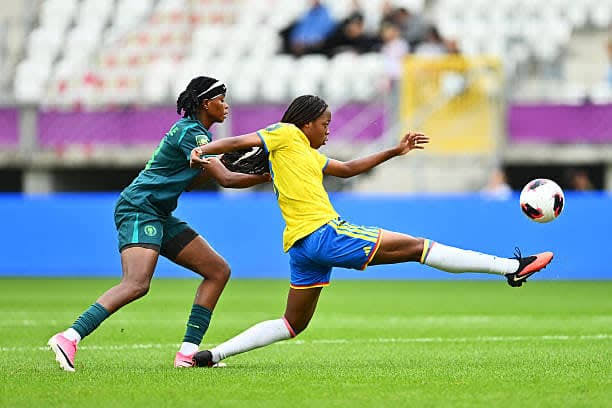
The Falconets of Nigeria have been eliminated from the 2026 FIFA U-20 Women's World Cup following a heartbreaking 1-0 quarter-final defeat to Colombia at the Stadion Miejski ŁKS in Łódź, Poland. Valerin Loboa's goal in the second minute of added time settled a contest that Nigeria had controlled for long stretches, denying the two-time runners-up a first semi-final appearance since 2010.
For 90 minutes, Nigeria looked the more likely side to break the deadlock. Head coach Moses Aduku named an unchanged 3-4-3 system, with captain and goalkeeper Christiana Uzoma anchoring the defence and wingers Seimeyeha Janet Akekoromowei and Tosin Rafiu providing width. Tumininu Adeshina, Favour Nkwocha and Onyedikachi Ekezie all tested the Colombian defence, while Adeshina's deliveries from set-pieces caused repeated problems. Colombia, lining up in a compact 5-4-1 formation under coach Carlos Paniagua, absorbed the pressure and looked to hit on the break through Loboa and Isabella Diaz. Neither side could find a breakthrough before the interval.
The match turned in the 77th minute when Kafayat Mafisere was shown a straight red card for a foul on Samantha Rodriguez. The decision was reviewed by the Video Assistant Referee and upheld, leaving Nigeria to see out the remaining minutes with ten players. Until that point, the Falconets had looked comfortable. After the dismissal, they retreated deeper, and Colombia began to find space. The South Americans pushed forward in search of a winner, and in the second minute of stoppage time, Loboa latched onto a through ball and found the decisive finish. The goal sent Colombia into the semi-finals, where they will face DPR Korea, and left Nigeria's players and travelling supporters in stunned silence.
The defeat is a painful end to what had been a promising campaign. Nigeria advanced from the group stage with a series of disciplined performances, then produced arguably their best display of the tournament in the Round of 16, defeating England 3-0. Colombia arrived at the quarter-final after edging hosts Poland 1-0 in their previous knockout fixture, a result that Aduku had warned his players not to take lightly. "Colombia sent out the host nation, so they will not be a walk in the park," he had said before the match. His warning proved prophetic. The South Americans defended resolutely, took their chance when it came, and left Nigeria to contemplate what might have been.
Aduku, speaking after the match, chose to focus on the positives rather than the pain of the result. "I think, first and foremost, this tournament is good for the young players," he told FIFA. "It gives them the ability to grow and reach the next level. I think, in Nigeria, we have seen the future of our players. And I think the future is very bright." His words reflect a broader reality. The Falconets squad featured several players who enhanced their reputations in Poland. Goalkeeper Christianah Uzoma was commanding throughout the tournament. Tosin Rafiu was a constant threat on the wing. Janet Akekoromowei and Ramotalahi Kareem also impressed. For a team that has reached two World Cup finals but never won the title, the challenge now is to ensure that the promise shown in Poland translates into sustained progress.
The defeat also raises familiar questions about Nigeria's ability to manage the decisive moments of knockout football. The red card was a turning point, but it was not the only moment that shaped the outcome. Nigeria created chances but could not take them. Colombia, by contrast, was clinical when it mattered most. The margin between the two sides was razor-thin, and on another day, the Falconets might have held on for extra time or found a winner of their own. But knockout football is unforgiving, and Nigeria paid the price for a single lapse in concentration at the death.
For Colombia, the victory is a landmark achievement. They reached the semi-finals of the U-20 Women's World Cup for the first time, and they did so by defeating a Nigerian side that had been widely regarded as one of the strongest teams in the tournament. Their reward is a meeting with DPR Korea, one of the most consistent teams in the competition. For Nigeria, the journey ends in the last eight, but the experience gained by the players will be invaluable as they look to build careers at senior level and return stronger for future tournaments.
The Falconets leave Poland with heads held high, as Voice of Nigeria noted, despite the pain of the result. They dominated significant periods of the quarter-final, held their own against a disciplined and dangerous opponent, and showed that Nigeria's future in women's football remains bright. The late concession will sting, but it should not obscure the progress made. Aduku's young squad has shown that it can compete with the best in the world. The challenge for Nigerian football authorities is to ensure that the talent on display in Łódź is nurtured, supported and given the opportunities to flourish at the highest level. The dream of a first U-20 World Cup title remains unfulfilled, but the players who wore the green and white in Poland have given Nigerian fans reason to believe that it is not beyond reach.
📩 Stone Reporters News | 🌍 stonereportersnews.com
✉️ info@stonereportersnews.com | 📘 Facebook: Stone Reporters News | 🐦 X (Twitter): @StoneReportNew | 📸 Instagram: @stonereportersnews
Add comment
Comments