

Reported by: Ijeoma G | Edited by: Oravbiere Osayomore Promise.
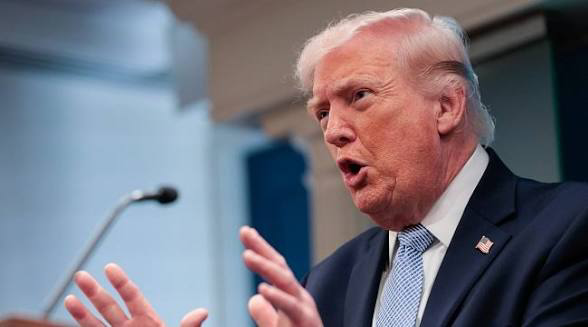
President Donald Trump has announced that the United States government will rename artificial intelligence as "super intelligence" in all official communications, arguing that the word "artificial" makes the technology sound fake. Speaking to the United Nations General Assembly in New York on Tuesday, September 22, 2026, Trump declared that the change takes effect immediately and expressed hope that the rest of the world would adopt the new term. "From this point forward, all of United States' documents, and hopefully the world's, will be changed to use the much more accurate term 'super' as opposed to 'artificial.' So it's super intelligence," he said.
The announcement was greeted with a mixture of applause from his allies and skepticism from the broader international community. Trump framed the rebrand as a matter of semantics and substance. "The use of the word 'artificial' makes intelligence fake—it makes it sound fake, and it is not fake," he said. "It's actually amazing, but we have to be careful". He said "super intelligence" sounded "much better" and was "much more accurate," and that he hoped the new terminology would catch on globally.
The decision followed a series of informal polls Trump conducted on his Truth Social platform. On September 19, he asked his followers to choose between "Super Intelligence," "Extreme Intelligence," and "Supreme Intelligence," describing the existing term as "inaccurate" and "very ineloquent." After a subsequent poll offered a choice between "Super Intelligence" and "Superior Intelligence," the former won by nearly a two-to-one margin, and Trump adopted it as his preferred option.
Trump's announcement comes amid heightened global debate over the risks and governance of advanced AI. In the days before his speech, leaders of more than 20 mostly European countries urged binding safety measures for advanced AI, warning that its development could outpace the ability to control it. China and the United States did not endorse that initiative. Speaking at the UN, British Prime Minister Andy Burnham said Britain would launch an effort to establish global AI standards during its 2027 G20 presidency, and announced an AI defense partnership with Washington to detect cyberattacks on critical infrastructure. French President Emmanuel Macron proposed building AI technology independent of the great powers, saying, "I don't want anyone to become the vassal of one of the great powers".
Trump used the occasion to reiterate his opposition to regulating AI, comparing warnings from AI safety advocates to climate change warnings. "The United States totally rejects any attempt to construct a globalist scheme to control... artificial intelligence," he said. "The very same people who said we'll all be dead in 12 years because of global warming... are now saying that AI is going to kill us all, that robots are going to attack us, and that everything is going to be a total disaster". He argued that the United States must maintain its lead over China in AI development, saying, "Whoever wins superintelligent, wins. That's the group that wins. We're leading now over China by a lot and everyone else, and we're going to keep it that way".
The announcement is the latest in a series of renamings pursued by the Trump administration. In 2025, Trump signed an executive order changing the Gulf of Mexico to the "Gulf of America." In August 2026, Lake Ontario was renamed "Lake America" amid a trade dispute with Canada. Trump's critics have seized on these moves as symbolic gestures that distract from substantive policy challenges. The AI rebrand drew immediate mockery on social media, with users questioning why the President was focused on renaming technology rather than addressing issues like gas prices.
Industry experts have also pushed back on the rebrand, noting that "superintelligence" already has a specific and different meaning. The term is associated with the philosopher Nick Bostrom, who defined it more than a decade ago as an intellect superior to humans in all forms—an entity that remains hypothetical. Simon Coghlan, a digital ethics lecturer at the University of Melbourne, described the rebranding as "misleading," noting that superintelligence typically refers to a system capable of self-improvement. "I doubt 'SI' will stick, in part because it exaggerates the current capacities of AI," he said. Ben Leong, a computer science lecturer at the National University of Singapore, added, "My guess is that professionals will want to save 'SI' for a higher level of AI, not so much to describe AI today. It doesn't feel like it's at that level yet".
Some members of Trump's circle have already adopted the new terminology. US Chief Technology Officer Ethan Klein wrote on social media, "The Super Intelligence (SI) President has spoken! The United States is and will remain the global leader in SI." Trump's ambassador to the UN, Michael Waltz, said, "If you didn't see the president's speech, it's now super intelligence. I think he's absolutely right". However, Canada's minister of AI, Evan Solomon, offered a pointed response when asked about the rebrand: "Canadians are not enthusiastic, at all, about renaming things".
The purpose of the renaming and whether it will be adopted by the technology industry remain unclear. The White House did not immediately respond to questions about the matter. The announcement comes as concerns about AI safety have intensified in recent weeks. Researchers at Anthropic and OpenAI have warned that the technology is growing exponentially smarter in ways they do not fully understand. One researcher even said there was a greater than 10 percent chance AI could destroy humanity. Trump dismissed such fears as a "hoax".
The United Nations Security Council was scheduled to hold a meeting on AI on Wednesday, September 23, 2026, initiated by France, which holds the Council presidency this month. OpenAI's Sam Altman, Anthropic's Dario Amodei, and Hugging Face co-founder Clement Delangue were expected to participate. UN Secretary-General Antonio Guterres called for the United States and China to start a dialogue on the technology's future akin to US-Soviet engagement at the height of the Cold War, saying governments with the greatest AI capabilities have the greatest responsibilities to humanity.
As Trump's rebrand takes effect in US government documents, the world watches to see whether "super intelligence" will replace "artificial intelligence" in common parlance or remain a politically charged exercise in nomenclature. For now, the President has made his position clear: artificial sounds fake, and super sounds accurate.
📩 Stone Reporters News | 🌍 stonereportersnews.com
✉️ info@stonereportersnews.com | 📘 Facebook: Stone Reporters News | 🐦 X (Twitter): @StoneReportNew | 📸 Instagram: @stonereportersnews
Add comment
Comments