

Reported by Ariajegbe Sylvia Esezobor
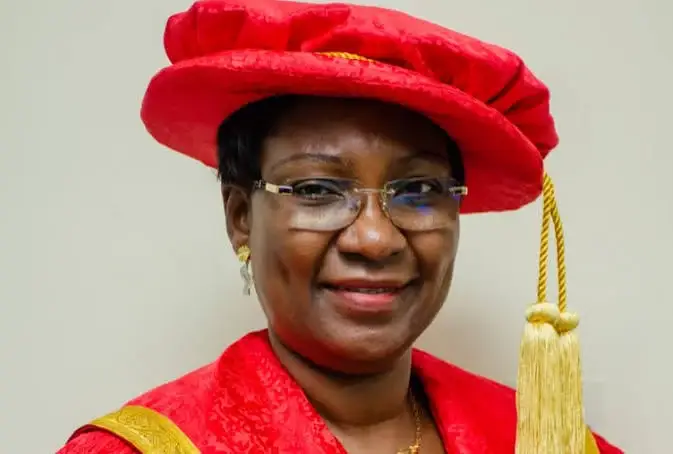
The media aide to the immediate-past Vice-Chancellor of Lagos State University, Professor Ibiyemi Olatunji-Bello, has moved to clarify widely circulated remarks about the cost of university education, saying the former vice-chancellor never suggested that students or their parents must pay ₦1 million annually in tuition fees.
In a statement issued on Wednesday, Emmanuel Adeyemi, the media aide to the former LASU VC, said excerpts of an interview published by PUNCH on Tuesday had been taken out of context and misinterpreted on social media, where a flurry of reactions had trailed the headline suggesting that public universities must charge ₦1 million per student to achieve self-sustainability. “Distinguished Professor Olatunji-Bello did not suggest that students or their parents must pay ₦1m annually for university education,” Adeyemi said. He urged the public, the media and education stakeholders to consider the former vice-chancellor’s complete remarks rather than isolated portions that could give a different impression of her position.
At the heart of the clarification is a distinction between the cost of delivering quality education and the price students should be asked to pay. According to Adeyemi, Olatunji-Bello was speaking about the estimated cost of providing quality undergraduate education, which she put at approximately ₦1 million per student annually. She was not, he insisted, advocating that the entire cost be transferred wholesale onto students or their parents. Her central argument, he explained, was made against the backdrop of Nigerians’ legitimate aspiration for university education comparable in quality to what is obtainable in other parts of the world, a standard that stands in sharp contrast to the comparatively low tuition fees currently charged by public universities in Nigeria.
Adeyemi said the remarks, when read in their entirety, reflected Olatunji-Bello’s call for universities to pursue innovation and develop diversified revenue streams to achieve financial sustainability. He quoted her as saying, “Universities can achieve financial self-sustainability. If they can innovate and ensure improvements in the institution, money will come in.” She went on to add, “I enjoin parents to ensure their children are well-educated by prioritising their fees. Good quality education needs money.” Read in full, her position reflected a broader call for universities to pursue innovation and diversified revenue streams as the primary pathway to financial sustainability, while also reminding parents of the genuine cost implications of quality education and encouraging shared responsibility rather than assigning that burden to any single party.
The controversy stems from an interview Olatunji-Bello granted to PUNCH, in which she reflected on her five-year tenure at LASU, which ended on Saturday. In the interview, she disclosed that LASU currently has a monthly payroll of over ₦1 billion, while its internally generated revenue of ₦13 billion is insufficient to cover salaries. She said that universities seeking financial self-sustainability would have to increase their fees substantially to meet the cost of running the institutions. “So, any public university that wants to sustain financial independence will have to charge school fees of not less than ₦1 million per student,” she was quoted as saying. She also noted that while secondary schools charge over a million naira per term, some universities still charge about ₦100,000 per year, which she described as unsustainable.
Those remarks, stripped of their context, circulated rapidly across social media and sparked widespread debate about the affordability of university education in Nigeria, a country where the minimum wage remains ₦70,000 per month and millions of families live below the poverty line. Critics accused the former vice-chancellor of being out of touch with the economic realities facing ordinary Nigerians, while others argued that she was simply stating an uncomfortable truth about the funding crisis in public universities. The Independent newspaper published a contextual clarification, noting that Olatunji-Bello had been widely quoted across social media as saying students must pay ₦1 million in fees for public universities to achieve self-sustainability, a quote it said had generated considerable reaction online with many commentators interpreting the statement outside its original context.
The debate over university funding is not new to Nigeria. Public universities have long been underfunded, with the Federal Government allocating a fraction of the national budget to education, well below the fifteen to twenty per cent benchmark recommended by UNESCO. The Minister of Education, Dr Maruf Tunji Alausa, acknowledged in June 2026 that government allocations to the sector had consistently ranged between five and eight per cent of the national budget, describing inadequate funding as one of the major obstacles confronting tertiary education. He urged vice-chancellors of public universities to diversify their sources of funding, saying government resources alone cannot sustain tertiary institutions. Alausa noted that public institutions are sitting on enormous opportunities through their alumni, research grants, philanthropy, endowments and private-sector partnerships.
The student loan scheme introduced by the Tinubu administration, the Nigerian Education Loan Fund, has disbursed over ₦355 billion to students and institutions since its launch, offering one pathway to easing the financial burden on families. But the gap between the cost of quality education and the capacity of both government and households to pay remains wide, and the debate triggered by Olatunji-Bello’s remarks reflects the anxiety that any discussion of tuition increases provokes in a country where access to education is already constrained by poverty.
For Olatunji-Bello, the episode is a reminder of the volatility of public discourse in the digital age, where a single sentence extracted from a lengthy interview can ignite a national controversy. Her aide’s statement is an attempt to reclaim the narrative and refocus attention on her broader message about innovation, diversified funding and the shared responsibility of government, institutions and families in financing quality education. Whether that message will penetrate the noise generated by the initial headlines remains to be seen, but the clarification has been placed on the record. As Adeyemi put it, the public should engage with the complete remarks in their proper context rather than isolated soundbites that do not accurately reflect the full weight and intent of her position.
📩 Stone Reporters News | 🌍 stonereportersnews.com
✉️ info@stonereportersnews.com | 📘 Facebook: Stone Reporters News | 🐦 X (Twitter): @StoneReportNew | 📸 Instagram: @stonereportersnews
Add comment
Comments