

Reported by Ariajegbe Sylvia Esezobor
The First Niger Bridge will remain closed to traffic until critical structural rehabilitation works are fully completed, the Minister of Works, Senator David Umahi, has declared, rejecting any suggestion that the bridge should be reopened before the damaged components identified during emergency inspections have been properly repaired and certified safe.
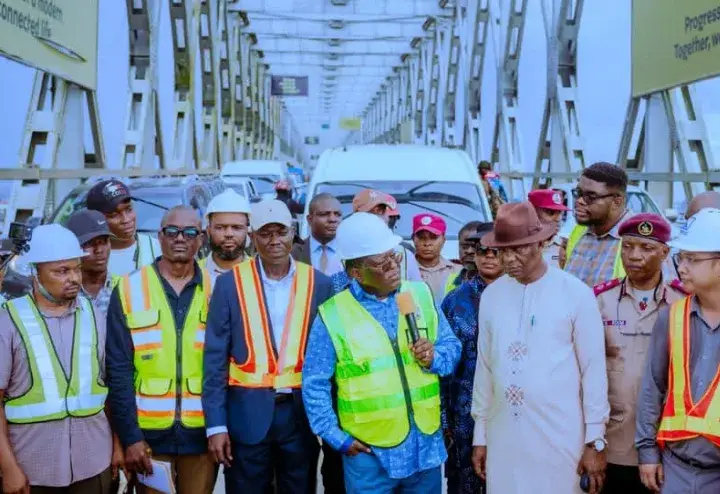
Umahi made the declaration on Wednesday at the Onitsha Bridge Head after inspecting the ongoing rehabilitation works on the bridge linking Anambra and Delta states. “We are not going to be stampeded to open the bridge until the major structural work has been achieved,” he said. His remarks came as the Federal Government formally extended the closure of the bridge by one week, pushing the expected reopening date from September 21 to September 28, 2026, citing persistent rainfall that has disrupted construction activities and affected sections of work already completed.
The bridge was closed to traffic on September 7 for what was initially scheduled as a two-week emergency rehabilitation exercise. The intervention followed the discovery of vandalised structural components, including bolts, nuts and portions of the expansion-joint steelwork, which had compromised the integrity of the over-50-year-old facility. The Acting Federal Controller of Works for Anambra State, Timothy Emenike, said contractors required at least three consecutive dry days to resume full-scale operations and accelerate the remaining work, noting that constant heavy rains had affected completed sections and disrupted construction. He confirmed that the rehabilitation would be inspected by the Minister before the bridge is reopened to traffic, and appealed to motorists and commuters to continue using the Second Niger Bridge and other approved alternative routes.
Umahi commended the contractor, SKECC, for the progress recorded within approximately ten days, saying the vandalised bolts had been replaced and secured. He disclosed that the specialised expansion joint stolen from the bridge had been manufactured and flown into the country for installation. The minister, however, directed the contractor to incorporate additional works into the rehabilitation programme. These include repainting the bridge’s structural elements, caps and internal carriageway areas, removing illegal advertisements mounted on the bridge, and installing additional solar-powered streetlights. He also ordered the completion of CCTV cameras on the bridge, with the surveillance system to be linked to the Second Niger Bridge, and directed an empirical assessment of the bridge’s structural elements both below and above the water level to determine their condition. The assessment report is expected to be submitted to him before the completion of the current phase of work.
On the approaches to the bridge, Umahi directed a review of the proposed use of asphalt, recommending that concrete be used on sections that would later undergo reconstruction. He explained that this measure would prevent the government from spending money on asphalt that would subsequently be destroyed during the reconstruction of the approaches. He added that one carriageway could be opened after the concrete attained the required strength, while work continued on the other carriageway.
The First Niger Bridge is a critical transport link between southeastern and south-southern Nigeria, and its closure has significantly increased travel times, traffic congestion and transportation costs on alternative routes between Onitsha and Asaba. Motorists and commuters have faced heavy delays, with many using alternative routes through the Onitsha-Owerri Road. Some travellers have been seen trekking from vehicles around diversion points, while others have resorted to commercial boats to continue their journeys. The Federal Government had advised road users to use the Second Niger Bridge through Obosi and the Onitsha-Owerri Road towards Asaba and other destinations during the rehabilitation period.
Speaking on behalf of the governors of Delta and Anambra states, the Delta State Commissioner for Works (Rural Roads) and Public Information, Charles Aniagwu, commended the Federal Government for the pace and quality of the rehabilitation. He recalled that Umahi had inspected the bridge on August 28 and issued directives for the replacement of vandalised bolts, nuts and expansion-joint components, and said those directives had been implemented, with sections of the deteriorated asphaltic surface also scarified and replaced. “We are pleased with the speed of work. We want to also appreciate our people who demonstrated a whole lot of patience to understand that you are after their safety,” Aniagwu said. He expressed confidence that the rehabilitation would stand the test of time.
The minister’s insistence on completing the structural works before reopening the bridge reflects a broader concern about the condition of Nigeria’s aging infrastructure and the consequences of premature reopening. Umahi has previously expressed alarm over the vandalism of bolts, expansion joints and iron bars holding the bridge together, describing the development as dangerous. The installation of CCTV cameras and solar-powered streetlights is intended not only to improve safety and visibility but also to deter further vandalism and theft of critical components.
For the thousands of commuters and commercial operators who depend on the First Niger Bridge daily, the extended closure represents a continued burden. The Second Niger Bridge, which was commissioned in 2023, has absorbed much of the diverted traffic, but congestion on alternative routes remains severe, particularly during peak hours and in adverse weather. The Federal Government has said the rehabilitation is necessary to prevent a catastrophic failure and to ensure that the bridge, which has served the nation for more than five decades, remains safe for public use. As Umahi put it, the government will not be stampeded into reopening the bridge until the major structural work has been achieved. For now, the bridge will remain closed until the Minister is satisfied that the repairs are complete, the safety assessments are concluded, and the facility is fit to carry the traffic that depends on it.
📩 Stone Reporters News | 🌍 stonereportersnews.com
✉️ info@stonereportersnews.com | 📘 Facebook: Stone Reporters News | 🐦 X (Twitter): @StoneReportNew | 📸 Instagram: @stonereportersnews
Add comment
Comments