

Reported by Ariajegbe Sylvia Esezobor
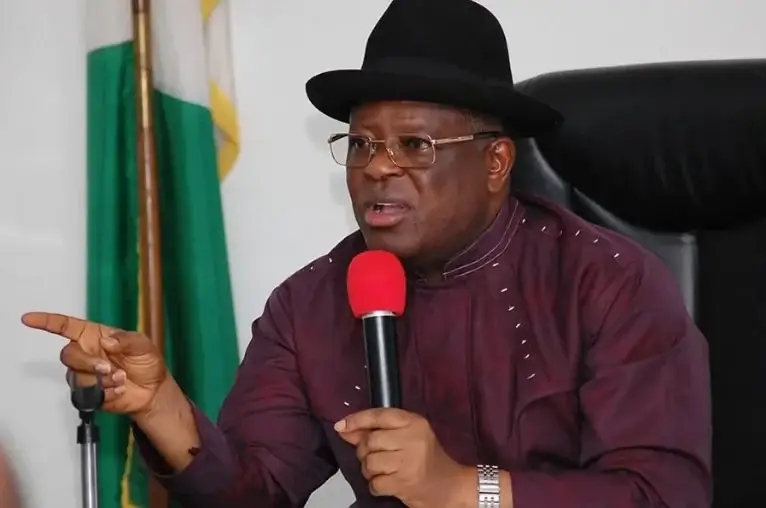
The Minister of Works, Senator David Umahi, has dismissed suggestions that he is not on the same level as the presidential candidate of the Nigeria Democratic Congress, Peter Obi, insisting there is no area in which the former Anambra State governor is superior to him, while declaring that the South-East will eventually produce Nigeria’s president but that the time is not yet right.
Umahi made the remarks on Thursday in Benin City at the ‘Operation Rescue Benin-Asaba Road’ event, where he also defended the administration of President Bola Ahmed Tinubu against mounting criticism and announced that the Federal Government would redesign the 136-kilometre Benin-Asaba dual carriageway with reinforced concrete pavement. The minister said comparisons between him and Obi should be based on their family backgrounds, intellectual capacity, records of service and contributions to the South-East. “When that guy says that Peter Obi is not my match, it took me ten minutes to think about it,” Umahi said. “Is it in my larger family background that his is better than my own? Is it in intellectual capacity? Is it in what we have done for the people of South-East? Is it what we did when we were governors? So, when you say he is not a match, put it side by side and tell me what Peter Obi is better than Dave Umahi.”
The minister’s intervention followed comments attributed to former National President of the Academic Staff Union of Universities, Professor Ukachukwu Awuzie, who was reported to have said that Anambra State Governor Chukwuma Soludo and Umahi were no match for Obi. Umahi described Obi as “a lucky person” while responding to claims that the former governor was being insulted. “I don’t think any reasonable person will insult Peter Obi, but I want to say that Peter Obi is a lucky person because when you tell people to go and verify and they verify and there is nothing they see, some people are still talking and talking,” he said. He also defended his support for Tinubu, saying members of the administration would not remain silent when the President and his government were criticised. “If you are challenging President Bola Ahmed Tinubu and the president is working and is using us to work and you expect us to keep quiet, we are not keeping quiet,” he said.
On the presidency, Umahi said the Igbo would eventually produce a president but argued that the time was not yet right. “What we are saying is that it is not the turn of Igbos yet. I heard one charlatan was saying, ‘Oh no, the Igbos can never be president.’ That man will not be alive when the Igbos become president because we will one day become president, but it is not yet our turn; it is the turn of President Bola Ahmed Tinubu,” he said. He added that political opportunities would eventually come for the South-East, saying, “When it is our turn, at the time of God, He makes all things beautiful.” The minister urged supporters of the Tinubu administration to defend what he described as the President’s achievements in the South-South and South-East, saying, “We are saying that the President has done very well. In South-South, in South-East and in the entire geopolitical zone, he deserves continuity, he deserves support.”
The remarks come amid a broader debate over the political future of the South-East and the rotational presidency in Nigeria. Since the return to democracy in 1999, the presidency has alternated between the South and the North under an informal arrangement designed to promote national unity. Olusegun Obasanjo, a southerner, served two terms from 1999 to 2007; Umaru Yar’Adua, a northerner, served from 2007 until his death in 2010; Goodluck Jonathan, a southerner, completed the term and won a full term in 2011; and Muhammadu Buhari, a northerner, served two terms from 2015 to 2023, before power returned to the South with Tinubu’s election in 2023. The argument advanced by those supporting Tinubu’s re-election is that the South should be allowed to complete its eight-year cycle before the North seeks another turn. Within the South, however, the question of which region produces the president has become increasingly contentious, with the South-East arguing that it has been marginalised since the end of the civil war and that the rotational arrangement has never favoured the region.
Obi’s candidacy in 2023 and his renewed bid in 2027 have brought the question of Igbo presidency to the forefront of national politics. Obi has consistently argued that his candidacy transcends ethnic considerations, framing his campaign around competence, character and capacity rather than regional identity. His supporters contend that the South-East has been unfairly excluded from the presidency and that 2027 represents the region’s best opportunity to produce a president. Umahi’s position, by contrast, aligns with the argument that the South-East’s turn will come, but not yet, and that President Tinubu deserves a second term to consolidate his reforms.
The political dynamics of the South-East have become increasingly complex ahead of the 2027 elections. Governor Soludo has endorsed Tinubu’s re-election and declared that his party, the All Progressives Grand Alliance, will not field a presidential candidate, a decision that has drawn criticism from Obi’s supporters. Umahi has publicly supported Soludo for what he described as his boldness in supporting the President, saying, “People should stop insulting supporters of the President; people should be allowed to support him.” The minister has also claimed that the Tinubu administration has done more for the South-East than any previous government in terms of appointments, inclusion and projects. “No other President has done what President Tinubu has done for the South-East, whether by appointment, inclusion or projects,” he said.
The dispute over Obi’s record and Umahi’s comparison of their credentials reflects the broader contest over the narrative of governance in the South-East. Obi’s supporters point to his eight years as governor of Anambra State, during which he was widely praised for fiscal discipline, savings and investments in education and healthcare. Umahi’s supporters point to his record as governor of Ebonyi State, where he implemented extensive infrastructure projects and transformed the state’s physical landscape. The comparison is complicated by the different contexts in which the two men governed, the resources available to them and the political environments in which they operated. Obi governed Anambra from 2006 to 2014, while Umahi governed Ebonyi from 2015 to 2023. Both have claimed records of achievement, and both have faced criticism over aspects of their tenures.
The political stakes extend beyond the South-East. The 2027 presidential election is scheduled for January 16, with the governorship and state assembly elections following on February 6. Tinubu is seeking a second term on the platform of the All Progressives Congress, while Obi is flying the flag of the Nigeria Democratic Congress with Senator Rabiu Kwankwaso as his running mate. Former Vice President Atiku Abubakar is contesting on the platform of the African Democratic Congress, and several other candidates are on the ballot. The contest is expected to be closely fought, and the South-East’s votes will be critical to the outcome. Obi’s strong showing in the region in 2023, when he won overwhelming support across the South-East and parts of the South-South, has made the region a key battleground for 2027.
Umahi’s decision to use the Benin-Asaba road event to address the presidency question and the comparison with Obi reflects the extent to which the 2027 campaign has permeated official engagements. The minister’s remarks have been interpreted by some as an attempt to frame the election as a contest between Tinubu’s continuity and Obi’s challenge, with the South-East’s political future positioned as contingent on the President’s re-election. For Obi’s supporters, the argument that it is “not yet our turn” will be seen as another attempt to defer the South-East’s political aspirations. For Tinubu’s camp, Umahi’s intervention reinforces the message that the President deserves a second term and that the South-East’s turn will come in due course.
The coming months will determine whether Umahi’s message resonates in the South-East or whether Obi’s candidacy galvanises the region behind a different narrative. The debate over the presidency and the competing records of the candidates will remain at the centre of the 2027 campaign, and the South-East will be one of the most closely watched regions in the country as the election approaches. For now, Umahi has made his position clear: the Igbo will produce a president, but not in 2027, and Peter Obi is not his match.
📩 Stone Reporters News | 🌍 stonereportersnews.com
✉️ info@stonereportersnews.com | 📘 Facebook: Stone Reporters News | 🐦 X (Twitter): @StoneReportNew | 📸 Instagram: @stonereportersnews
Add comment
Comments