

Reported by: Oahimire Omone Precious | Edited by: Oravbiere Osayomore Promise.
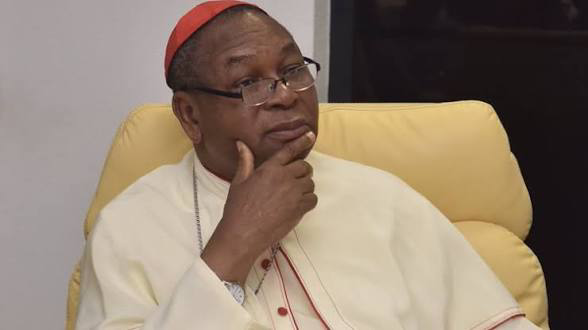
The 22nd All Nigeria Editors Conference, organised by the Nigerian Guild of Editors, concluded on Friday, September 25, 2026, in Enugu with a powerful consensus: Nigeria's elections must be decided by voters at polling units, not by judges in courtrooms. Catholic Archbishop Emeritus of Abuja, Cardinal John Onaiyekan, and former Nigerian Bar Association President, Afai Osigwe (SAN), led the charge, warning that the judiciary's growing role in determining electoral outcomes was undermining democracy and eroding public trust ahead of the 2027 general elections.
The conference was themed "The Ballot, the Media and the Task of Keeping Democracy Alive," with a sub-theme focused on detecting and debunking AI-driven misinformation before, during, and after elections. It drew more than 500 editors and stakeholders, including Vice President Kashim Shettima, Governor Peter Mbah of Enugu State, Information Minister Mohammed Idris, and INEC Chairman Joash Amupitan.
Onaiyekan, who delivered the keynote address, anchored his proposals on the primacy of the voter. "We must insist on the primary position of the people who cast their votes," he declared. He proposed a minimum 50 per cent threshold for presidential elections, arguing that no candidate should be declared winner without securing at least half of all votes cast. Where no candidate reaches that threshold, he said a second round should be held between the two highest scorers. "A 50 per cent minimum would ensure that whoever becomes our president has a traceable margin of endorsement by the Nigerian people," the Cardinal said.
The Judiciary Is Not to Determine Elections
Onaiyekan expressed alarm at the trend of electoral outcomes being decided in court rather than at the polls. "The judiciary is supposed to be the last stage in the electoral process," he said. "It should be stressed that the judiciary is not to determine elections about who wins, but rather to adjudicate disputes when they arise." He argued that if elections were properly conducted, there would be little need for prolonged litigation. "Our experience in the recent past has almost become that we have witnessed a situation where our elections are being determined not at the polls, but in the courts," he lamented.
The Cardinal proposed that all election petitions be concluded before successful candidates are sworn into office. "A situation where a candidate has been declared a president still going to tribunal to defend his position using state means and state resources to defend himself against his opponents is not serious as far as natural justice is concerned," he said. He also called for legal standing for ordinary voters, not just candidates, to challenge election results. "As of now, only candidates have a locus standi to challenge election results. But we who cast the votes and whose votes are at stake have no room to complain. This must change," he declared.
Seven-Point Reform Agenda
Onaiyekan presented a seven-point reform agenda for consideration by the National Assembly. He called for a review of the process for appointing the INEC chairman and national commissioners, arguing that the electoral umpire should not depend on the President or governors who are themselves contestants. "They should not depend on Mr. President and the governors, who are themselves contestants in elections," he said. He proposed a special election tribunal dedicated exclusively to electoral disputes, with a strict timeframe for concluding cases before candidates assume office. He also advocated for independent candidacy, particularly at the local government level, to curb "the tyranny of political parties and their ruthless godfathers." He further called for stricter rules against lawmakers defecting from the parties on whose platforms they were elected.
Osigwe: Courts Have Usurped the Role of Voters
Osigwe echoed the Cardinal's concerns, stating that Nigeria has one of the highest numbers of election petitions globally. He attributed the problem to what he called the "judicialisation" of the electoral process. "The courts have gradually and increasingly usurped the role of the voters in determining the representatives of the people," he said. He criticised the handling of evidence obtained through the Bimodal Voter Accreditation System, noting that petitioners challenging state-wide elections could be required to produce BVAS devices from every polling unit within the limited time allowed for election petitions. He also questioned the treatment of subpoenaed evidence, explaining that petitioners were required to file their evidence within 21 days, making documents obtained later through subpoenas inadmissible. He urged journalists to continue holding political leaders and institutions accountable, warning that an uninformed public was a threat to democracy.
AI Misinformation: A New Threat to 2027
The conference's sub-theme on AI-driven misinformation was underscored by INEC Chairman Amupitan, who warned that generative AI, voice cloning, and manipulated videos could be used to impersonate electoral officials and fabricate election results. He called on media organisations to establish specialised fact-checking desks and deploy digital forensic tools, cautioning against publishing unofficial results before INEC's official declarations. Information Minister Idris, represented by NAN Managing Director Ali M. Ali, warned that AI could make citizens lose trust in genuine information altogether. "A false statement can be produced in the voice of a public official. A fabricated video can be circulated within minutes. An old photograph can be presented as a current event," he said, urging editors to make verification a permanent part of newsroom culture.
The 2027 general elections are scheduled for January and February 2027. The conference's outcome signals that civil society and media leaders are preparing for a contest that will test Nigeria's electoral integrity like never before.
📩 Stone Reporters News | 🌍 stonereportersnews.com
✉️ info@stonereportersnews.com | 📘 Facebook: Stone Reporters News | 🐦 X (Twitter): @StoneReportNew | 📸 Instagram: @stonereportersnews
Add comment
Comments