

Reported by: Ijeoma G | Edited by: Oravbiere Osayomore Promise.
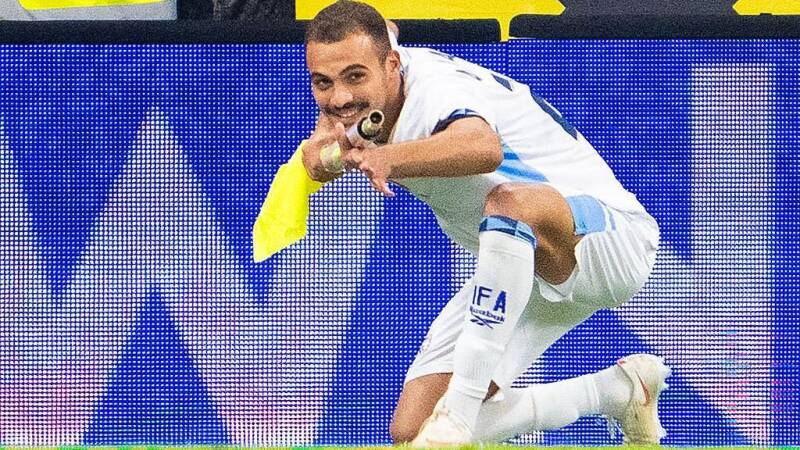
A moment of joy turned into a red card, and a football match turned into a geopolitical flashpoint. Israel midfielder Sayed Abu Farhi, 20, was sent off during his side's 3-1 UEFA Nations League defeat to Austria on Thursday, September 24, 2026, after he celebrated his equalising goal by grabbing a corner flag and appearing to mimic the firing of a gun. The referee, who had already booked the Colorado Rapids player four minutes earlier, showed him a second yellow card for the celebration, followed by a red, leaving Israel to play the remainder of the match with ten men.
The incident occurred in the 55th minute at the Raiffeisen Arena in Linz. Abu Farhi, who had headed home to cancel out Romano Schmid's first-half penalty for Austria, ran to the corner flag, uprooted it, and held the pole across his body before making a gesture that match officials, and most observers, interpreted as the firing of a weapon. Football's Laws of the Game permit referees to caution players for goal celebrations that are provocative, derisory, or inflammatory. The referee applied that rule without hesitation. Abu Farhi looked perplexed as he was shown the red card, but the decision stood.
Austria capitalised on the numerical advantage. Phillipp Mwene restored Austria's lead in the 90th minute, finishing from a Paul Wanner cross, and Sasa Kalajdzic added a third in stoppage time to seal a victory that had seemed far from certain before Abu Farhi's dismissal.
The sending-off carries immediate consequences. Abu Farhi will miss Israel's next Nations League fixture against the Republic of Ireland on Sunday. The match is one of two fixtures between the sides scheduled to be played at neutral venues, a decision taken because of the wider political context surrounding Israel's participation in international football. Campaigners in Ireland have called for a boycott of the matches, citing Israel's military actions in Gaza. More than 73,000 people have been killed in Israeli attacks, according to the territory's Hamas-run health ministry, figures the United Nations has described as broadly reliable. The war was triggered by the Hamas-led attack on southern Israel on October 7, 2023, in which about 1,200 people were killed and 251 others were taken hostage.
That context is impossible to ignore. Abu Farhi is a Palestinian citizen of Israel, and his gesture, whether intentional or not, landed in a week when Israel's actions in Gaza had already made football headlines. The campaign for a boycott of the Ireland fixtures has amplified the scrutiny on every action taken by Israeli players and officials. Whether Abu Farhi intended to make a political statement or simply got carried away in the emotion of scoring an equaliser in a Nations League match, the effect was the same: his celebration became a symbol, and his red card became a story far bigger than the game itself.
UEFA has yet to announce whether it will take further disciplinary action. The automatic one-match ban for the red card is certain, but the governing body could impose additional sanctions if it determines that the celebration was provocative or inflammatory beyond the ordinary threshold. The referee's decision to issue a second yellow card, rather than a straight red, suggests that the offence was treated as a cautionable act of unsporting behaviour rather than a more serious breach. But UEFA's disciplinary bodies have wide discretion, and the political sensitivity of the moment could influence their assessment.
Some observers have suggested that Abu Farhi may have been mimicking a snooker cue action rather than a gun, a claim that has circulated on social media but has not been substantiated. The referee's interpretation, however, was clear, and the images of Abu Farhi holding the corner flag across his body and making a firing motion are difficult to interpret any other way. The player himself has not issued a statement explaining his intent.
For Abu Farhi, a 20-year-old at the beginning of his career, the incident is a painful lesson in the power of symbols. A goal celebration that might have been forgotten by the next matchday has become an international talking point, and the red card will follow him. He will sit out the Ireland match, watching from the sidelines as his teammates navigate a fixture that is already charged with political tension. Whether UEFA adds to his punishment remains to be seen. What is certain is that a moment of celebration has become a moment of controversy, and a young player has learned that on the football pitch, as elsewhere, gestures can speak louder than goals.
📩 Stone Reporters News | 🌍 stonereportersnews.com
✉️ info@stonereportersnews.com | 📘 Facebook: Stone Reporters News | 🐦 X (Twitter): @StoneReportNew | 📸 Instagram: @stonereportersnews
Add comment
Comments