

Reported by Ariajegbe Sylvia Esezobor
The Nasarawa State Ministry of Health has adopted the Federal Government's Health National Adaptation Plan 2025–2030, becoming one of the first 15 states in Nigeria to develop and validate a state-level framework for addressing the effects of climate change on its health system.
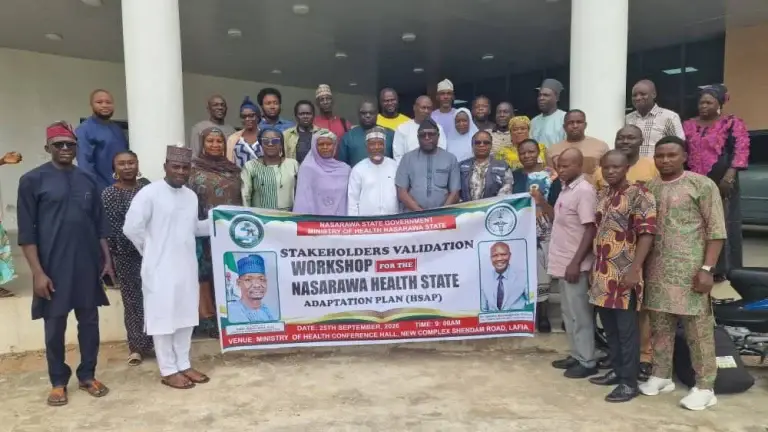
The adoption was disclosed on Friday at a one-day stakeholders' validation workshop for the Nasarawa Health State Adaptation Plan in Lafia, the state capital. The Health National Adaptation Plan is a framework for integrating climate adaptation into health policies, programmes and infrastructure development across the country. The validation exercise brought together representatives from the ministries of health, budget and planning, livestock, agriculture and human capital development, as well as the Nigerian Meteorological Agency, the Renewable Energy Commission and the Red Cross.
Speaking at the workshop, the State Desk Officer for Climate Change and Health, Dr Godwin Ewuga, said climate change had contributed to several health challenges in the state, affecting health through the disruption of health services and injuries and deaths associated with flooding and other disasters. He said climate change had also contributed to the spread of waterborne, foodborne and vector-borne diseases, including malaria, while people with pre-existing conditions such as hypertension, heart and kidney diseases and asthma could be affected by heat stress resulting from rising temperatures. Ewuga explained that the Health State Adaptation Plan was based on evidence of the effects of climate change on the health system and contained intervention plans covering five years. "So, the HSAP contains evidences of climate impact on health, health infrastructure, and the health system, and then, assigned interventions that will help address those challenges in the health sector, and then how we intend to get it done," he said. He said the document would be implemented if approved by the state government, acknowledging the contributions of stakeholders from various ministries, departments and agencies who participated in its validation.
The Permanent Secretary of the Nasarawa State Ministry of Health, Dr Ibrahim Alhassan, said the document took about 20 months to prepare. "We are here today to validate a document that has taken a journey in preparation. So for me, this is a celebration of hard work, a celebration of commitment. And I will say that we are grateful to the Desk Officer for agreeing to take up this onerous task. We are also grateful to all the stakeholders for their inputs in making this document a success," he said. The Director of Public Health in the state, Dr Peter Attah, said Nasarawa was among the first 15 states in the country to develop its Health State Adaptation Plan, and that the document was ready for approval by the governor.
The Nasarawa plan is part of a broader national effort to climate-proof Nigeria's health system. Nigeria's Health National Adaptation Plan 2025–2030, developed under the Federal Ministry of Health, aims to address climate threats to health, including increased disease burden from respiratory, vector-borne, water-borne and other forms of illness, as well as mental health effects. The plan's vulnerability and assessment component predicts that the country will experience a 21 per cent additional disease burden due to climate change. The framework includes measures to develop climate-resilient health infrastructure models and blueprints, strengthen early warning systems and build capacity for disease management. Each state is expected to develop its own state climate and health adaptation plan and supporting governance and implementation frameworks.
The urgency of the intervention is underscored by the health impacts of climate change already being recorded across Nigeria. Nigeria is a global epicentre of malaria, representing an estimated 25.9 per cent of all cases worldwide, and climate change is intensifying the threat by altering the geographical range, seasonality and transmission intensity of the disease. Flooding, which has become more frequent and severe, creates breeding grounds for mosquitoes and contaminates water sources, increasing the risk of waterborne diseases. Heat stress, linked to rising temperatures, poses particular risks to outdoor workers, the elderly and people with pre-existing cardiovascular and respiratory conditions. The Nasarawa plan explicitly recognises these pathways, linking climate hazards to specific health outcomes and assigning interventions to address them.
The validation workshop is a critical step in a process that began in May 2025, when the Nigeria Climate Change and Health National Adaptation Plan was developed with support from development partners. A three-day workshop was convened to develop a roadmap for the domestication of the plan for nine pilot states, including Nasarawa, Borno, Cross River, Ekiti, Enugu, Jigawa, Kaduna, Kano and Yobe. The Nasarawa State Ministry of Finance has pledged to support relevant sectors in creating dedicated budget lines for climate action, a commitment that will be essential to funding the plan's implementation. The state government has also developed a comprehensive strategic framework to combat climate change, with a policy that aims to mainstream climate action and create a Climate Change Agency.
The plan's approval and implementation will depend on the governor's assent and the allocation of budgetary resources. The ministry has said it will implement the document if the necessary approvals are obtained. For Nasarawa, the adoption of the Health State Adaptation Plan represents a recognition that the health system cannot be protected from climate change through clinical interventions alone. The disruption of health services during floods, the spread of disease vectors into new areas and the physiological toll of extreme heat all require a coordinated response that spans health, environment, agriculture, water resources and infrastructure.
The coming months will determine whether the plan moves from validation to implementation, and whether the budgetary commitments that have been pledged are matched by actual allocations. The stakes are considerable. Across Nigeria, the health system is already under strain from inadequate funding, workforce shortages and infrastructure deficits. Adding the pressures of climate change to those existing challenges risks overwhelming a system that is struggling to meet the demands of a growing population. The Nasarawa plan is an attempt to anticipate those pressures and to build the resilience required to withstand them. As Ewuga put it, the document contains evidence of climate impact on health and the interventions needed to address it. Whether that evidence translates into action will depend on the political will to fund and implement the plan, and on the ability of the state's health system to absorb the changes it prescribes.
📩 Stone Reporters News | 🌍 stonereportersnews.com
✉️ info@stonereportersnews.com | 📘 Facebook: Stone Reporters News | 🐦 X (Twitter): @StoneReportNew | 📸 Instagram: @stonereportersnews
Add comment
Comments