

Reported by Ariajegbe Sylvia Esezobor
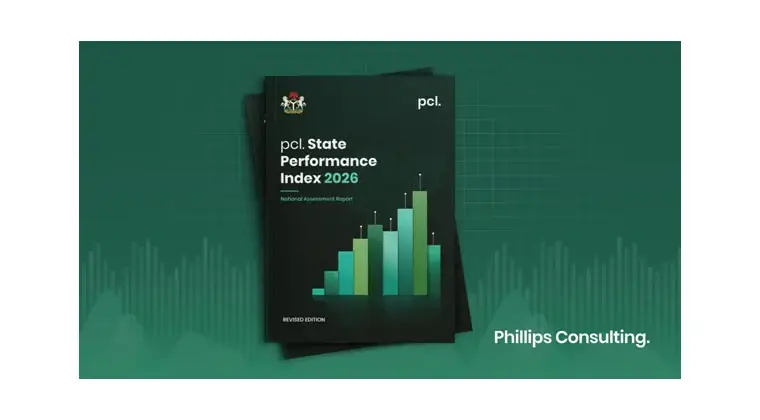
Phillips Consulting Limited has released the revised edition of the 2026 State Performance Index, incorporating newly available FY2025 audited financial statements and strengthening the methodology used to assess state performance across Nigeria, the firm announced on Friday, September 25, 2026.
The revised edition supersedes the initial 2026 pSPI released on July 23, 2026, and now serves as the definitive 2026 edition. The revision reflects pcl.'s commitment to ensuring that its research and reports remain grounded in the most current, relevant and robust evidence available, the firm said. The initial edition was developed using FY2024 audited financial statements, which were the most recent available at the time the report was prepared. Following the subsequent release of FY2025 audited accounts, pcl. undertook a detailed review of the Index to incorporate the newer financial data and further strengthen the methodology and interpretation of results.
The 2026 National Assessment Report was first launched on July 23, 2026, using a single Momentum Index that ranked states on a blended score. A subsequent review identified areas where the methodology and the interpretation of results needed strengthening. The model was audited in detail, the issues were corrected, and the results were recalculated. This edition presents those revised results. The revised 2026 pSPI introduces several methodological improvements designed to provide a clearer and more balanced view of state performance.
Two measures now replace the single Momentum Index. The revised assessment separates the measurement of current performance from the measurement of performance trajectory. A Performance Snapshot shows where each state currently stands, while the Rank Trajectory shows how its position has changed across the 2024, 2025 and 2026 editions. Movement is now measured by change in performance rank rather than differences in scores, recognising that the three editions were calculated using different score scales. This provides a more consistent basis for understanding changes in state positioning over time.
The financial assessment has also been updated to use FY2025 audited accounts, replacing the FY2024 figures used in the initial 2026 edition. In assessing debt sustainability, the revised methodology now considers both debt per capita and debt relative to state revenue, providing a more balanced view of the scale and sustainability of state indebtedness. The Index has also strengthened its assessment of financial transparency. Rather than simply considering whether audited accounts are available, the revised methodology assesses the date on which each state published its audited accounts relative to the statutory deadline. States without qualifying audited accounts are left unscored rather than assigned a zero, ensuring that the absence of qualifying data is not interpreted as a performance outcome.
These refinements are intended to improve the comparability, interpretability and integrity of the Index while preserving its broader objective of providing evidence-based insight into how states are performing and progressing. Under the initial 2026 edition, Enugu State was ranked as Nigeria's fastest-improving state in the Momentum Index, with a score of +1.15, ahead of Jigawa (+0.77) and Abia (+0.67). Osun (+0.65), Kano (+0.46), Gombe (+0.39), Akwa Ibom (+0.33), Sokoto (+0.27), Borno (+0.26) and Ogun (+0.24) completed the top ten. Edo State recorded the lowest momentum score at -0.79, followed by Imo (-0.72), Katsina (-0.66) and Benue (-0.49). The revised methodology is expected to produce adjusted rankings.
The pSPI is built on a methodology that combines 70 per cent objective secondary data and 30 per cent citizen perception data, providing a comprehensive 360-degree view of state performance across seven critical dimensions of development: security, education, health, basic infrastructure, governance, economic development and fiscal performance. Using 37 carefully selected performance indicators, the report measures current performance while identifying areas of progress, persistent challenges, and the interventions most likely to accelerate development. Beyond the index rankings, each state receives a comprehensive State Brand and Performance Report that interprets the findings, highlights strengths and priority areas for improvement, and provides tailored recommendations, along with a strategic roadmap for sustainable growth.
Speaking on the release, Foluso Phillips, Chairman of Phillips Consulting, emphasised the importance of institutional discipline in research. “Credible research requires more than publishing findings; it requires the discipline to interrogate the evidence behind those findings. When new audited information became available and our review identified areas where the model could be strengthened, the responsible course was to undertake that review rigorously and publish the resulting improvements. This reflects the standard we set for our research and the trust stakeholders place in our work.”
Olawanle Moronkeji, Chief Operating Officer of Phillips Consulting, stated that the revision reinforces the value of the Index to stakeholders who rely on it to understand Nigeria's subnational performance landscape. “The value of the pSPI lies in helping stakeholders see beyond a single point-in-time ranking. Governments, investors, development organisations, researchers and citizens need to understand not just where states stand today, but how they are moving and whether that movement is sustainable.”
The 2026 pSPI arrives at a time when evidence-based governance has become more critical than ever, particularly as Nigeria approaches another election cycle. The report provides a credible, data-driven assessment of the progress, strengths, opportunities and development priorities of each of Nigeria's 36 states and the Federal Capital Territory. The report has been developed to support a wide range of stakeholders, including federal and state governments, legislators, development agencies, donor organisations, financial institutions, investors, researchers, academia, civil society organisations, the media and citizens seeking credible insights into state performance.
The revised State Performance Index is available on the pSPI website. For the states assessed, the revised edition offers a more nuanced picture of performance, distinguishing between where states stand and how they are progressing, and providing a stronger evidentiary basis for policymaking, investment decisions and public accountability as Nigeria approaches the 2027 general elections.
📩 Stone Reporters News | 🌍 stonereportersnews.com
✉️ info@stonereportersnews.com | 📘 Facebook: Stone Reporters News | 🐦 X (Twitter): @StoneReportNew | 📸 Instagram: @stonereportersnews
Add comment
Comments