

Reported by Ariajegbe Sylvia Esezobor
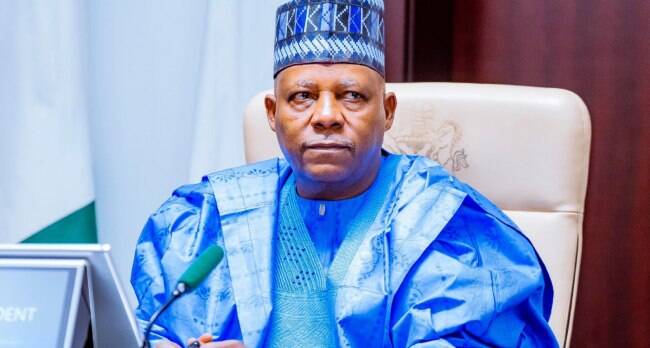
Vice President Kashim Shettima has declared that Africa's continued exclusion from permanent membership of the United Nations Security Council undermines the fairness and legitimacy of the global governance system, insisting that a continent cannot be summoned to bear the burdens of the international order and then denied an equal hand in directing it.
Shettima made the declaration during a meeting with the United Nations Deputy Secretary-General, Amina Mohammed, on the sidelines of the 81st United Nations General Assembly in New York, according to a statement issued by his media aide, Stanley Nkwocha. He reaffirmed Nigeria's support for urgent reform of the United Nations, noting that the country would remain a dependable partner in efforts to rebuild trust among nations, defend international law and address hunger, violence and exclusion. He commended the UN Secretary-General, António Guterres, for his consistent support for a more representative Security Council, particularly his declaration that a 21st-century Council without permanent African representation is "unjust and indefensible." "A continent cannot be summoned to bear the burdens of the international order and then denied an equal hand in directing it," Shettima said.
The Vice President maintained that Nigeria would continue to support reforms that make international institutions more representative, responsive and credible, stressing that global decisions must better reflect contemporary geopolitical and demographic realities. He also praised Guterres for defending international law and human dignity amid widening global conflicts and rising geopolitical tensions. "You have remained a voice of reason as individual states drift from the obligations they assumed under the United Nations Charter and the rules of international law," Shettima said. "You have insisted that sovereignty carries duties, that might confers no licence to injure, and that the worth of a human life cannot vary with the flag above it."
The Vice President warned that diplomacy must not lose sight of the human consequences of war and instability. "The mother searching for her child, the family driven from home and the hungry child awaiting food must never become abstractions in the language of states," he added. Shettima also commended Amina Mohammed for her contributions to multilateral diplomacy and sustainable development, describing her service as a source of pride to Nigeria. "Nigeria will remain a willing ally in the work of restoring trust among nations and dignity to lives diminished by hunger, violence and exclusion. We owe our children a world in which conscience has authority and the law has meaning," he said. He added that the credibility of the international system would ultimately depend on its ability to respond fairly to human suffering and provide all regions with a meaningful voice in global decision-making. "Civilisation endures only when the suffering of a stranger becomes a claim on our conscience," Shettima said.
The meeting with the UN Deputy Secretary-General came days after Shettima delivered Nigeria's national statement at the General Debate of the 81st UNGA, where he made a formal demand for at least two permanent seats for Africa on the Security Council, with all the rights and responsibilities of permanent membership, including the veto for as long as it exists, alongside five non-permanent seats. He delivered the address on behalf of President Bola Tinubu, who remains on a working vacation in Europe. "The reform of this institution must begin with the reconstitution of the Security Council, for the world of 2026 cannot remain captive to the distribution of power in 1945," Shettima said. "Africa cannot continue to fill the Council's agenda while remaining absent from its permanent membership. The authority to speak for humanity carries an obligation to represent it."
The demand aligns with the Ezulwini Consensus and the Sirte Declaration, the African Union's longstanding common position on UN Security Council reform, which calls for at least two permanent seats for Africa with full privileges, including the veto, alongside five non-permanent seats. The African Union reaffirmed the position in May 2026, saying Africa's exclusion from permanent representation constituted a historical imbalance and calling for stronger coordination among African states to advance the reform agenda. Africa currently has no permanent representative on the 15-member Security Council, which has five permanent members — China, France, Russia, the United Kingdom and the United States — while 10 other members are elected by the General Assembly for two-year terms. Shettima argued that the current structure no longer reflected contemporary geopolitical realities and that Africa should have permanent representation in the body responsible for maintaining international peace and security. He pointed to Nigeria's contributions to peace operations and regional efforts through ECOWAS and the African Union, citing involvement in Liberia, Sierra Leone, Darfur, Mali and The Gambia, alongside counterterrorism, democratic governance and maritime security initiatives.
The Vice President's meeting with Mohammed also underscored the human dimension of the global governance debate. He told the UN Deputy Secretary-General that diplomacy must not lose sight of the human consequences of war and instability, a message that resonated with the broader theme of Nigeria's UNGA engagement. Mohammed expressed gratitude to Nigeria and the Tinubu administration for their support for the UN as an institution and for her office as Deputy Secretary-General. "It's a deep honour to have your esteemed delegation here to come and surprise me. I am truly honoured and grateful," she said. "I want to thank, through you, the President of the Federal Republic of Nigeria, President Bola Ahmed Tinubu, and you for embracing me wholeheartedly, not just as the DSG but as a daughter of the soil. He has been an incredible support to me, and he has also supported this institution."
The Vice President was accompanied on the visit by Governors Abdulrahman AbdulRazaq of Kwara State, Hyacinth Alia of Benue, Siminalayi Fubara of Rivers and Dauda Lawal of Zamfara, alongside the Minister of Foreign Affairs, Ambassador Bianca Odumegwu-Ojukwu, and Nigeria's Permanent Representative to the UN, Ambassador Jimoh Ibrahim, among other senior officials.
The call for UN Security Council reform is a central plank of Nigeria's foreign policy and a recurring theme in its engagement at the United Nations. The reform process requires broad support among UN member states and agreement on changes to the UN Charter, making the expansion of permanent membership a complex and protracted diplomatic issue. Nigeria has previously said it would continue engaging African and international partners in support of the continent's common position on Security Council reform. Shettima's meeting with Mohammed and his remarks at the General Debate represent the latest chapter in that campaign, and they come at a time when the credibility of the international system is under scrutiny amid widening conflicts, rising geopolitical tensions and growing demands from the Global South for a more equitable distribution of power in global institutions.
For Nigeria, the demand for permanent African representation on the Security Council is both a matter of principle and a reflection of its own aspirations as Africa's most populous nation and a leading contributor to peacekeeping and regional security. For Africa, it is a question of whether the continent will continue to be a subject of the Council's agenda or a participant in shaping it. For the world, as Shettima put it, the credibility of the international system will ultimately depend on its ability to respond fairly to human suffering and provide all regions with a meaningful voice in global decision-making. Whether the reform he has demanded materialises will depend on the willingness of the Council's current permanent members to share power, but Nigeria has made its position unambiguous: the world of 2026 cannot remain captive to the distribution of power in 1945, and a continent cannot be summoned to bear the burdens of the international order while being denied an equal hand in directing it.
📩 Stone Reporters News | 🌍 stonereportersnews.com
✉️ info@stonereportersnews.com | 📘 Facebook: Stone Reporters News | 🐦 X (Twitter): @StoneReportNew | 📸 Instagram: @stonereportersnews
Add comment
Comments