

Reported by Ariajegbe Sylvia Esezobor
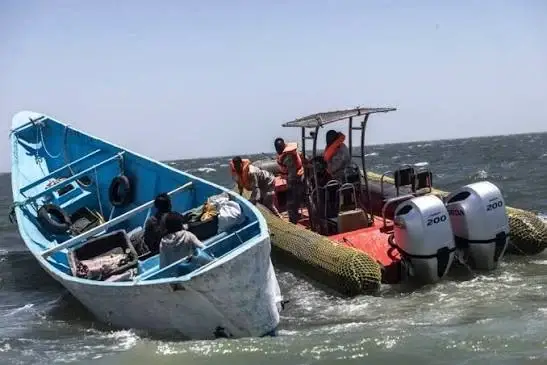
The Mauritanian Coast Guard has rescued 260 West African migrants, including 17 children and 61 women, from two boats that ran into difficulty off the country’s Atlantic coast, the service announced on Sunday, in the latest mass rescue on a migration route that has claimed thousands of lives in recent years.
The migrants were travelling on two vessels that departed from Banjul, the capital of The Gambia, and were spotted off the coast of Nouakchott, Mauritania’s capital, after spending approximately seven days at sea. According to a coast guard statement, the boats’ occupants were in a state of shock after running out of food and encountering fuel and navigation problems during the voyage. The rescue operation was carried out near Nouakchott’s fish market, where the two boats were sighted by coast guard units.
Among those rescued were 132 Senegalese nationals, 120 Gambians, four Guineans, two Nigerians and two Malians, according to coast guard data. The group comprised 180 men, 61 women and 17 children. Local sources noted that the sum of these figures is two short of the total count of 260 migrants, a discrepancy that Mauritanian authorities did not address. The coast guard did not provide details regarding the migrants’ health status following the rescue, nor did it state whether the voyage had encountered any incidents or difficulties prior to the boats being spotted off the coast of Nouakchott.
The rescue is the latest in a series of operations conducted by Mauritanian authorities along a migration route that has become increasingly deadly. Thousands of mostly young people have for years attempted the perilous Atlantic crossing on overloaded and often dilapidated boats to reach Europe via Spain’s Canary Islands. Many are fleeing poverty and economic hardship, resorting to the clandestine journey as European countries have drastically restricted the issuance of visas and tightened controls at their borders.
The scale of the crisis is reflected in the numbers recorded by the International Organization for Migration. Between January and mid-2026, at least 168 people were reported dead or missing along the Atlantic route, and the figure rose sharply in July when a single shipwreck off the coast of Mauritania left 144 people dead or missing, the deadliest such incident on the West African Atlantic route in 2026. In that incident, 38 survivors were rescued by the Mauritanian Coast Guard near Nouadhibou on July 18 after the boat drifted in the Atlantic for nearly 25 days. The International Organization for Migration expressed its deep sadness at the reports and extended condolences to the families of those who lost their lives.
Mauritania has become a critical transit and departure point for migrants seeking to reach Europe. Since the start of 2026, the country has recorded 17 rescue and disembarkation operations in Nouadhibou and Nouakchott, bringing 2,147 people safely ashore. In early June alone, Mauritanian authorities intercepted 1,076 migrants and refugees over a ten-day period, and between late May and early June, the coast guard reported rescuing 1,187 migrants attempting to reach the Canary Islands. In August, the coast guard rescued more than 300 migrants, including 40 children, from an overloaded boat drifting off the West African country’s Atlantic coast, and later intercepted another boat carrying 161 people, including 17 children.
The migration route from West Africa to the Canary Islands has become one of the world’s most dangerous maritime corridors. Migrants typically depart from Senegal, The Gambia, Mauritania, and other coastal West African states, often in wooden fishing boats known as pirogues that are ill-suited to the open Atlantic. The journey can take anywhere from a few days to several weeks, depending on weather conditions and the vessel’s condition. Many boats run out of fuel, food, or water, and navigation failures are common. In some cases, boats drift for weeks before being rescued or washing ashore.
The International Organization for Migration and other humanitarian organisations have repeatedly called for greater international cooperation to address the root causes of migration and to improve search and rescue capacity along the route. In July 2026, the International Organization for Migration urged strengthened cooperation on the Atlantic route following the deadliest shipwreck of the year, stressing the need for enhanced search and rescue operations, improved information-sharing among coastal states, and expanded legal pathways for migration. The organisation has also emphasised the importance of protecting the rights of migrants, regardless of their legal status, and of ensuring that those rescued receive adequate medical care, shelter, and psychological support.
For the 260 migrants rescued on Sunday, the ordeal at sea has ended, but the challenges that prompted their journey remain. Many will likely be returned to their countries of origin or processed through Mauritania’s migration system, while others may attempt the crossing again. The rescue underscores the persistent demand for migration among young West Africans and the deadly risks they are willing to take in pursuit of a better life. As the International Organization for Migration has repeatedly warned, the absence of safe and legal pathways to Europe leaves migrants with little choice but to embark on journeys that all too often end in tragedy. Sunday’s rescue is a reminder of what is at stake, and of the urgent need for comprehensive solutions that address both the drivers of migration and the humanitarian obligations of states along the route.
📩 Stone Reporters News | 🌍 stonereportersnews.com
✉️ info@stonereportersnews.com | 📘 Facebook: Stone Reporters News | 🐦 X (Twitter): @StoneReportNew | 📸 Instagram: @stonereportersnews
Add comment
Comments