

Reported by: Ijeoma G | Edited by: Oravbiere Osayomore Promise.
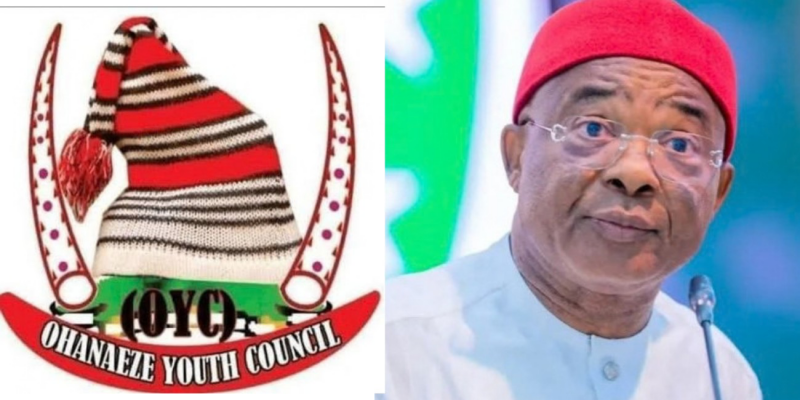
The Ohanaeze Youth Council has given Imo State Governor Hope Uzodimma 48 hours to apologise over remarks in which he questioned the representation of Igbo people in Nigeria’s government and said minorities within the Igbo population were being presented as the majority.
The demand followed comments made by Uzodimma at an Independence Day banquet on October 1, 2026, where he discussed ethnic representation and compared the treatment of the Hausa, Igbo and Yoruba in the allocation of political appointments.
Uzodimma said the three major ethnic groups contained minority communities, but argued that government representation was handled differently in the case of the Igbo. According to remarks reported from the event, he said, “To form Nigeria, there are the Hausa, Igbo and Yoruba. Among the Hausa, we have minorities; among the Igbo, we also have minorities, and likewise among the Yoruba.”
He then questioned why, in his view, “it is only the Igbos whose minorities are being represented”, adding that Hausa and Yoruba appointments were generally occupied by members of what he described as their respective “full” ethnic groups. He concluded that, in the Igbo case, “minorities are claiming to be the majority.”
Reports of the speech did not identify the specific communities Uzodimma had in mind when he referred to Igbo minorities. The governor also did not, in the reported remarks, name particular officials or appointments that he believed illustrated the problem. That omission has become important to the debate because the statement can be interpreted in different ways without further clarification.
The Ohanaeze Youth Council, led by National President Igboayaka O. Igboayaka, reacted by demanding an apology from the governor. The council described the remarks as unacceptable and said they could create division among Igbo communities at a time when greater unity was required.
The council’s 48-hour demand is a political and organisational ultimatum rather than a legal order. It is calling on Uzodimma to publicly withdraw or clarify the statement and apologise to those it says were demeaned by the governor’s characterization.
Uzodimma has remained a prominent voice in South-East politics. He is serving his second term as Imo governor and has also played a prominent role in national political discussions as chairman of the Progressive Governors’ Forum. In recent months, he has publicly argued for greater political engagement between the South-East and the federal government and has supported President Bola Tinubu’s political ambitions for 2027.
The governor’s latest comments therefore come at a politically sensitive moment. The remarks were made shortly after Nigeria marked its 66th Independence anniversary, during a period when questions about political representation and regional interests are increasingly prominent ahead of the 2027 general elections.
The dispute is especially notable because Ohanaeze youth groups have not always taken a uniform position on Uzodimma. In May 2026, another youth leadership publicly backed the governor, praising his role in advancing Igbo interests. That contrasting position highlights the divisions among organisations operating under the broader Ohanaeze youth banner and makes attribution important when reporting statements made in its name.
There is also a history of disputes over the status of the Ohanaeze Youth Council itself. In June 2023, Ohanaeze Ndigbo Worldwide publicly disowned a youth council operating under the name Ohanaeze Ndigbo Youth Council Worldwide, saying it was not recognised by the organs and structures of the apex socio-cultural organisation. Other youth leaders have since operated under different names and leadership structures, making it important to identify the particular body issuing a statement rather than treating every Ohanaeze youth group as one organisation.
The latest statement attributed to the council led by Igboayaka should therefore be understood as the position of that particular youth leadership. It does not automatically represent the official position of every Ohanaeze Ndigbo structure or every Igbo organisation.
The broader issue raised by the dispute is the meaning of ethnic representation in a country with more than 250 ethnic groups and significant overlap between language, ancestry, geography and political identity. Nigeria’s constitutional system is based on citizenship and federal representation rather than a formal classification of citizens into major and minor ethnic categories for political office. The Constitution also contains provisions intended to promote inclusiveness in public institutions through the federal character principle.
Against that background, the question of who qualifies as an Igbo representative is not merely a matter of political rhetoric. It can touch on the identities of communities whose histories, languages and cultural affiliations do not always fit neatly within contemporary state or geopolitical boundaries.
Nigeria’s Igbo population is itself diverse and is concentrated in the South-East while also having substantial communities in other parts of the country. A recent Australian government country information report noted the diversity of Igbo communities in social, economic and professional terms, as well as their significant presence outside the South-East. Such diversity makes broad claims about who is or is not a “full” Igbo representative particularly sensitive.
The issue also comes amid continuing debate over how Igbo interests should be represented nationally. Different political and socio-cultural organisations have disagreed over the role of South-East governors, federal appointments, regional political alliances and the handling of issues such as the continued imprisonment of Indigenous People of Biafra leader Nnamdi Kanu. The Ohanaeze Youth Council led by Igboayaka has recently called for Kanu’s release and framed the issue as part of a wider need for reconciliation in the South-East.
As of October 4, 2026, there has been no widely reported public response from Uzodimma accepting the demand, apologising or providing a detailed clarification of the communities and officials he had in mind. The absence of such clarification leaves the central question unresolved: which groups did the governor mean when he referred to Igbo minorities, and what specific government representation was he challenging?
The 48-hour period set by the youth council is now the focus of attention. Whether Uzodimma responds, clarifies his remarks or ignores the demand could determine whether the dispute remains a short political controversy or develops into a wider confrontation among Igbo leaders and organisations.
For now, the positions are clear. Uzodimma questioned the way Igbo representation is handled in government and argued that minorities were being presented as the majority. The Ohanaeze Youth Council led by Igboayaka has rejected that characterization and demanded an apology within 48 hours. Neither side has yet resolved the disagreement, leaving representation at the centre of the latest political dispute in the South-East at this stage.
📩 Stone Reporters News | 🌍 stonereportersnews.com
✉️ info@stonereportersnews.com | 📘 Facebook: Stone Reporters News | 🐦 X (Twitter): @StoneReportNew | 📸 Instagram: @stonereportersnews
Add comment
Comments