

Reported by Ariajegbe Sylvia Esezobor
The Federal Government has said it is implementing a series of interventionist policies aimed at strengthening the education sector, with the Minister of Education, Dr Maruf Alausa, outlining the administration’s reform agenda at the opening of the 85th Joint Consultative Committee on Education Plenary Meeting in Port Harcourt, Rivers State, on Tuesday, October 6, 2026.
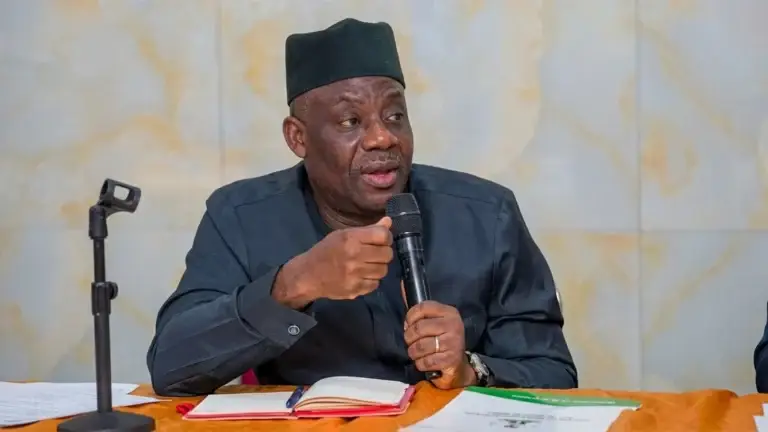
Alausa, who was represented by the Director overseeing the Office of the Permanent Secretary, Dr Folake Olatunji-Davies, said the President Bola Tinubu-led government was not just interested in physical infrastructure but in the quality of teachers and the learning environment. He said the administration, through the Renewed Hope Agenda, had continued to place education at the centre of national development, and he identified the Nigerian Education Sector Renewal Initiative as the coordinated framework for transforming the sector. “The Federal Ministry of Education instituted the Nigerian Education Sector Renewal Initiative to provide a coordinated framework for transforming the sector with emphasis on quality assurance, TVET, STEM education, digitization, inclusion, and improved learning environments,” he said.
Within that framework, Alausa said the government was implementing targeted interventions to enhance infrastructure and learning conditions. He cited the Renewed Hope Energizing Education Programme, which supports critical interventions in the education sector, and the Next Gen Student Hostel Projects at institutions including Yaba College of Technology and Lagos State University. “This underscores the administration’s commitment to improving the physical conditions under which students live and learn,” he said. He also disclosed that the ministry was strengthening science, technology, engineering, mathematics and medical sciences education through interventions to rehabilitate and upgrade medical schools and engineering and technology faculties in higher institutions. According to him, these investments are intended to ensure institutions are better positioned to produce the skilled manpower required for national development.
The minister further said the National Digital Learning Initiative was rolling out smart classrooms and digital learning resources across the country, expanding access to technology-enabled education and strengthening digital literacy among learners and teachers. He listed the ministry’s drive to reduce the number of out-of-school children through targeted enrollment campaigns, alternative learning pathways and strengthened collaboration with state governments and development partners. In the tertiary sub-sector, he said the government was establishing and upgrading vocational and innovation hubs across federal polytechnics and colleges of education, providing learners with practical industry-aligned skills for employability and self-reliance. He called on state and local communities, development partners and corporate bodies to complement Federal Government interventions, stressing that education is a shared responsibility and that sustainable improvement would require collective ownership.
The 85th JCCE plenary, hosted by the Rivers State Ministry of Education in collaboration with the Federal Ministry of Education, is holding at the Obi Wali International Conference Centre from October 6 to 9, 2026, under the theme, “Infrastructural Development and Teacher Motivation: Panacea For Improved Learning Outcomes.” The JCCE is a federal agency established to assist in the management of education in Nigeria. It operates through various reference committees focusing on specific areas such as primary, secondary, teacher and technical education before bringing recommendations to the plenary session. Its functions include the creation of minimum standards, quality of education, certification of teachers, and decisions on the design or level of salaries and fringe benefits paid to teachers. The four-day event brings together state commissioners of education, education administrators, policymakers and other stakeholders from across the country.
The timing of the plenary is significant. Nigeria is confronting a persistent out-of-school children crisis, with UNICEF estimating that about 18.5 million Nigerian children are out of school as of 2026, nearly one in every five out-of-school children in the world. The Federal Government has itself raised alarm over the crisis, with figures ranging from 15 million to 18.5 million depending on the source. The Nigerian Education Loan Fund has disbursed a total of N372.62 billion in student loans since the launch of its portal in May 2024, benefiting over 1.1 million students, a flagship intervention that the government cites as evidence of its commitment to expanding access to tertiary education. The government has also introduced a nationwide Learner Identification Number, a digital system designed to assign every student a permanent academic identity and enhance learning continuity across the country.
The choice of Rivers State as the host of the 85th plenary is notable. The state’s Ministry of Education has been implementing its own reforms, including the shutdown of unapproved private schools from June 15, 2026, and the migration from paper filing to the Rivers State Digital National Education Management Information System and the Rivers Education Management Information System, which are critical changes in the school management system in both public and private institutions. The state has also keyed into digital assessment reforms, with two fully equipped Computer-Based Test centres to be set up in each of its three senatorial zones as part of the rollout of Computer-Based Education in 2026. Parents in Port Harcourt have welcomed the new federal curriculum for basic, senior secondary and technical education, which officially took effect in September 2026 and is designed to reduce content overload and give students more learning time.
The political context of the plenary is significant. The 2027 general elections are less than four months away, and education has emerged as a central issue in the campaign. President Tinubu is seeking a second term on the All Progressives Congress platform, while former Vice President Atiku Abubakar of the African Democratic Congress, former Anambra Governor Peter Obi of the Nigeria Democratic Congress and Oyo State Governor Seyi Makinde of the Allied Peoples Movement are among the major challengers. The government has consistently pointed to its education reforms, including the student loan scheme, the expansion of technical and vocational training, and the establishment of new universities, as evidence of its commitment to human capital development. Critics, however, argue that the reforms have yet to translate into improved learning outcomes for the majority of Nigerian children, particularly those in rural and underserved communities where infrastructure deficits, teacher shortages and poverty continue to undermine access to quality education.
For the delegates gathered in Port Harcourt, the plenary offers an opportunity to review the implementation of federal education policies, share best practices from their respective states and develop recommendations that will be forwarded to the National Council on Education for review and possible adoption. The theme of the plenary, focusing on infrastructure and teacher motivation, reflects the government’s recognition that physical facilities alone cannot transform education without corresponding investment in the people who deliver it. As Alausa put it, the success of the reforms will depend not only on the government’s policies and investments but also on effective implementation, accountability and sustained collaboration among all tiers of government and stakeholders. The coming days will determine whether the 85th JCCE produces actionable recommendations that strengthen the education system or becomes another meeting in a long series of consultations that fail to deliver tangible results for Nigerian learners.
📩 Stone Reporters News | 🌍 stonereportersnews.com
✉️ info@stonereportersnews.com | 📘 Facebook: Stone Reporters News | 🐦 X (Twitter): @StoneReportNew | 📸 Instagram: @stonereportersnews
Add comment
Comments