

Reported by Ariajegbe Sylvia Esezobor
Delta State Governor Sheriff Oborevwori has ordered immediate medical intervention for communities affected by a massive crude oil spill along the Trans-Forcados pipeline, as the number of impacted communities rose from an initial assessment of 86 to 216, contaminating water sources, destroying aquatic life and crippling the fishing economy that sustains thousands of families across the riverine creeks of Warri South-West and neighbouring local government areas.
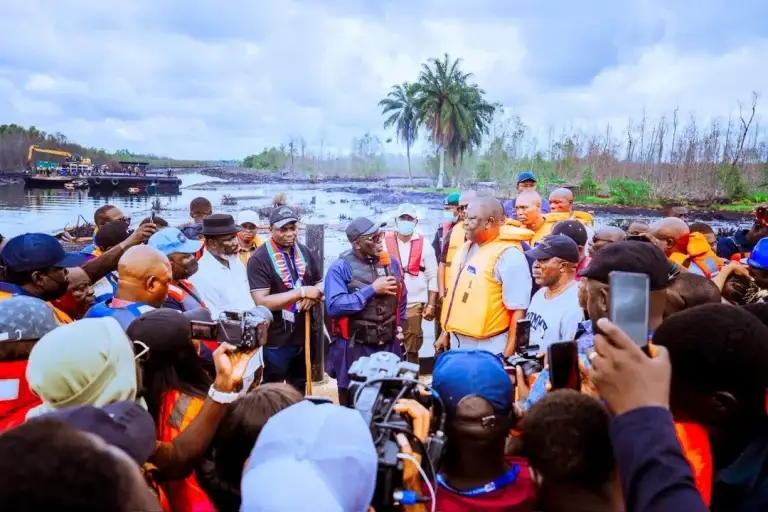
The governor gave the directive on Tuesday during an inspection visit to Odidi community in Warri South-West Local Government Area, where he assessed the impact of the spill on residents and the environment. He directed the Commissioner for Health to immediately deploy medical teams to the affected communities to assess residents and determine the health implications of prolonged exposure to pollution. "We have to take this matter seriously. Once you see what is happening, you realise that it is a very big issue. We don't want our people dying at this time. We cannot afford to lose our focus or waste time. We have to act quickly and decisively," Oborevwori said. He emphasised that the intervention would go beyond the distribution of relief materials, stressing that residents must be medically examined because of the possible health consequences of prolonged exposure to pollution. "Our people must be medically examined because of the possible health consequences of prolonged exposure to pollution," he said. The medical teams, he said, would visit the affected communities, assess the environmental and health impact, and determine appropriate interventions.
The governor also directed Heritage Energy Operational Services Limited, the operator of the Trans-Forcados pipeline, to deploy its own medical team and provide relief materials to affected communities. The company confirmed it was working with the state government, host communities and the Nigerian Upstream Petroleum Regulatory Commission to resolve the crisis. Nelson Wilbert, the General Manager of Operations Integrity at HEOSL, said the company's immediate priority was to complete ongoing technical operations, including installation, stopping the spill and pressure testing, to restore normal operations safely. However, the President of the Ijaw Youth Council, Dr Doubra Okotete, alleged that crude oil was still being pumped through leaking pipelines and called for urgent action to halt the pollution, as well as comprehensive remediation, compensation and increased medical support for residents experiencing respiratory problems.
The human and economic toll of the spill has been severe. Fishing, the primary source of livelihood for many residents of the affected communities, has been devastated. Oborevwori lamented that the pollution had resulted in scarcity and increased prices of fish, further affecting the livelihoods of residents. "When you affect fishing, you affect their livelihood, and that is why we are seeing scarcity and increased prices of fish," he said. He stressed that the crisis was not merely about compensation. "The crisis is not merely about compensation. It is about restoring the environment, protecting human lives and safeguarding the livelihoods of the affected people," he said. The governor's position reflects a recognition that the damage extends beyond the immediate loss of income to the broader ecological systems on which the communities depend for food, water and economic survival.
The Trans-Forcados pipeline system, which traverses the creeks of the western Niger Delta, has been the scene of repeated spills over the years, often linked to a combination of aging infrastructure, vandalism and operational failures. The current spill had been reported by community stakeholders as ongoing for approximately seven months before the governor's visit, according to an appeal letter addressed to the governor by Concerned Stakeholders and Indigenes of Odidi Federated. The stakeholders had also raised concerns about a leadership crisis in the community, urging the governor to ensure that any government delegation maintained strict neutrality and did not inadvertently recognise one faction over another. They called for a neutral peace and stakeholders' meeting involving affected residents and relevant government institutions.
The governor also directed the Commissioners for Oil and Gas, Chief Peter Uviejitobor, and Environment, Moses Ogodo, to monitor the implementation of his directives to the oil company and report back to him. He said HEOSL had assured the government that the technical process would be concluded and the cleanup completed before the end of October, after which the affected communities would be engaged on compensation and other measures. "Commitments made by the company must be honoured. Government will take the necessary steps to ensure compliance," Oborevwori warned. He appealed to the affected communities to remain peaceful and law-abiding, stressing that the government would pursue the matter through dialogue and due process. "Meaningful engagement is necessary to resolve the crisis and prevent further tension," he said.
As part of measures to address the needs of Odidi community, the governor approved the construction of a landing jetty and directed the Chairman of Warri South-West Local Government Area to build a modern health centre for the community. The Chairman of Odidi Community, Comrade Truston Gbenekama, expressed gratitude to the governor for leading a high-powered delegation to the creeks and appealed for swift implementation of the promised health facility, potable water systems and complete environmental reclamation. The governor was accompanied on the inspection tour by the Speaker of the Delta State House of Assembly, Rt. Hon. Emomotimi Guwor; the Commissioner of Police, CP Samuel Erale; the Commander of the 63 Brigade, Nigerian Army, Brigadier General Ibrahim Buhari; the Commander of the Nigerian Navy Ship Delta, Commodore Shehu Tasiu; the Commander of the 3144 Operating Base of the Nigerian Air Force, Group Captain Charles Abara; and the State Director of the Department of State Services, Dr Peter Afunanya, among other senior government officials. The presence of the state's top security leadership underscored the seriousness with which the administration views the crisis and the need to maintain order during the intervention.
The political context of the spill is significant. The 2027 general elections are less than four months away, with the presidential and National Assembly elections scheduled for January 16, and the governorship and state assembly elections for February 6. Oborevwori, who was elected on the platform of the Peoples Democratic Party but has since aligned with the All Progressives Congress-led Federal Government, is expected to seek a second term. The environmental and humanitarian crisis in the Niger Delta has long been a central political issue in the region, and the governor's response to the Trans-Forcados spill will be scrutinised by voters who have grown weary of promises that fail to translate into clean water, restored fishing grounds and compensation for lost livelihoods. For the communities affected by the spill, the governor's visit and the directives he issued represent both a recognition of their plight and a test of whether the government's words will be followed by action. As Oborevwori put it, the crisis is about restoring the environment, protecting human lives and safeguarding the livelihoods of the affected people.
📩 Stone Reporters News | 🌍 stonereportersnews.com
✉️ info@stonereportersnews.com | 📘 Facebook: Stone Reporters News | 🐦 X (Twitter): @StoneReportNew | 📸 Instagram: @stonereportersnews
Add comment
Comments