

Reported by Ariajegbe Sylvia Esezobor
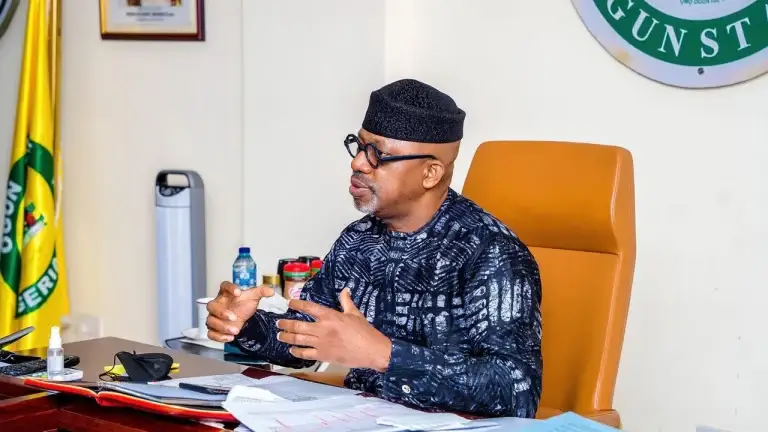
Ogun State Governor Dapo Abiodun has said Nigeria will require an additional 554,353 personnel to adequately staff the proposed State Police system, warning that the country's current policing architecture is inadequate for its population and that the centralised security model has run its course. Abiodun, who chairs the Nigeria Governors' Forum Committee on State Police, disclosed the figure on Thursday, October 8, 2026, during a stakeholders' engagement in Ibadan, Oyo State.
According to the governor, the estimate is based on empirical data from the Nigeria Governors' Forum and derived from the United Nations benchmark of one police officer to 414 citizens. He said the calculation showed that Nigeria would need 554,353 additional State Police personnel, translating to approximately 184,784 recruits annually over a three-year period. "The centralised security model has run its course," Abiodun said. "We cannot continue to police a country of over 200 million people from one centre. The establishment of State Police will immediately improve our police-to-citizen ratio while creating employment opportunities across the country's 774 local government areas."
Abiodun contrasted Nigeria's current policing ratio with international standards. He said Nigeria currently has approximately one police officer for every 660 citizens, compared with the United Nations recommendation of one officer to 414 citizens. Using Ogun State as an example, he noted that the state has about 6,000 personnel across Amotekun, the So-Safe Corps, vigilante groups and other security outfits, but these are not sufficient to address the state's security challenges. He argued that establishing State Police would not only strengthen security but also create jobs and improve the effectiveness of law enforcement at the grassroots level.
The governor, however, warned that the proposed State Police system would fail without far-reaching judicial, fiscal and institutional reforms. He said differences in states' revenue-generating capacities could affect the effectiveness of State Police if not properly addressed, and called for a clear funding framework that would prevent poorer states from being left behind. "We must ensure that no state is left behind due to fiscal constraints," Abiodun said. "There must be a take-off fund and a sustainable funding mechanism that guarantees that every state can adequately equip, train and remunerate its State Police personnel." He also called for comprehensive judicial reforms to ensure that State Police personnel are held accountable and that the system does not become a tool for political victimisation or abuse of power.
The demand for State Police has gained momentum in recent months, with all 36 State Houses of Assembly expected to simultaneously approve the constitutional amendment bill seeking to establish the system. Abiodun expressed confidence in July 2026 that the state assemblies would pass the bill together, saying the reform would strengthen security by increasing the number of personnel available and improving the police-to-citizen ratio. The bill, which seeks to alter the Constitution to provide for the establishment of State Police Services, was passed by the National Assembly in June 2026 and transmitted to the state legislatures for consideration. For the amendment to succeed, it must be approved by at least 24 of the 36 state Houses of Assembly. Several states have already endorsed the proposal, including Osun, Jigawa and others. The National Assembly has also established a Presidential Working Group to draft the National Policing Bill, which will provide the legal framework for implementing State Police across the country.
The proposal has not been without opposition. Critics, including some governors and civil society organisations, have warned that State Police could be weaponised against political opponents and used to entrench impunity at the sub-national level. The Nigeria Labour Congress and the Trade Union Congress have also expressed concerns, with the NLC warning that governors could use State Police to harass workers and silence dissent. Supporters counter that the current centralised system has failed to address Nigeria's security challenges, which include banditry, kidnapping, terrorism, communal violence and farmer-herder conflicts. The Federal Government has consistently defended the proposal, arguing that decentralised policing would improve response times, enhance local intelligence gathering and bring security closer to communities.
The political context of the State Police debate is significant. The 2027 general elections are less than four months away, with the presidential and National Assembly elections scheduled for January 16, and the governorship and state assembly elections for February 6. President Bola Tinubu is seeking a second term on the All Progressives Congress platform, while former Vice President Atiku Abubakar of the African Democratic Congress, former Anambra Governor Peter Obi of the Nigeria Democratic Congress and Oyo State Governor Seyi Makinde of the Allied Peoples Movement are among the major challengers. Security has emerged as one of the central issues in the campaign, and the State Police proposal is one of the most consequential reforms under consideration. If approved by the requisite number of states, it would represent the most significant restructuring of Nigeria's policing architecture since independence. The coming weeks will determine whether the state assemblies can meet the deadline for approval and whether the funding and accountability frameworks proposed by Abiodun and other governors can be put in place before the system takes off. As Abiodun put it, the centralised security model has run its course, and the country must now decide whether it is ready to embrace a decentralised system capable of meeting the demands of a rapidly growing population.
📩 Stone Reporters News | 🌍 stonereportersnews.com
✉️ info@stonereportersnews.com | 📘 Facebook: Stone Reporters News | 🐦 X (Twitter): @StoneReportNew | 📸 Instagram: @stonereportersnews
Add comment
Comments