

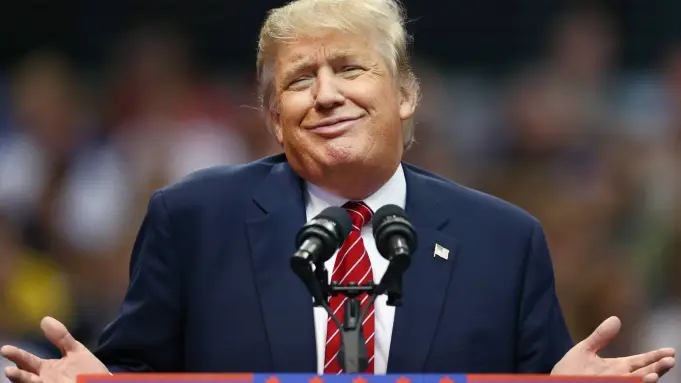
United States President Donald Trump has attracted widespread attention after telling supporters at a political rally that they would applaud him even if he made foolish statements. The remark, delivered during an enthusiastic address in Tennessee, prompted laughter and applause from the audience and subsequently circulated widely on social media. Although some critics interpreted the statement as an insult to his supporters, Trump immediately followed it with an explanation that his political messages were based on common sense and reflected the priorities of his movement.
Trump made the comment on Saturday, October 10, 2026, during a Republican campaign rally at the F&M Bank Arena in Clarksville, Tennessee. The gathering was organised to support Republican Senator Bill Hagerty and gubernatorial candidate Marsha Blackburn ahead of the November 3 midterm elections. Speaking before cheering supporters, Trump reflected on his relationship with rally audiences, discussed his political record and outlined priorities including border security, taxation and military strength.
The president introduced the remark while describing a conversation with a friend who had reportedly asked how he managed to address large audiences so frequently without experiencing stage fright.
Trump explained that speaking before supporters was relatively easy because he believed there was considerable affection between him and the people attending his events.
As he discussed that relationship, the crowd interrupted with cheers and chants of his name. One attendee reportedly shouted an expression of affection towards the president, prompting him to continue describing the atmosphere inside the venue.
Trump then made the statement that became the focus of public discussion: "I could say the stupidest things and you'd clap."
Rather than expressing displeasure, members of the audience responded with laughter and applause. The exchange was captured on video, and excerpts quickly circulated across social media platforms.
However, the president did not leave the remark without further explanation. He immediately distinguished between his hypothetical statement and what he believed his administration and political movement actually represented.
Trump said his political messages were grounded in common sense, rather than foolishness. He went on to identify border protection, lower taxes and a strong military as examples of the policies he believed resonated with his supporters.
The surrounding remarks are important because the widely shared quotation, when presented alone, does not fully convey how Trump framed his relationship with the audience.
His statement formed part of a broader discussion about the enthusiastic reception he receives at political gatherings and his belief that supporters respond positively to his leadership.
Nevertheless, the unusual choice of words attracted attention because it appeared to acknowledge the extent to which his audiences might applaud him regardless of what he said.
For some online commentators, the exchange became an example of strong personal loyalty within Trump's political movement. Others interpreted it as a humorous exaggeration intended to entertain an audience already supportive of his policies.
Those reactions represent interpretations of the president's words rather than independently established evidence of his intentions.
The footage showed an audience responding positively to the remark, but that response alone cannot establish what every attendee understood or believed about the statement.
Trump's appearance in Tennessee was part of his involvement in Republican campaigning ahead of the midterm elections, which will determine control of the United States House of Representatives and a portion of the Senate.
The president used the rally to promote Republican candidates and encourage political participation among supporters in a state where his party has maintained a significant electoral presence.
During the address, Trump also questioned why he needed to campaign in Tennessee, given his assessment that Hagerty and Blackburn were performing well politically.
He described his visit as an opportunity to thank residents for their support during previous presidential elections.
In doing so, he repeated his longstanding assertion that the 2020 presidential election had been stolen from him through cheating.
That allegation remains unsupported by evidence establishing widespread fraud sufficient to change the outcome of the election. Joe Biden was certified as the winner of the 2020 contest and served as president from January 2021 until January 2025.
Trump's reference to the election was part of his broader political remarks rather than the immediate context of the comment about applause.
The president's speaking style has long included spontaneous exchanges with supporters, personal anecdotes and statements designed to produce immediate reactions from rally audiences.
At the Tennessee event, the discussion about stage fright provided the setting for his comments about the emotional connection he believes exists between himself and those who attend his speeches.
The reaction demonstrated that the remark was received positively by at least some people present, although the available footage does not provide a reliable measure of the entire audience's response.
Beyond the venue, however, the same words generated different reactions among viewers encountering the recording online.
Some critics suggested that Trump had openly acknowledged unquestioning loyalty among his followers, while others regarded the remark as an example of his informal and provocative speaking style.
The competing interpretations illustrate how a brief statement can acquire different meanings when circulated outside the immediate setting in which it was delivered.
The episode also highlights the importance of considering the remarks that followed the quotation. Trump did not simply state that supporters would applaud foolish comments; he went on to defend the substance of his political agenda.
His references to immigration enforcement, taxation and military policy were presented as examples of positions he considered practical and widely understood by his audience.
These issues have remained central to his political messaging, particularly his emphasis on border controls, economic policy and national defence.
The president's supporters have frequently demonstrated enthusiasm at campaign events, where applause, chants and audience participation are common features of his speeches.
Such reactions are not unique to Trump or the Republican Party. Political rallies generally bring together people already sympathetic to the speaker or candidates appearing before them.
Consequently, applause at a campaign event should not automatically be interpreted as proof that supporters agree with every statement or would endorse any position presented to them.
In this instance, the central fact is that Trump made the remark, the audience responded positively and he immediately followed it with a defence of his policy messages.
The viral circulation of the footage brought renewed attention to the relationship between political leaders, their audiences and the ways short video excerpts shape public debate.
The incident comes as Republicans and Democrats intensify campaigning before the November elections, with both parties seeking to mobilise supporters and communicate their policy priorities.
While Trump's statement has become a subject of online discussion, the complete exchange shows that he presented it within a lighthearted account of his popularity among rally attendees.
His comments about common sense and government policy followed immediately, providing context that is essential to understanding the exchange.
The Tennessee rally therefore produced a moment that attracted attention beyond its original audience, demonstrating how political humour, public reactions and social media circulation can influence the interpretation of a leader's words.
📩 Stone Reporters News | 🌍 stonereportersnews.com ✉️ info@stonereportersnews.com | 📘 Facebook: Stone Reporters News | 🐦 X (Twitter): @StoneReportNew | 📸 Instagram: @stonereportersnews
Add comment
Comments