

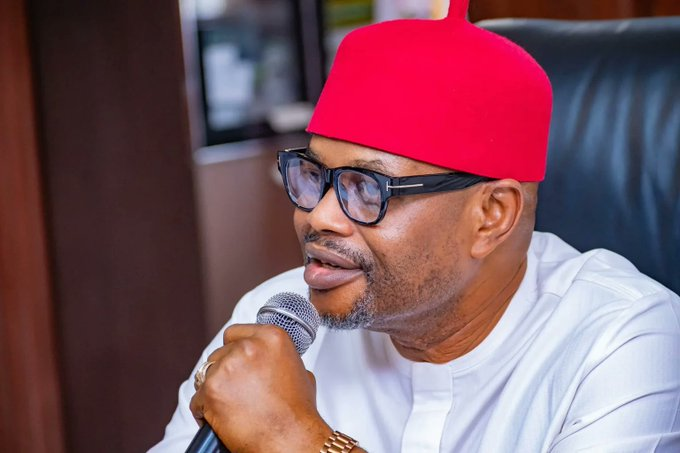
Former Nigerian Minister of Innovation, Science and Technology, Geoffrey Uchechukwu Nnaji, has been included in the Independent National Electoral Commission's final list of candidates for the 2027 governorship election in Enugu State, despite an ongoing criminal case involving allegations of forged academic credentials. The development has renewed scrutiny of the former minister's qualifications, particularly after reports that he submitted a West African Examinations Council result in support of his candidacy rather than relying on the university degree that became the subject of controversy.
INEC's publication of its final governorship candidates' list on Sunday, October 11, 2026, identifies Nnaji as the Peoples Democratic Party candidate in Enugu State. The former minister, who resigned from President Bola Ahmed Tinubu's cabinet in October 2025, is seeking to govern the southeastern state after securing his party's nomination. His inclusion follows investigations concerning a disputed University of Nigeria, Nsukka degree certificate and National Youth Service Corps discharge certificate.
The development marks a significant return to electoral politics for Nnaji, whose ministerial career ended following allegations concerning the authenticity of documents presented during his appointment.
Daily Trust reported that the former minister submitted a WAEC result among his electoral credentials, drawing attention to the difference between the minimum educational qualification required for a governorship candidate and the disputed university documents.
The distinction is important because Nigerian electoral law does not require every governorship candidate to possess a university degree.
Under Section 177 of the 1999 Constitution, a person seeking election as governor must satisfy several requirements, including citizenship, age, party sponsorship and education to at least School Certificate level or its equivalent.
Consequently, the existence of a dispute concerning a university qualification does not automatically establish that a candidate lacks the minimum educational qualification required to contest.
However, meeting electoral qualification requirements is a separate matter from determining whether documents previously submitted for public appointment were authentic.
Nnaji's certificate controversy became public following an investigation published by PREMIUM TIMES in October 2025.
The investigation examined academic records associated with the University of Nigeria, Nsukka, and questioned whether the former minister had completed the requirements for the degree he claimed.
University records cited in the investigation indicated that Nnaji had been admitted to the institution but did not establish that he graduated in the year claimed.
The university also disputed the authenticity of the degree certificate attributed to it.
Questions were separately raised about an NYSC discharge certificate associated with the former minister's 2023 screening for ministerial appointment.
The allegations prompted extensive public debate about the verification of educational qualifications presented by political appointees.
Nnaji subsequently resigned from the Federal Executive Council, maintaining that the allegations were politically motivated.
In his resignation statement, he insisted that stepping aside should not be interpreted as accepting wrongdoing.
He described the decision as an effort to protect the integrity of ongoing legal proceedings and prevent the controversy from distracting attention from government responsibilities.
His statement that the resignation was not an admission of guilt remains relevant because the criminal allegations against him have since entered formal judicial proceedings.
The Independent Corrupt Practices and Other Related Offences Commission subsequently investigated the allegations.
According to an official statement issued by the commission, Nnaji was arrested on July 1, 2026, at Nnamdi Azikiwe International Airport in Abuja after arriving in the country.
The arrest followed a bench warrant issued by the Federal High Court.
The ICPC said investigators had previously invited him for questioning through notices sent to addresses in Abuja and Enugu, as well as by electronic mail.
The commission maintained that his failure to honour those invitations led it to seek judicial intervention.
The warrant, issued on June 11, concerned investigations into the disputed degree and NYSC documents.
The Department of State Services assisted in carrying out the arrest before Nnaji was transferred to ICPC custody.
On July 13, 2026, the former minister appeared before Justice Joyce Abdulmalik of the Federal High Court in Abuja.
He pleaded not guilty to six criminal counts brought by the ICPC.
The charges included allegations relating to forged academic credentials and approximately ₦29.5 million in salary and allowances allegedly received under false pretences.
Money laundering allegations also formed part of the prosecution's case.
His not-guilty plea means the allegations remain contested, and the prosecution must establish its case through the judicial process.
The filing of charges or an arrest does not constitute a conviction.
Despite the controversy, Nnaji pursued the PDP governorship nomination in Enugu State.
His candidacy was supported by the faction of the party associated with Federal Capital Territory Minister Nyesom Wike.
During the screening process, a committee chaired by former Kaduna State governor Ahmed Makarfi cleared Nnaji to participate in the governorship primary.
Another aspirant, businessman Samson Nnamani, also received clearance.
The screening decision attracted criticism from the civil society organisation Defence for Democracy, whose national president, Emeka Nwachukwu, questioned the party's decision to advance a candidate facing certificate forgery allegations.
The criticism represented the organisation's position and did not amount to a judicial determination of Nnaji's eligibility.
Nnaji subsequently emerged as the PDP governorship candidate after securing 7,424 votes against Nnamani's 600.
Austin Nwachukwu, chairman of the party's seven-member governorship primary committee, announced the result.
The committee described the exercise as peaceful and conducted in accordance with applicable party guidelines.
That nomination provided the basis for Nnaji's inclusion in the candidate list subsequently published by INEC.
The publication of the final candidate list has therefore brought together two distinct legal issues: whether Nnaji meets the constitutional requirements to contest the governorship election and whether the academic documents previously attributed to him were forged.
INEC's inclusion of a candidate on an electoral list should not be interpreted as an acquittal in an unrelated criminal proceeding.
Likewise, an ongoing criminal prosecution does not, by itself, establish that an accused person has been convicted or automatically disqualified from every electoral contest.
The reported submission of a WAEC result is significant because it relates directly to the constitutional minimum educational qualification.
However, the complete examination details and independent verification of that result were not established from the accessible reporting.
Enugu's governorship contest also includes candidates from other parties. INEC's published list identifies Ndubuisi Mbah of the APC, Ocho Chukwuma of the ADC and Christian Ohaa of the NDC.
Their inclusion confirms that Nnaji's nomination forms part of a wider multiparty election rather than an uncontested candidacy.
For the former minister, the immediate development is his formal inclusion among the candidates seeking to lead Enugu State in 2027.
For the courts, the outstanding matter remains the determination of the criminal allegations through admissible evidence and due process.
The certificate controversy has not disappeared with the publication of the electoral list. It remains a separate legal matter whose outcome cannot be presumed.
As the election approaches, Nnaji's candidacy places renewed attention on the relationship between electoral eligibility, academic verification and accountability in public office.
📩 Stone Reporters News | 🌍 stonereportersnews.com ✉️ info@stonereportersnews.com | 📘 Facebook: Stone Reporters News | 🐦 X (Twitter): @StoneReportNew | 📸 Instagram: @stonereportersnews
Add comment
Comments