

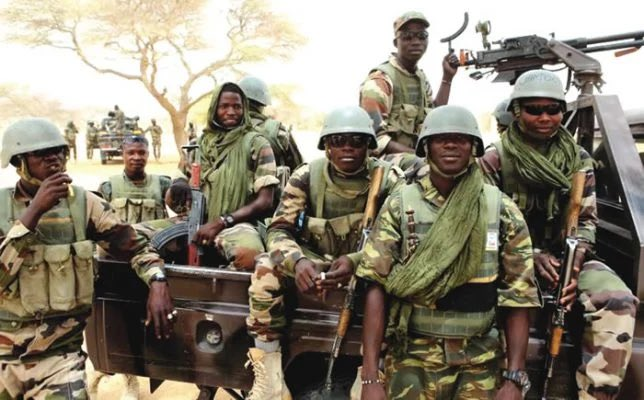
A Nigerian soldier has been killed and two weapons stolen after unidentified gunmen attacked a military checkpoint in Riyom Local Government Area of Plateau State, prompting security forces to launch a manhunt for the attackers amid renewed concerns about violence against troops and rural communities.
The attack occurred at approximately 8 p.m. on Saturday, October 31, 2026, at the Sopp checkpoint in Ungwan Boka, where personnel of Operation Enduring Peace were deployed. Military authorities confirmed the incident on Sunday, saying soldiers had restored order and intensified operations to apprehend those responsible.
Captain Chinonso Polycarp Oteh, spokesperson for Operation Enduring Peace, described the assault as deliberate and unprovoked. He said troops were carrying out their security responsibilities when the gunmen attacked, forcing personnel at the checkpoint into an armed confrontation.
According to security accounts, the attackers opened fire from different directions, prompting soldiers to return fire. The exchange continued before the assailants withdrew into surrounding bushes, taking weapons reportedly seized during the confrontation.
The military confirmed that efforts were underway to recover the stolen weapons and arrest the perpetrators. However, authorities had not announced any arrests or confirmed the identity or affiliation of the attackers by the time of reporting.
The deceased soldier was reportedly a sergeant attached to the Nigerian Army Medical Outpost at Tigi. Security sources indicated that he was visiting the checkpoint on administrative duties when the attack occurred.
His remains were subsequently evacuated to the mortuary at the 3 Division Medical Services and Hospital. The military had not publicly disclosed his name or announced funeral arrangements.
Reports differed slightly on the description of the stolen equipment, with some accounts referring to a rifle and others specifying two weapons. Several news organisations reported two weapons, while the military spokesperson confirmed that efforts to recover the missing arms were continuing.
Oteh said security personnel had strengthened surveillance and maintained heightened vigilance following the attack. He reassured residents that the situation was under control and urged them to continue their lawful activities.
The spokesperson also appealed for credible information from members of the public that could help investigators identify the attackers and establish their movements after leaving the checkpoint.
The appeal reflects the importance of local intelligence in areas where armed groups can exploit difficult terrain and move between isolated settlements.
Residents interviewed after the incident condemned the killing and expressed concern that attacks on security personnel could undermine efforts to protect their communities.
One resident, Dung Gyang, described the assault as an attack on the wider community, arguing that soldiers stationed in the area were responsible for protecting civilians against criminal activity.
Another resident, Sarah Bot, appealed to military authorities to maintain their presence despite the attack, saying the checkpoint had helped discourage insecurity.
Their concerns highlight the difficult position of communities that depend on security deployments while facing the possibility of further violence around those positions.
Riyom has experienced recurring attacks, kidnappings and disputes involving farming communities and armed groups. Its location within Plateau's conflict-affected central zone has made sustained security operations particularly important.
The military has maintained checkpoints and patrols in vulnerable locations to monitor movements, respond to emergencies and discourage attacks against civilians.
However, the latest incident demonstrates that security installations themselves can become targets, exposing personnel and nearby communities to additional risks.
The stolen weapons present another concern because firearms taken from security personnel may be used in subsequent criminal activities if they are not recovered.
Their recovery is therefore an important objective alongside identifying the perpetrators and establishing the circumstances of the soldier's death.
The attack occurred during a period of heightened tension involving security personnel elsewhere in Plateau State.
On October 29, troops reportedly encountered protesters along the Jos–Mararaban Pushit–Pankshin highway in Mangu Local Government Area.
The demonstrators were demanding the release of a man identified as Karfe, who had reportedly been arrested in connection with an investigation into the killing of a Fulani elder.
Security accounts alleged that the confrontation escalated when some protesters threw stones and other objects at personnel attempting to manage the situation.
A mobile police officer was reportedly injured during the disturbance.
Separately, a soldier was reportedly attacked with a machete in Bukuru, Jos South Local Government Area, on the same day.
The incidents involved different locations and circumstances. No verified evidence establishes that those responsible for either confrontation participated in the Sopp checkpoint attack.
Military sources have also cautioned against attributing the Riyom assault to any particular ethnic community without evidence.
That distinction is especially important in Plateau State, where longstanding communal tensions have sometimes been intensified by accusations circulated before investigations are completed.
The identity of the gunmen remains unknown, and there is no established basis for describing them as members of either Fulani or Berom armed groups.
Investigators will need to examine available evidence, including eyewitness accounts and operational information, before determining responsibility.
For communities affected by recurring violence, impartial investigations are essential to maintaining public confidence and preventing retaliatory accusations.
The military's immediate response has focused on pursuing the attackers, recovering the stolen weapons and preventing further security breaches.
Longer-term protection will depend on sustained cooperation between security agencies, local authorities and residents, alongside effective accountability for attacks against civilians and personnel.
The killing of the soldier represents a serious loss for Operation Enduring Peace and raises further questions about the safety of personnel deployed to vulnerable checkpoints.
As the manhunt continues, residents await information about possible arrests and whether the missing weapons have been recovered.
The incident underscores the continuing security challenges facing Plateau State, where restoring lasting peace requires both effective protection and investigations that establish responsibility without inflaming existing tensions.
📩 Stone Reporters News | 🌍 stonereportersnews.com
✉️ info@stonereportersnews.com | 📘 Facebook: Stone Reporters News | 🐦 X (Twitter): @StoneReportNew | 📸 Instagram: @stonereportersnews
Add comment
Comments