

Reported by: Oahimire Omone Precious | Edited by: Oravbiere Osayomore Promise.
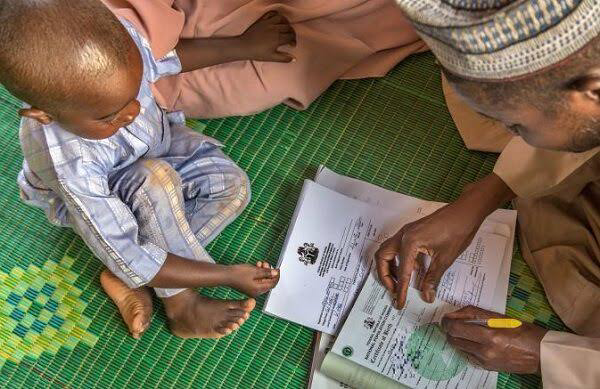
Every day, babies are born in Nigerian hospitals, wrapped in clean linens, weighed, and handed to their mothers. Yet in that same moment, a fundamental failure occurs that will shadow these children for life. They leave the hospital without a legal identity, invisible to the state, and absent from the records that determine access to education, healthcare, and citizenship. This is the stark reality of Nigeria's birth registration crisis. According to the United Nations Children's Fund, at least 3.5 million children across Lagos, Ogun, Oyo, Osun, Ondo, Ekiti and Edo states have no birth certificates, leaving governments with an incomplete picture of the population they must plan schools, healthcare, vaccination and social services for. The children are not missing; they live with their families, attend communities and use public services, but their births have never been formally captured in the civil registration system.
The contradiction is jarring. A child may be born inside a health facility, surrounded by doctors, nurses and midwives, yet leave that same facility without a legal identity. Celine Lafoucriere, Chief of UNICEF Lagos Field Office, told journalists at a two-day Birth Registration Media Dialogue organised by the National Population Commission in Lagos that some children born in hospitals are never registered. "They are children who are alive, at home, loved by their families, but completely invisible to their state and the country," she said. "Some are in cities. Some are in villages. Some were born in hospitals and still never got registered. The gap is everywhere".
The National Population Commission has confirmed that only about 40 per cent of births in Nigeria are currently registered, despite more than five million children being born in the country annually. NPC Chairman Dr Aminu Yusuf described the low rate of birth and death registration as a major challenge to Nigeria's efforts to establish a reliable national population database. The situation has made it difficult to obtain accurate demographic information required for effective planning, governance and sustainable development. For education authorities, this means less certainty about the number of children who will enter primary school. For health planners, it affects estimates of infants requiring immunisation and primary healthcare.
Hospitals, maternity centres and primary healthcare facilities occupy a unique position in the life of a newborn. They know when a baby is born. They know where the child was born. They have access to the mother, father or caregiver at one of the few moments when the entire family is physically present. They are therefore potentially the most strategic entry points for universal birth registration. Experts argue that birth registration must become part of routine maternal and newborn care, just as immunisation, weighing, postnatal checks and other essential services are integrated into the continuum of care. The delivery room should be the first registration point.
The National Population Commission has acknowledged this opportunity and is working to deploy more registrars to health facilities across the country. Kekere Ekun Abiola, Lagos State Director of the NPC, said that while registrars had been deployed to many facilities, some still lacked registration personnel, and the need extended to private health facilities. He explained that once a child is born and the health facility issues a birth notification, parents are directed to the registrar for formal registration. The Commission is also working with traditional birth attendants because of their importance in communities where access to formal health facilities is limited.
Digitalisation is at the heart of the government's strategy to close the registration gap. The NPC has deployed the electronic Civil Registration and Vital Statistics system through the Vital Rights Platform, representing a shift from manual registration to technology-driven processes. Digital registration services have been extended to about 4,000 of the country's 8,809 wards, with plans to establish 8,000 registration centres nationwide. UNICEF has facilitated 14 million birth registrations across Nigeria over the past two years while spearheading digitalisation of registration systems at health facilities nationwide. The Commission is working with the National Primary Health Care Development Agency, state governments and health institutions to integrate birth registration into routine healthcare services.
The integration of birth registration with primary healthcare services, alongside decentralisation, digitalisation, data interoperability and social mobilisation, is identified as a key accelerator for scaling up legal identity services. Under the proposed model, birth notification at a health facility or community level would trigger the registration process, followed by issuance of a birth certificate and linkage with the national identity system. This would make birth registration less dependent on parents making separate journeys to registration centres. The National Identity Management Commission would facilitate the linkage of registered births to the national identity database and prompt assignment of the National Identification Number. Local governments would play a critical role through ward and community-level registration points.
Despite the progress, significant barriers remain. Denis Onoise, UNICEF Child Protection Specialist, identified inadequate registration centres, long distances to service points, language barriers, inefficient registration processes and insufficient resources as factors limiting access. Families also bear indirect costs, including transportation, time away from work and repeated journeys to registration points. Many parents are unaware that birth registration is free, that it can be done at nearby health facilities, or that digital registration is now available. Lafoucriere told journalists: "They do not know because no one has told them in a language they trust, on a platform they use, in a voice that sounds like their own".
The stakes could not be higher. An unregistered child can encounter difficulties accessing basic services and exercising rights throughout life. "They do not exist for access to basic social services like education, like health. But they will also continue not to exist as they reach adult age when it is time for them to vote, to participate in political life, but also when they will be in a position to inherit their parents' wealth," Lafoucriere warned. Without reliable data on how many children are born, where they live and how their numbers change, governments risk planning essential services around an incomplete picture of the population. A government cannot efficiently allocate resources to a population it cannot accurately count.
The solution requires a fundamental shift in mindset. Birth registration should be viewed not as an administrative burden but as the first right of every child. Wafaa Saeed Abdelatef, UNICEF Representative in Nigeria, described it as "a gateway to protection, services, and opportunity". President Bola Tinubu has acknowledged that every child must be registered immediately after birth, adding that "every child counts". The National Population Commission, NIMC, ALGON and UNICEF have intensified efforts to ensure every Nigerian child is registered at birth. But the gap between policy and practice remains wide. As Nigeria works towards universal birth registration, the message is clear: hospitals must become the first line of defence against invisibility. Every delivery room must be a registration point. Every newborn must be counted. Every child matters.
📩 Stone Reporters News | 🌍 stonereportersnews.com
✉️ info@stonereportersnews.com | 📘 Facebook: Stone Reporters News | 🐦 X (Twitter): @StoneReportNew | 📸 Instagram: @stonereportersnews
Add comment
Comments