

Reported by: Ijeoma G | Edited by: Oravbiere Osayomore Promise.'
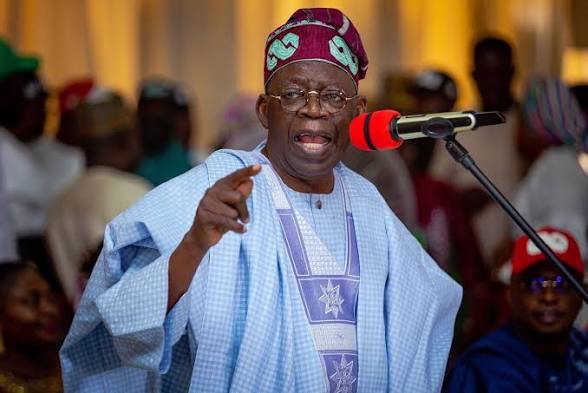
President Bola Ahmed Tinubu on Wednesday stood before a gathering of some of Nigeria's most influential Christian leaders and delivered a message that cut to the heart of the relationship between faith and politics in the run-up to the 2027 general elections. Speaking at the 2026 International Synod of Charismatic Archbishops, Bishops and Apostles at the National Christian Centre in Abuja, the President urged the Church to promote peace and responsible participation in the electoral process, warning against the use of the pulpit to incite violence or deepen divisions. The occasion, however, carried a striking contradiction: the same conference that received his caution had already endorsed him for a second term, declaring its support for him "even beyond 2027".
Represented by the Secretary to the Government of the Federation, Senator George Akume, Tinubu framed the 2027 election as a contest that must not be allowed to tear the country apart. He stressed that political contests were temporary while Nigeria would remain beyond the elections. "As charismatic bishops and fathers of faith, you have a decisive role to play in helping to ensure that Nigeria does not lose. I urge you, therefore, to encourage peaceful and consensual participation in the election," he said. He called on the Church to raise its voice against anti-democratic practices such as vote buying, hate speech and the weaponisation of ethnicity or religion, and to demand issue-based campaigns while cautioning political actors whose ambition must never be placed above national peace and interest. Then came the line that has since dominated public discourse: "This charge would, however, be incomplete if I do not admonish you to please refrain from turning the pulpit into an instrument of incitement instead of the sanctuary of conscience."
The President's admonition landed in a room that had already made up its mind about the 2027 election. The President-General of the Charismatic Bishops Conference of Nigeria, Archbishop Leonard Bature Kawas, used the same synod to announce the conference's endorsement of Tinubu's re-election bid. Kawas said the Church had examined the administration's record and was prepared to continue supporting the President through prayers, advocacy and public engagement, citing what he described as efforts to promote national development and inclusivity. "We support him now. We support him today, we support him tomorrow, and we support him for as long as he's willing to be our president," Kawas declared. He went further, stating that the President's commitment to religious inclusion, including his support for the emergence of Christian governors and the appointment of a "born-again Christian" as the APC's national leader, justified the conference's decision to stand with him beyond the next electoral cycle.
The endorsement was not an isolated event. It followed a broader pattern of religious and political entanglement that has intensified as the 2027 campaign season gathers momentum. Earlier in September, 500 Islamic scholars, preachers and clerics from the North had endorsed Tinubu for a second term. In August, the Catholic Bishops Conference of Nigeria had met with the President and urged him to address the legitimate concerns of Christians, including the controversial Muslim-Muslim ticket and the security situation in the Middle East Belt. The Catholic Bishops have not issued an endorsement, but the Charismatic Bishops have now taken a firm position, drawing the Church deeper into the political fray. Human rights lawyer Deji Adeyanju had already condemned what he described as the renewed patronage of churches by politicians, specifically criticising governors who gathered clerics to endorse the President. His criticism predated the Charismatic Bishops' endorsement but now reads as a prescient warning about the dangers of using the pulpit as a political instrument.
The Minister of Information and National Orientation, Mohammed Idris, reinforced the President's message with a call for religious leaders to use their influence to steer young people away from radicalisation and criminality, and to support community early-warning mechanisms and dialogue. He stressed that keeping Nigeria united required more than government action and that religious leadership had a critical role to play. "No election should be allowed to turn Christian against Muslim, Muslim against Christian, North against South, or one ethnic group against another. Nigeria belongs to all of us," Idris said. His words echoed the President's caution but also underscored the tension at the heart of the event: the government was asking the Church to remain a moral compass while simultaneously accepting its political endorsement.
For Tinubu, the endorsement by the Charismatic Bishops is a significant boost as he prepares for a re-election contest that is expected to be fiercely contested. But the President's own words have now created a standard by which his relationship with the Church will be judged. If the pulpit must not become an instrument of incitement, can it be an instrument of endorsement? If the Church must remain a sanctuary of conscience, can it also serve as a campaign platform? These are the questions that will linger long after the synod has ended, as Nigeria navigates the treacherous intersection of faith, politics and power ahead of 2027.
The President's admonition and the Charismatic Bishops' endorsement, delivered in the same hall on the same day, encapsulate the paradox of Nigerian politics. The government needs the moral authority of religious leaders to legitimise its electoral project, while religious leaders seek proximity to power to advance their institutional interests and protect their flocks. The result is a delicate dance in which both sides claim to be serving the nation's highest ideals while pursuing their own strategic objectives. As the 2027 elections draw closer, the pulpit will remain a contested space, a platform that can either heal a divided nation or deepen its fractures. The President has made his preference clear. Whether the Church will heed his warning, even as it embraces his candidacy, remains to be seen.
📩 Stone Reporters News | 🌍 stonereportersnews.com
✉️ info@stonereportersnews.com | 📘 Facebook: Stone Reporters News | 🐦 X (Twitter): @StoneReportNew | 📸 Instagram: @stonereportersnews
Add comment
Comments