

Reported by: Oahimire Omone Precious | Edited by: Oravbiere Osayomore Promise.
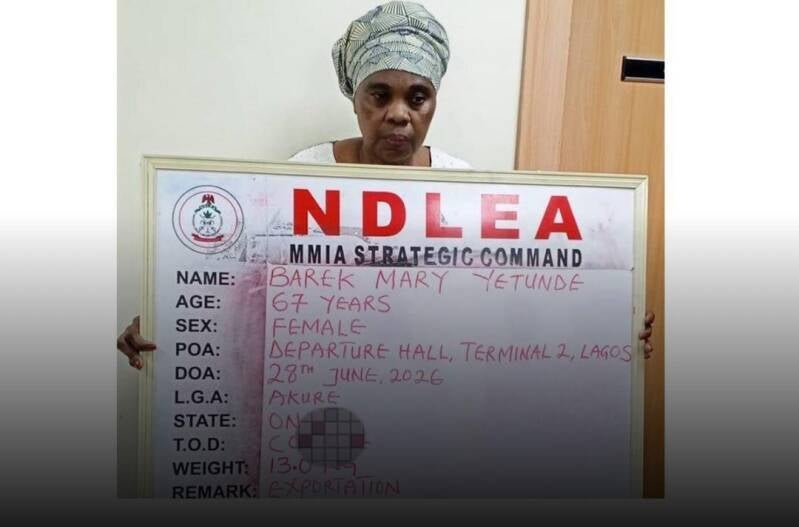
A Federal High Court sitting in Lagos has granted ₦150 million bail to a 67-year-old United Kingdom-based Nigerian woman, Mrs Mary Yetunde Barek, who is facing trial for allegedly trafficking 13 kilogrammes of cocaine disguised as plantain to the United Kingdom. Justice Friday Ogazi granted the bail on Wednesday, September 9, 2026, with two sureties in like sum, bringing a measure of relief to the elderly suspect who has been in custody since her arrest in June. The conditions attached to the bail are stringent: the sureties must reside within the court's jurisdiction and own landed property worth at least ₦150 million, provide proof of property ownership, and present evidence of tax payments for three years. Barek, who resides in the United Kingdom, was also ordered to deposit her British international passport with the court and remain in Nigeria throughout the trial unless granted permission to travel.
The National Drug Law Enforcement Agency accused Barek of exporting and transporting 13kg of cocaine disguised as plantain to the Murtala Muhammed International Airport in Lagos for onward shipment to the UK. According to the agency, the offence occurred on June 28, 2026, during the outward clearance of passengers on a Virgin Atlantic flight at Terminal 2 of the airport in Ikeja. The NDLEA alleged that Barek transported the cocaine from her residence on Alhaji Azeez Ajanaku Street in Okota, Lagos, to the airport for export. The seizure was described by the agency as one of the largest single recoveries of the drug at the Lagos airport in recent years, with the cocaine concealed in a manner designed to evade detection by customs and security officials.
Barek was arraigned in August 2026 and pleaded not guilty to the charges, which the NDLEA said contravene Section 11(b) of the NDLEA Act. Following her arraignment, the prosecution opposed her bail application, arguing that the severity of the offence and the international dimension of the case made her a flight risk. Her lawyer, however, cited her health condition and advanced years as grounds for bail, urging the court to consider her medical needs and her cooperation with authorities since her arrest. Justice Ogazi, after hearing both submissions, granted bail on the stated conditions and ordered that Barek must not leave Nigeria without the court's permission pending the determination of the case.
The case has drawn significant attention due to the age of the suspect and the quantity of drugs involved. Barek, a Nigerian-born British citizen, had reportedly been living in the United Kingdom before her arrest. Her decision to allegedly smuggle such a large quantity of cocaine at an age when most of her peers are enjoying retirement has puzzled observers and raised questions about the pressures that drive elderly Nigerians into the drug trade. Some have speculated that financial desperation or coercion may have played a role, while others have pointed to the growing involvement of diaspora-based Nigerians in international drug trafficking networks.
For the NDLEA, the case represents a significant victory in its ongoing campaign against drug trafficking through Nigeria's airports. The agency has intensified its surveillance and screening operations at major international gateways, including the Murtala Muhammed International Airport, in an effort to disrupt the flow of illicit drugs to Europe, Asia, and other destinations. The seizure of 13kg of cocaine at the airport was a major operational success, and the prosecution of Barek is expected to serve as a deterrent to others considering similar ventures.
Barek's trial is expected to resume in the coming weeks, with the prosecution expected to present its evidence and witnesses. The defence has indicated that it will challenge the evidence and argue that Barek was not aware of the contents of the package she was allegedly transporting. The case will be closely watched by legal observers and anti-drug campaigners, as it tests the courts' approach to elderly defendants in drug trafficking cases and the balance between compassion and accountability in sentencing. For now, Barek remains in Nigeria, her British passport in the custody of the court, awaiting the next phase of a legal battle that could determine whether she spends the rest of her life in a Nigerian prison or returns to her home in the United Kingdom.
📩 Stone Reporters News | 🌍 stonereportersnews.com
✉️ info@stonereportersnews.com | 📘 Facebook: Stone Reporters News | 🐦 X (Twitter): @StoneReportNew | 📸 Instagram: @stonereportersnews
Add comment
Comments