

Reported by: Ijeoma G | Edited by: Oravbiere Osayomore Promise.
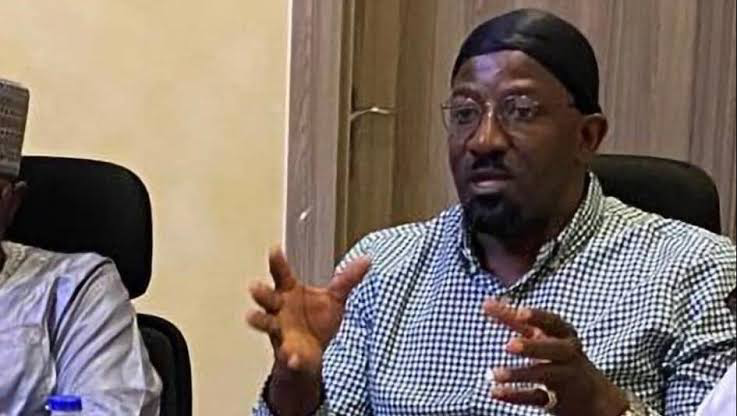
A former South-East spokesman to President Bola Ahmed Tinubu, Denge Josef Onoh, has issued a direct and uncompromising ultimatum to the Minister of the Federal Capital Territory, Nyesom Wike: formally join the All Progressives Congress or step aside from the party’s affairs entirely. Onoh, who is also the Chairman of the Forum of Former Members of the Enugu State House of Assembly, made the demand in a statement issued in Abuja on Saturday, September 12, 2026, describing the political alignment being promoted by Wike as a “Rainbow Coalition” that could undermine the APC ahead of the 2027 general election. His intervention lays bare a deepening tension within the ruling party over the role of a minister who remains a card-carrying member of the Peoples Democratic Party while wielding significant influence in the affairs of a government formed by another party.
Onoh did not mince words. He described the coalition as a “Trojan horse” capable of creating divisions within the ruling party. “This so-called ‘Rainbow Coalition’ is a toxic distraction, a political mirage, and a well-calculated vehicle for personal ambition that will ultimately undermine the All Progressives Congress and jeopardise the presidential election if left unchecked,” he said. According to Onoh, the coalition does not represent a unified political bloc capable of delivering significant votes to President Tinubu outside Rivers State. He argued that Wike’s political influence is largely concentrated in Rivers State and questioned attempts to replicate what he described as a “fractured blueprint” across other geopolitical zones. “There is no ‘rainbow’ or ‘stripes’ in this arrangement that offers a single block vote to President Bola Ahmed Tinubu outside the creeks of Rivers State,” Onoh said. “Wike’s political currency is heavily localized, and his attempt to export this fractured blueprint to other geopolitical zones is an act of extreme political overreach.”
The former presidential aide also rejected comparisons between Wike’s current alignment and the G5 governors’ alliance that emerged ahead of the 2023 election. He said the G5 was built around regional equity and involved five serving governors with control of state political structures. Onoh recalled his own involvement in efforts to promote the APC in the South-East while working with former Enugu State Governor Ifeanyi Ugwuanyi, saying the political realignments came at a cost to some of the actors involved. He said the current coalition lacked the institutional and electoral structures associated with the G5. “Today, Wike’s new ‘Rainbow Coalition’ has completely crumbled from that standard,” he said. “It is not an alliance of powerful state executives; it is a desperate collection of political castaways, disgruntled ex-office holders, and floating political contractors who hold no real electoral value in their own political wards. You cannot use spent forces to build a shield for a sitting President.”
Onoh also turned his attention to Wike’s recent political disagreements with Kwara State Governor AbdulRahman AbdulRazaq and Imo State Governor Hope Uzodimma, describing the disputes as a “diversionary tactic.” He alleged that Wike was creating political tension in the North-Central and South-East as part of an attempt to weaken APC structures. “By attacking highly respected APC governors who are the authentic custodians of the party’s grassroots votes, Wike is actively sowing the same seeds of discord, insubordination, and structural decay that he used to tear the Peoples Democratic Party apart,” Onoh alleged. He accused Wike of attempting to influence the APC from within using the same political strategy that contributed to divisions in the PDP. The implication is clear: Onoh views Wike not as an ally of the APC but as a political operator whose methods, while effective in the short term, are corrosive to the long-term health of any party he associates with.
The former aide further criticised what he described as the promotion of cross-party voting, warning that such a strategy could weaken the APC’s parliamentary strength. He argued that presidential and National Assembly elections are held concurrently and that encouraging voters to support the APC at the presidential level while backing opposition candidates in legislative contests could affect the party’s ability to secure a majority. “We cannot exchange a robust, organic party victory for a transactional arrangement,” he said. Onoh cited the 2023 elections in Enugu State as an example, claiming that efforts to combine support for different parties at different levels produced outcomes that benefited neither the party nor its candidates. His argument reflects a broader concern within the APC that Wike’s coalition-building efforts, however well-intentioned, could fragment the party’s vote and undermine its chances in 2027.
Onoh’s statement is the latest chapter in a long and complicated relationship between Wike and the APC. Wike served as governor of Rivers State on the platform of the PDP and was a key figure in the G5 governors’ alliance that refused to support Atiku Abubakar’s presidential bid in 2023. His decision to work for Tinubu’s victory in that election, while remaining a PDP member, earned him a place in the Tinubu administration as Minister of the FCT. Since then, he has been a vocal supporter of the President’s re-election bid and has positioned himself as a bridge between the APC and political actors in the South-South. His “Rainbow Coalition” is designed to bring together politicians from different parties behind Tinubu’s 2027 ambition. But Onoh’s intervention suggests that not everyone in the APC is comfortable with a non-member building a parallel political structure and calling the shots in party affairs.
The ultimatum from Onoh is a direct challenge to Wike’s political strategy. It also raises a fundamental question about the nature of political alliances in Nigeria. Wike is not a member of the APC. He has not registered at his ward. He does not hold an APC membership card. Yet he is building a coalition that is ostensibly meant to deliver votes for the APC’s presidential candidate. Onoh’s position is that this arrangement is untenable. If Wike wants to play a leading role in the APC’s 2027 campaign, he should formally join the party and submit himself to its structures and discipline. If he does not want to join, he should step aside and allow card-carrying members of the party to build the structures that will deliver victory. It is a logic that many in the APC hierarchy are likely to find persuasive, even if they are not willing to say so publicly.
For now, Wike has not responded to Onoh’s demand. The Minister of the FCT has built a reputation as a political fighter who does not back down from a confrontation. But the stakes in this dispute are higher than a personal rivalry. They go to the heart of the APC’s internal cohesion and its ability to present a united front in 2027. If Onoh’s concerns are shared by a significant section of the party, Wike’s continued involvement in APC affairs without formal membership could become a source of sustained friction. The coming weeks will determine whether the FCT minister chooses to formalise his relationship with the ruling party or whether he continues to operate from the outside, building a coalition that, in the words of his critic, is “a toxic distraction and a political mirage.” For a party that has already suffered the loss of key figures in recent months, the last thing it needs is another internal battle. But as Onoh’s statement makes clear, the debate over Wike’s role is one that the APC can no longer avoid.
📩 Stone Reporters News | 🌍 stonereportersnews.com
✉️ info@stonereportersnews.com | 📘 Facebook: Stone Reporters News | 🐦 X (Twitter): @StoneReportNew | 📸 Instagram: @stonereportersnews
Add comment
Comments