

Reported by: Ijeoma G | Edited by: Oravbiere Osayomore Promise.
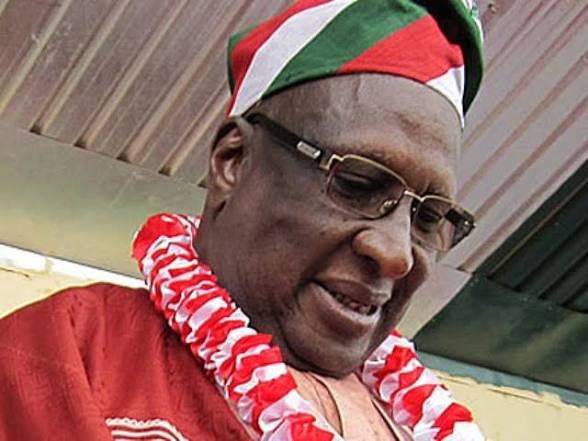
The news broke on Saturday, September 12, 2026, from his residence on Adetokunbo Ademola Street in Wuse 2, Abuja, where the patriarch had drawn his last breath at approximately noon. Just three days shy of his 91st birthday, Alhaji Bamanga Mohammed Tukur, the Tafidan Adamawa, had returned to his Creator. His son, Honourable Awwal Tukur, the Secretary to the Adamawa State Government, confirmed the passing in a statement issued on behalf of the family, expressing profound sadness and total submission to the will of Almighty Allah. "Alhaji Bamanga Tukur lived a distinguished life of service to his family, community, Adamawa State and Nigeria," the family said. "His wisdom, generosity and commitment to the development of our nation touched countless lives, and his legacy will endure for generations." It was a death that, while not unexpected given his prolonged illness, still landed with the weight of a national loss.
From the dusty administrative offices of the Nigerian Ports Authority in the 1970s to the rarefied chambers of the Peoples Democratic Party's national secretariat and the global stages of pan-African business, Tukur lived a life that seemed to span several eras of Nigeria's turbulent history. Born on September 15, 1935, in present-day Adamawa State, he first rose to national prominence as General Manager and Chief Executive of the NPA between 1975 and 1982. His tenure coincided with a period of massive port congestion, yet he was credited with efforts to expand capacity and modernise the nation's maritime infrastructure, laying the groundwork for the ports that serve Nigeria today. He then made the leap into partisan politics, contesting and winning the governorship of the old Gongola State in 1983 on the platform of the National Party of Nigeria. His tenure, however, proved to be one of the shortest in Nigerian history. Barely three months after he assumed office in October 1983, the military coup of December 31, 1983, brought the Second Republic crashing down, and with it, his administration.
But Tukur was far from finished. When the military regimes gave way to a new democratic experiment, he returned to the political fray, seeking the presidency on the platform of the defunct National Republican Convention during the botched Third Republic. He later served as Minister of Industries under General Sani Abacha between 1993 and 1995, adding a federal cabinet role to a career that had already included leadership of the NPA and a state government. His most consequential political chapter, however, was still to come. In March 2012, Tukur was elected National Chairman of the Peoples Democratic Party, the ruling party at the time. His tenure was marked by significant political tensions, but the family noted that his leadership brought "sanity, progress, electoral victories and political decorum" to the party. He resigned in January 2014, leaving behind a complex legacy of institutional contributions and internal party battles.
Beyond politics, Tukur was a formidable force in the private sector. He founded BHI Holdings and the DADDO Group of Companies, with interests spanning manufacturing, agriculture, logistics and trading. His influence extended far beyond Nigeria's borders. He served as Executive President of the African Business Roundtable, Chairman of the NEPAD Business Group, and became the first African Vice-President of the International Association of Ports and Harbours. He also made history as the first African to address the United Nations General Assembly as a private individual, not as a head of state. Such was his stature that his home state held him in the highest regard, conferring on him the traditional title of Tafidan Adamawa, a position of immense cultural significance.
The tributes poured in from the highest echelons of power as news of his death spread. President Bola Ahmed Tinubu, in a condolence message issued by his Special Adviser on Information and Strategy, Bayo Onanuga, described Tukur as a "towering figure whose career spanned public administration, governance, business, politics and pan-African economic leadership." The President said Tukur was "urbane, generous and deeply rooted in the values of integrity and service that the Adamawa Emirate and the nation hold dear," adding that "Nigeria will sorely miss his wise counsel and fatherly guidance." Adamawa State Governor, Ahmadu Fintiri, declared three days of mourning across the state, directing that government flags be flown at half-mast. He described the death as a "monumental loss" and a "colossal" one, noting that he would personally miss Tukur's wise counsel and extensive experience. The Northern States Governors' Forum, the PDP, and former Senate President Bukola Saraki also joined the chorus of mourning, with Saraki describing Tukur as a man who "lived a distinguished life of service." The PDP called his death an "irreplaceable loss" to the party and the nation.
Tukur is survived by two wives and 18 children, including Awwal, and a legacy that stretches from the ports of Lagos to the highest levels of Nigeria's political and business establishment. His remains were flown to Yola, where he was laid to rest on Sunday, September 13, at the Lamido's Palace in accordance with Islamic rites. In a nation often defined by its fractures, Tukur's life served as a reminder of the possibilities of service across different epochs. As his family, the people of Adamawa, and the political and business communities across Nigeria and Africa mourn, the question that lingers is not just who will fill the void he leaves behind, but whether the values of integrity, diligence, and pan-African vision that defined his career will survive in the generations that follow.
📩 Stone Reporters News | 🌍 stonereportersnews.com
✉️ info@stonereportersnews.com | 📘 Facebook: Stone Reporters News | 🐦 X (Twitter): @StoneReportNew | 📸 Instagram: @stonereportersnews
Add comment
Comments