

Reported by: Oahimire Omone Precious | Edited by: Oravbiere Osayomore Promise.
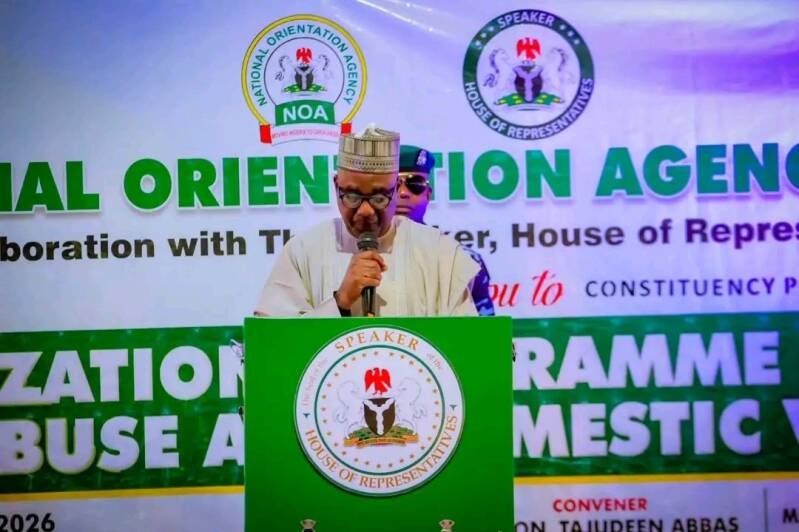
The Speaker of the House of Representatives, Abbas Tajudeen, has issued a direct and uncompromising call for a dual-track approach to Nigeria's drug crisis: dealers must face the full weight of the law, while people trapped in addiction must be treated with compassion, care and support. Abbas made the declaration in Kaduna on Saturday, September 12, 2026, at the conclusion of a three-day sensitisation programme on drug abuse and domestic violence organised in collaboration with the National Orientation Agency. The programme, which brought together community leaders, parents, educators and civil society stakeholders, was designed to confront two of the most intractable social crises facing Nigeria today, and the Speaker's intervention signalled that the legislative branch of government intends to play a more aggressive role in addressing both.
The core of Abbas's message was a careful distinction between the criminal and the victim. Drug pushers, he said, must face the full weight of the law. But people trapped in addiction need care, treatment and support to help them recover. The distinction is not a matter of semantics. It goes to the heart of how Nigeria has historically approached drug abuse, often treating addicts as criminals to be punished rather than patients to be treated. The Speaker's position reflects a growing consensus among public health experts, law enforcement officials and civil society organisations that the war on drugs cannot be won through incarceration alone. If addicts are not treated, they will return to the streets, and if dealers are not punished, the supply will continue to flow. Both halves of the equation must be addressed simultaneously.
Abbas then turned his attention to what he described as the direct link between drug abuse and Nigeria's escalating insecurity crisis. Proceeds from drug trafficking, he said, can provide criminals with funds for weapons and recruitment. The argument is not theoretical. Nigeria's security agencies have repeatedly identified the nexus between the illicit drug trade and the proliferation of small arms and light weapons across the country. The National Drug Law Enforcement Agency has documented the use of drug proceeds to purchase weapons, and the violent criminality that has engulfed parts of the North-West and North-Central regions is fuelled in part by the financial resources that the drug trade generates. In the Niger Delta, the proceeds from oil theft and drug trafficking are often intertwined, creating criminal economies that are both resilient and self-sustaining.
The Speaker's decision to hold the sensitisation programme in Kaduna, a state that has experienced its share of both drug-related crime and domestic violence, was significant. Kaduna has become a microcosm of the broader crisis. In recent months, the state has seen the killing of a political commentator, the abduction of schoolchildren, and the killing of a 17-year-old in Barkin Ladi. The drug trade has fuelled much of this violence, providing both the financial resources and the addictive substances that keep criminal networks operational. Communities in the state have also been subjected to waves of kidnapping, banditry and communal violence, all of which are exacerbated by the availability of drugs and the impunity with which dealers operate.
Abbas also addressed the issue of domestic violence, describing it as abuse rather than discipline or culture. His framing was deliberate and pointed. In many Nigerian communities, domestic violence is often excused as a private family matter, a form of discipline, or a cultural practice. The Speaker rejected all three justifications, insisting that violence within the home is a crime that demands the same level of enforcement and accountability as violence on the streets. He pledged to strengthen laws, support enforcement and treatment, and use parliamentary oversight to demand results in the fight against drug abuse and violence. The legislative branch, he said, would no longer be a passive observer. It would use its power of oversight to hold agencies accountable, to demand progress, and to ensure that the laws passed by the National Assembly were actually implemented.
The theme of community involvement was central to Abbas's address. Prevention, he said, must begin with information and involve parents, schools and communities. "No family is immune," he said, urging communities to reject silence around addiction and domestic violence. The call for community engagement reflects a recognition that the state cannot solve these problems alone. The police cannot be in every home. The courts cannot adjudicate every dispute. The NDLEA cannot monitor every street corner. Only communities, mobilised and informed, can create the kind of environment where addiction is addressed early, where domestic violence is reported rather than hidden, and where drug dealers are exposed rather than protected.
The programme was organised in collaboration with the National Orientation Agency, which has been at the forefront of the government's efforts to combat drug abuse and promote social values. The agency's involvement reflects a broader strategy of prevention through education, using its network across the country's 774 local government areas to reach communities with messages about the dangers of drug abuse and the importance of peaceful coexistence. The partnership between the National Assembly and the NOA is a positive development, but it also raises questions about resources and sustainability. Sensitisation programmes are valuable, but they cannot replace the sustained investment in law enforcement, treatment facilities, rehabilitation centres and social support services that are required to address the drug crisis at its roots.
As the 2027 elections approach, drug abuse and insecurity are likely to emerge as defining political issues. Politicians across the spectrum will be pressed to articulate their plans for addressing both. Abbas's intervention sets a marker for the ruling party's approach: enforcement against dealers, compassion for addicts, and a recognition that the drug trade is not merely a public health crisis but a national security threat. The question now is whether his words will be matched by action. Will the House of Representatives strengthen the laws governing drug offences and domestic violence? Will it provide the oversight and funding required to treat addiction as a health issue rather than a criminal justice problem? Will the agencies tasked with enforcement be held accountable for results? The Speaker has promised to use parliamentary oversight to demand results. The coming months will reveal whether that promise is kept. For the millions of Nigerians who have been affected by drug abuse and domestic violence, the stakes could not be higher.
📩 Stone Reporters News | 🌍 stonereportersnews.com
✉️ info@stonereportersnews.com | 📘 Facebook: Stone Reporters News | 🐦 X (Twitter): @StoneReportNew | 📸 Instagram: @stonereportersnews
Add comment
Comments