

Reported by: Ijeoma G | Edited by: Oravbiere Osayomore Promise.
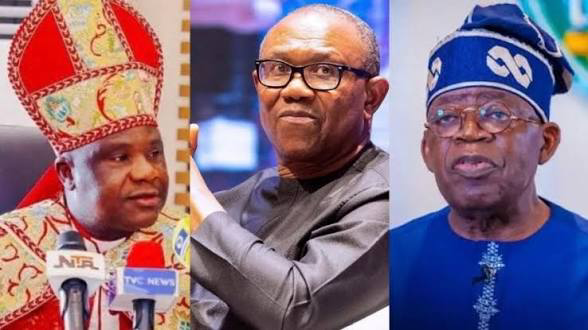
Archbishop Leonard Bature Kawas has publicly defended his decision to support President Bola Ahmed Tinubu, pushing back against critics who have labelled him a fake for switching his political allegiance from Peter Obi to the ruling All Progressives Congress. In an interview on Arise News on Sunday, September 13, 2026, the cleric recounted his political journey, insisting that his support for candidates has always been driven by conviction rather than financial inducement, and that the accusations of fakery are hypocritical and unfair.
"When I was supporting Peter Obi initially, he never gave me one naira. Now that I am supporting Tinubu, people are calling me fake," Kawas said, visibly frustrated. He explained that during the 2023 election cycle, he travelled across Nigeria to support Obi's presidential ambition, often funding his own trips and those of other clergymen who accompanied him. "He would just see me at the campaign. We would pray for him. I would pay the transportation of six clergymen. We would come there and support him. He never asked me, 'How did I come? Which hotel did I sleep?' Yet I did it, and nobody called me fake," he said. Kawas said he would attend Obi's campaign events, pray for him and support his ambition without ever being asked how he funded his trips or where he stayed.
The cleric also recalled his support for former President Goodluck Jonathan, saying he was involved in Jonathan's political journey from his days as Bayelsa State Deputy Governor and later served on his Presidential Campaign Council. "I was the only bishop in Goodluck Jonathan's presidential campaign council. And I took campaign everywhere. Nobody called me fake," he added. He questioned why his decision to support Tinubu should now make people label him as fake. "Is it now, because I have prayed and God has led me that it is Tinubu, that I suddenly now become fake?" he asked. His remarks came days after the Charismatic Bishops Conference of Nigeria, which he leads as President-General, formally endorsed Tinubu for re-election in 2027, declaring that the conference would stand with him "even beyond 2027."
The endorsement, announced at the 2026 International Synod of Charismatic Archbishops, Bishops and Apostles in Abuja, drew sharp criticism from opposition figures and civil society groups. Human rights activist Deji Adeyanju condemned what he described as the renewed patronage of churches by politicians, accusing governors of gathering clerics to endorse Tinubu. Others questioned the propriety of religious leaders using their pulpits to campaign for political candidates, arguing that it blurs the line between faith and partisan politics. Kawas's appearance on Arise News was intended to address those criticisms, but his defence has instead reignited the debate over the role of religious leaders in Nigeria's electoral process.
The Archbishop's political journey is not unusual in Nigeria, where religious leaders often align themselves with political candidates and parties, sometimes shifting allegiances as the political landscape changes. What sets Kawas apart is his willingness to publicly acknowledge the financial sacrifices he made in support of his previous political choices, and his insistence that his current support for Tinubu is equally sincere. The argument he makes is essentially one of consistency: he supported Obi and Jonathan without receiving financial benefits, and he is now supporting Tinubu for the same reasons of conviction. If his critics did not question his motives then, he asks, why are they questioning them now?
But the question of motive is not the only issue at stake. Critics of religious leaders in politics argue that the problem is not whether a cleric receives money from a politician, but whether the cleric's endorsement compromises the independence of the church and the trust of its members. When a bishop endorses a candidate, his followers may feel pressured to support that candidate, regardless of their own political preferences. The church, which is supposed to be a sanctuary for all, becomes a campaign platform for one party. And the cleric, who is supposed to speak truth to power regardless of who holds it, becomes an ally of power rather than a check on it.
Kawas's defence also raises questions about the nature of political support in Nigeria. If a cleric can support a candidate without receiving money, does that make the support more legitimate? Or does it simply mean that the support is driven by other factors, such as ideological alignment, personal relationships, or political calculation? The Archbishop did not say why he shifted his support from Obi to Tinubu. He said God led him, but he did not elaborate on what that divine guidance entailed or how he discerned it. His critics may accept his explanation, or they may not.
What is clear is that Kawas has no intention of backing down. He has endorsed Tinubu for 2027, and he has done so publicly and repeatedly. The Charismatic Bishops Conference, which he leads, has declared its support for the President's re-election. And the cleric has made it clear that he will not be shamed into silence by accusations of fakery. His message to his critics is simple: judge me by my consistency, not by your political preferences. Whether that message resonates with Nigerians will depend on how they view the relationship between faith, politics, and power in a country where the lines between the three have never been clear.
As the 2027 elections approach, the debate over religious leaders and political endorsements is likely to intensify. Kawas's intervention ensures that he will be at the centre of that debate. Whether he is seen as a principled cleric who follows his convictions or a political opportunist who trades spiritual authority for political influence will depend on the perspective of the observer. What is certain is that he has forced Nigerians to confront uncomfortable questions about the role of the church in politics, the meaning of political support, and the accountability of those who claim to speak for God in the public square.
📩 Stone Reporters News | 🌍 stonereportersnews.com
✉️ info@stonereportersnews.com | 📘 Facebook: Stone Reporters News | 🐦 X (Twitter): @StoneReportNew | 📸 Instagram: @stonereportersnews
Add comment
Comments