

Reported by: Ijeoma G | Edited by: Oravbiere Osayomore Promise.
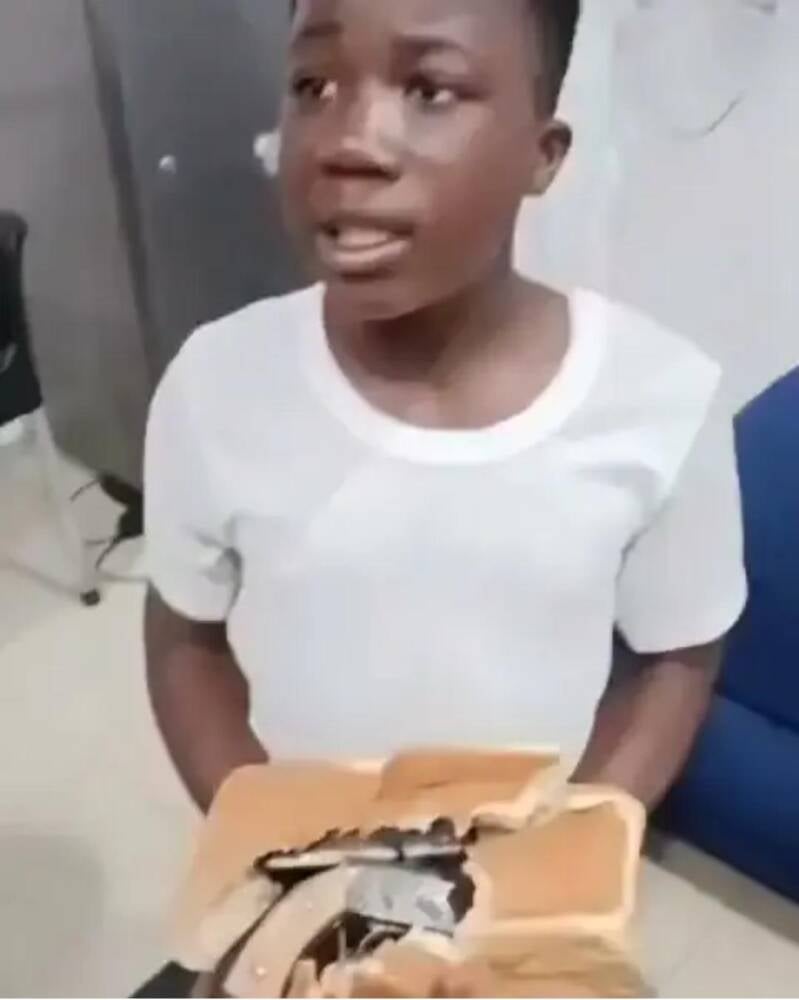
A chilling video circulating on social media has exposed the alarming ease with which criminal networks are recruiting minors as couriers in Nigeria's commercial capital. A 15-year-old boy living in the Mushin area of Lagos State was caught carrying a firearm concealed inside a loaf of bread. The boy, whose identity has been withheld due to his age, was intercepted by vigilant residents or security personnel who became suspicious of his movements. When searched, the loaf of bread he was carrying revealed a hidden compartment containing a gun.
During interrogation, the boy told his captors that his friend, identified only as Samuel, had given him the package and instructed him to deliver it to Oshodi Terminal 1, where an unidentified person was supposed to collect it. The boy appeared confused and frightened, suggesting that he may not have fully understood the gravity of what he was carrying or the danger he was in. His account raises troubling questions about the recruitment of minors into criminal activities, particularly the transportation of illicit weapons and other contraband.
The incident highlights a growing and deeply disturbing trend in Lagos and across Nigeria: the use of children as couriers by criminal syndicates. These syndicates exploit the vulnerability of minors, often luring them with small amounts of money or false promises, and use them to move guns, drugs, and other illegal items across the city. Because children are less likely to be suspected by security agents, they have become valuable assets in the underground economy of crime. They are pawns in a deadly game, and their involvement often goes unnoticed until it is too late.
The concealment of a gun inside a loaf of bread is a stark reminder of the ingenuity of criminal networks. It also underscores the challenges facing law enforcement agencies in detecting and intercepting these operations. Traditional methods of policing are increasingly inadequate in the face of adaptive criminal tactics. The use of children as couriers is particularly insidious because it preys on the most vulnerable members of society, robbing them of their childhood and exposing them to extreme danger.
What makes this case even more disturbing is the involvement of the boy's "friend Samuel." Who is Samuel? Is he an adult manipulating a child for criminal purposes, or a peer who was himself recruited into the criminal underworld? The answers to these questions matter, not just for this case but for the broader fight against criminality in Lagos. If Samuel is an adult, he represents the sophisticated predators who deliberately target children. If Samuel is a minor, he represents the tragic cycle of exploitation, where victims become perpetrators. Both scenarios demand urgent attention.
The boy's interrogation also raises questions about whether he understood what he was carrying. Did he know there was a gun inside the bread? Or was he told it was something else? The psychological manipulation of children in criminal networks is a key weapon in the syndicates' arsenal. They use confusion, fear, and dependency to control their young couriers. Many of these children come from broken homes, impoverished backgrounds, and unstable environments. They are easy prey for anyone offering money, attention, or a sense of belonging. This is not an excuse for criminal behaviour, but it is an explanation that demands a response rooted in prevention and protection.
The police have yet to issue an official statement on the incident, and there is no indication of whether Samuel has been identified or arrested. The gun has been recovered, but the broader network that it was intended to serve remains largely intact. The boy is now in custody, but questions remain about what will happen to him. Will he be prosecuted as an adult? Will he be treated as a victim of child trafficking? Will he be given counselling and rehabilitation, or will he be forgotten in the system? These are not abstract questions. They will determine whether this child becomes a statistic or has a chance to rebuild his life.
The Mushin incident is a microcosm of a much larger problem. Lagos, like many Nigerian cities, is grappling with a surge in violent crime, much of it driven by armed robbery, kidnapping, and drug trafficking. Criminal syndicates are constantly evolving, and they are increasingly targeting young people to carry out their dirty work. According to the National Bureau of Statistics, Lagos recorded thousands of reported cases of armed robbery and kidnapping in recent years, and many of those cases involved young perpetrators or couriers. The recruitment of minors is a logical extension of a system that has failed to provide opportunities for young people and has allowed criminality to flourish in the shadows.
The role of community vigilance cannot be overstated. In this case, it was alert residents or security personnel who intercepted the boy before he could complete his mission. Their intervention may have prevented a violent crime. It may have saved lives. But community vigilance alone is not enough. The government must take decisive action to disrupt the recruitment pipeline that draws children into criminal networks. This requires more than just arrests. It requires investment in youth programmes, education, and job creation. It requires strengthening the social safety net so that children are not forced to choose between poverty and crime. And it requires holding the recruiters accountable with the full weight of the law.
For now, the 15-year-old boy from Mushin is in custody. His story is a warning. It tells us that our children are being targeted. It tells us that the criminals are not just in the shadows; they are in our neighbourhoods, in our schools, and sometimes in our homes. It tells us that the fight against crime must also be a fight for the soul of our youth. The question is whether we will listen before it is too late.
📩 Stone Reporters News | 🌍 stonereportersnews.com
✉️ info@stonereportersnews.com | 📘 Facebook: Stone Reporters News | 🐦 X (Twitter): @StoneReportNew | 📸 Instagram: @stonereportersnews
Add comment
Comments