

Reported by: Ijeoma G | Edited by: L. Stone
The National Publicity Secretary of the All Progressives Congress, Felix Morka, has criticised former Vice-President Atiku Abubakar over his recent call for President Bola Ahmed Tinubu to reduce petrol prices and take further measures to ease the economic burden on Nigerians.
Morka said Atiku, who is the presidential candidate of the African Democratic Congress, should present his own policy programme to Nigerians instead of asking the Tinubu administration to implement proposals that he believes could reduce the cost of living.
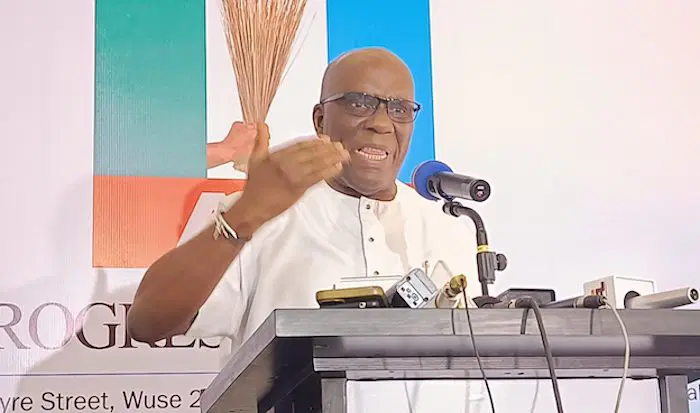
The APC spokesman made the remarks during an appearance on Channels Television’s Politics Today on Friday, September 18, 2026, after Atiku addressed a press conference in Abuja where he called for government intervention to reduce petrol prices.
Atiku had argued that the government should prioritise policies capable of lowering the cost of living regardless of who originally proposed them. He said the administration should be willing to adopt a sensible proposal even when it comes from a political opponent.
“A sensible idea does not become a bad idea because it came from your opponent,” Atiku said during the briefing, according to reports of his remarks.
Morka rejected Atiku’s approach, arguing that the former vice-president was seeking the presidency and should therefore explain to Nigerians what he would do differently if elected.
“The last I checked, the former Vice President is a candidate of a political party for the office of president. He should be telling Nigerians exactly what he plans to do to improve the lives of Nigerians,” Morka said.
The APC spokesman further argued that Atiku had not presented what he considered a clear alternative to the economic policies introduced by the Tinubu administration.
“Asking Mr President to listen to him, he is neither here nor there, he is simply just pulling his own political stunts,” Morka said.
He added that Atiku had not articulated what he described as a sensible policy proposal that could serve as an alternative to the measures being implemented by the current administration.
Morka’s comments came amid a growing political debate over petrol prices and the wider consequences of Nigeria’s economic reforms. Atiku has repeatedly criticised the effects of the removal of the petrol subsidy and argued that the government should introduce measures that provide greater relief to households, businesses and productive sectors.
During his Abuja press conference, the former vice-president called on Tinubu to use the remaining period of his administration to reduce petrol prices. He argued that high energy and transportation costs were contributing to financial pressure on Nigerians and increasing operating expenses for businesses.
Atiku also offered to make his policy framework available to the Federal Government, saying that the administration could implement any proposal capable of reducing the burden on citizens regardless of its political source.
The disagreement extends beyond petrol prices. Atiku also raised concerns about the planned phase-out of electricity subsidies from 2027, warning that households, small businesses and manufacturers were already struggling with high electricity costs and expenses associated with diesel and alternative power supplies.
He argued that the government should consider the consequences of removing another major form of support before proceeding with changes to electricity subsidies.
Morka challenged Atiku’s position by referring to the former vice-president’s experience in government, particularly his period as Vice-President under President Olusegun Obasanjo. The APC spokesman questioned why Atiku was now proposing solutions to Nigeria’s electricity challenges after having previously served in government.
According to Morka, Atiku had an opportunity to influence policies addressing the country’s power sector while he was in office and should therefore explain what was achieved during that period.
The exchange reflects a wider disagreement between the governing APC and Atiku’s ADC over the direction of Nigeria’s economic policy ahead of the 2027 general election.
Atiku has increasingly placed economic hardship, energy prices and the cost of living at the centre of his criticism of the Tinubu administration. His position is that government policy should focus more directly on reducing the financial pressure facing ordinary Nigerians and productive sectors.
The APC, meanwhile, has defended the Tinubu administration’s reform programme and has continued to challenge opposition figures to provide detailed alternatives rather than simply criticising existing policies.
Morka’s latest comments also revive an argument that has featured prominently in the political debate since the removal of the petrol subsidy in 2023: whether opposition politicians who supported or advocated reform measures during the previous election cycle should now criticise their implementation by the current administration.
The APC spokesman accused Atiku of supporting petrol subsidy removal during the 2023 presidential campaign before subsequently criticising the policy after Tinubu assumed office and implemented it. That claim concerns Atiku’s previously stated position and has become part of the political dispute over responsibility for Nigeria’s fuel-pricing policy.
The broader policy question remains how Nigeria should balance market-oriented reforms with measures designed to protect households and businesses from sudden increases in the cost of essential goods and services.
The Tinubu administration has maintained its commitment to economic reforms, while opposition politicians have continued to argue that the social and economic consequences require stronger intervention.
The latest disagreement therefore combines competing approaches to economic management with the emerging political contest ahead of 2027. Atiku is positioning himself as an alternative to the current administration, while the APC is challenging him to provide detailed policies that demonstrate how his approach would differ from that of the Tinubu government.
For Nigerians following the debate, the competing positions centre on several substantive questions: the appropriate level of government intervention in petrol pricing, the future of electricity subsidies, the management of energy costs and the extent to which government should provide direct relief to households and businesses.
Morka's criticism does not resolve those policy questions but reflects the APC’s position that Atiku should present a detailed alternative programme rather than primarily calling on the incumbent government to adopt his recommendations.
Atiku, for his part, has maintained that the immediate priority should be policies that reduce the cost of living and that the government should be prepared to adopt workable proposals regardless of their political origin.
Stone Reporters correspondent reports that the exchange is part of the broader political debate expected to intensify as Nigeria moves towards the 2027 presidential election, with economic management, energy prices and the effects of reforms likely to remain central issues for the major political parties and their candidates.
📩 Stone Reporters News | 🌍 stonereportersnews.com
✉️ info@stonereportersnews.com | 📘 Facebook: Stone Reporters News | 🐦 X (Twitter): @StoneReportNew | 📸 Instagram: @stonereportersnews
Add comment
Comments