

Reported by: Ijeoma G | Edited by: Oravbiere Osayomore Promise.
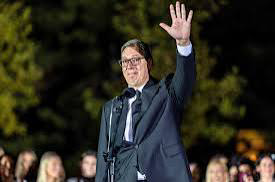
Belgrade woke up on Monday to a country without a president. Aleksandar Vučić, the man who has dominated Serbian politics for more than a decade, signed and submitted his resignation on Sunday evening, September 27, 2026, ending a presidency that began in 2017 and was set to run until May next year. The decision, announced from the presidential palace in Belgrade before a crowd of chanting supporters, was framed by Vučić as a strategic move to lead his Serbian Progressive Party into snap parliamentary elections on October 25 as an ordinary citizen. But the timing and the manner of his departure laid bare a calculated attempt to retain power while appearing to concede to the demands of a protest movement that has shaken his rule for nearly two years.
The resignation was not the only act of the day. Minutes before formally stepping down, Vučić used his constitutional powers to pardon 49 people, including 23 individuals linked to the protests that have swept Serbia since November 2024. Among those pardoned were students, party loyalists, and members of the so-called "Novi Sad group," including its prominent figure Mila Pajić, as well as 11 individuals prosecuted for attacking protesters. Vučić acknowledged that security services had opposed the decision, but he proceeded anyway. The pardons were announced with the same breath as the resignation, a parting gift to those who had stood by him and a calculated move to defuse some of the anger that has fuelled the demonstrations.
The protests that led to this moment were ignited by a tragedy that became a symbol of everything the demonstrators believe is wrong with Serbia. On November 1, 2024, a canopy collapsed at the newly renovated railway station in Novi Sad, killing 16 people. The station renovation had been a flagship project of Vučić's government, a symbol of progress that instead became a monument to corruption and mismanagement. University students demanded accountability. Their demands for a transparent investigation evolved into calls for early elections, and the movement grew to include teachers, workers, and farmers. At their peak, the protests drew hundreds of thousands into the streets, the largest since the fall of Slobodan Milošević in 2000.
For nearly two years, Vučić resisted the calls for early elections, promising them repeatedly without setting a date. The pressure mounted. A series of resignations by officials failed to placate the protesters. Accusations of police brutality during demonstrations only deepened the anger. By September 2026, with his second presidential term nearing its end and the constitution barring him from a third, Vučić faced a choice: exit politics entirely or find a new avenue to power. He chose the latter. He called the snap parliamentary election for October 25, citing "major turbulence on the domestic political scene," and announced he would run for prime minister, a position that is formally more powerful than the presidency in Serbia's political system.
The decision to resign the presidency while running for prime minister was not constitutionally necessary. Vučić could have remained president while campaigning. His choice to step down was widely interpreted as an attempt to consolidate his authority in the office that matters most for day-to-day governance. The presidency is a largely ceremonial role in Serbia, while the prime minister wields executive power. By becoming prime minister, Vučić would control the government apparatus, the ministries, and the security services. The move also allowed him to present himself as a man of the people, unburdened by the trappings of high office. "I want to compete as an ordinary man, as one of the people," he said. The reality was more strategic than humble.
The political landscape he leaves behind is fractured and tense. Under the constitution, the speaker of the National Assembly, Ana Brnabić, a close Vučić ally and former prime minister, has assumed the role of acting president for up to three months. During that period, a presidential election must be called. This means Serbians will go to the polls twice before the end of the year: once for the parliamentary election on October 25, and again for the presidential election at a date to be determined. Brnabić, who has been a loyal lieutenant throughout Vučić's tenure, will hold the presidency in the interim, ensuring that the levers of state remain within the Progressive Party's orbit.
The October election will pit Vučić's Progressive Party against a student-led movement called "Students Win" and a coalition of pro-Western opposition parties known as "European Serbia". The students who led the protests have transformed their movement into a political force, channeling the energy of the streets into an electoral challenge. Their demands are straightforward: accountability for the Novi Sad tragedy, an end to corruption, and a government that serves the people rather than a narrow political elite. Whether they can translate the momentum of protest into votes remains to be seen. Vučić, for his part, has spent recent weeks touring the country, opening roads, offering financial assistance, and visiting voters in their homes, all with the extensive coverage of pro-government media.
International observers will be watching closely. Vučić has been accused of eroding democratic freedoms, controlling the media, and allowing organised crime to flourish with impunity. His opponents describe him as a populist who has consolidated power by dismantling the institutions meant to hold him accountable. His supporters see him as a stabilising force in a turbulent region. The truth, as is often the case, lies somewhere in between, but the direction Serbia takes after October will depend on whether the opposition can overcome its divisions and present a credible alternative.
The man who resigned the presidency on Sunday did not leave the stage. He simply moved to a different part of it. The pardons he issued hours before stepping down were a reminder that power, even when relinquished, can be wielded in ways that shape the future. The 49 people who walked free, some of them students who had taken to the streets to demand accountability, will carry with them the memory of a president who gave them liberty even as he sought to retain power. Whether that gesture will be seen as mercy or manipulation is for the Serbian people to decide. They will have their say on October 25, and again when the presidential election comes. For now, the man who has been the face of Serbia for more than a decade has signed a piece of paper, handed his duties to a trusted ally, and turned his gaze toward the prime minister's office. The protests that brought him to this point have not ended. They have simply entered a new phase, and the outcome is anything but certain.
📩 Stone Reporters News | 🌍 stonereportersnews.com
✉️ info@stonereportersnews.com | 📘 Facebook: Stone Reporters News | 🐦 X (Twitter): @StoneReportNew | 📸 Instagram: @stonereportersnews
Add comment
Comments