

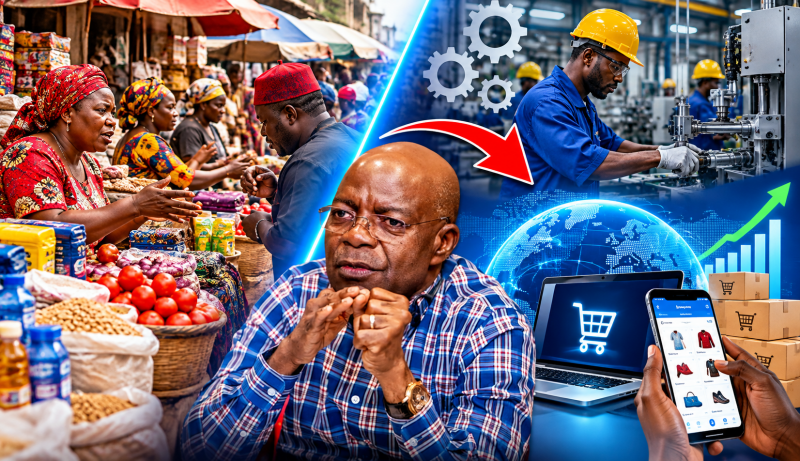
Abia State Governor Alex Otti has urged Igbo entrepreneurs to move beyond dependence on conventional trading and build stronger businesses in manufacturing, technology and digital commerce, arguing that changing global competition requires a new economic strategy rather than concentrating solely on traditional markets.
Otti made the remarks on Monday, September 28, 2026, at the Michael Okpara Auditorium in Umuahia during the Igbo Day Lecture and Dinner organised by Ohanaeze Ndigbo Worldwide. The event was held under the theme, “The Igbo Charter and Development of Ala Igbo.”
His comments followed concerns raised about the growing presence of Chinese traders in retail businesses in Lagos and the competition this has created for Nigerian entrepreneurs, including Igbo traders who have traditionally maintained a significant presence in the city’s commercial markets.
Rather than treating Chinese participation in retail trade solely as a threat, Otti argued that Igbo businesses should reposition themselves further along the economic value chain by manufacturing goods and using technology to reach consumers.
“We are leaving that place of trading. In Abia, we have markets; the markets are important. But we are moving from the market to manufacturing,” Otti said.
The governor said his administration was supporting manufacturing while simultaneously promoting digital methods of conducting business. His argument was that physical markets would remain relevant but should no longer represent the limit of commercial ambition for entrepreneurs in Abia and the wider South-East.
Otti pointed to digital commerce as another area where businesses could expand their reach beyond traditional shops and markets. He referenced Alibaba, the Chinese multinational e-commerce company, while explaining the kind of technology-driven commercial model he believes businesses should increasingly embrace.
“We are driving digital delivery. We are leaving that physical store for digital delivery. So, when somebody talked about Alibaba, that’s exactly where we are headed,” he said.
His remarks are particularly significant against the background of recent concerns among traders in Lagos about Chinese nationals participating directly in retail commerce.
Earlier in September, reports emerged of protests by some Igbo traders at the Lagos International Trade Fair Complex over competition from Chinese businesses. Protesters complained that some Chinese operators were selling products directly in the local market at prices Nigerian traders found difficult to match.
Some of the traders argued that Chinese businesses benefit from direct connections with manufacturers and supply chains while Nigerian traders face costs ranging from transportation and customs duties to shop rents, taxes and other operating expenses.
The controversy reflects a wider economic challenge. Nigerian businesses importing finished products can find themselves competing against companies or traders with direct access to the factories producing those same goods.
Otti’s proposed response is essentially to reduce dependence on that model.
“So, why are the Chinese coming to compete with us? We are moving away from there. And it’s going to start in Abia,” the governor said.
He explained that he did not envisage the abandonment of commerce altogether. Instead, he described a model combining production with trading while moving an increasing share of commercial activity online.
“Abia is both manufacturing and then trading. But we are moving from conventional trading to digital trading. That is where the world is going. You either embrace it, or you risk being left behind,” Otti said.
The distinction is important because Igbo entrepreneurship has historically developed strong networks in wholesale and retail trade across Nigeria and elsewhere in Africa. Markets in Lagos, Aba, Onitsha and other commercial centres have become important distribution points for imported and locally produced goods.
Moving towards manufacturing would mean entrepreneurs increasingly producing some of the goods they currently import or distribute, potentially allowing businesses to exercise greater control over production, supply and pricing.
Such a transition, however, involves challenges beyond the decisions of individual traders. Manufacturing depends on access to electricity, finance, industrial land, transportation, technology, skilled labour and predictable government policies.
Abia has particular economic importance in that discussion because Aba is one of Nigeria’s best-known manufacturing and commercial centres. The city has long been associated with locally made footwear, clothing, leather products and other goods produced by small and medium-sized enterprises.
Otti’s administration has consequently sought to present industrial development and infrastructure improvements as central parts of its economic programme.
The governor also linked manufacturing to investment in technology skills. He said Abia was training young people through its TechRise programme and claimed that some beneficiaries were already working remotely from Aba for international technology companies.
That approach suggests Otti sees the future of the state’s economy as involving both physical production and digital services rather than manufacturing alone.
The Igbo Day event at which he spoke was organised by Ohanaeze Ndigbo Worldwide, the apex Igbo socio-cultural organisation. Its 2026 theme focused on an “Igbo Charter” and the development of Ala Igbo, providing a platform for discussions about economic development, political cooperation and the future of the South-East.
Otti also endorsed the celebration’s broader message of “Njikọ Ka,” translated as “Unity is Supreme,” saying unity remained important to the development of the region.
His comments do not mean conventional trading is disappearing from Abia or that traders are being directed to abandon their existing businesses. Rather, Otti presented manufacturing and digital commerce as areas into which entrepreneurs should increasingly expand.
For traders facing stronger foreign competition, that distinction matters. The governor’s argument is that competing only at the retail end of the supply chain leaves businesses vulnerable when foreign manufacturers or their representatives can enter the same market with lower prices.
Moving into production could create additional opportunities for local value addition and employment, although achieving that transformation would also require an environment in which Nigerian manufacturers can operate competitively.
Otti’s remarks therefore shift the discussion away from simply asking how Nigerian traders can prevent Chinese competitors from entering their traditional commercial spaces. His proposed alternative is to ask how Igbo entrepreneurs can become producers, technology-driven businesses and international competitors themselves.
The message from Umuahia was ultimately one of economic adaptation: markets and trading remain important, but Otti believes manufacturing and digital commerce should occupy a much larger place in the future of Igbo enterprise.
📩 Stone Reporters News | 🌍 stonereportersnews.com
✉️ info@stonereportersnews.com | 📘 Facebook: Stone Reporters News | 🐦 X (Twitter): @StoneReportNew | 📸 Instagram: @stonereportersnews
Add comment
Comments