

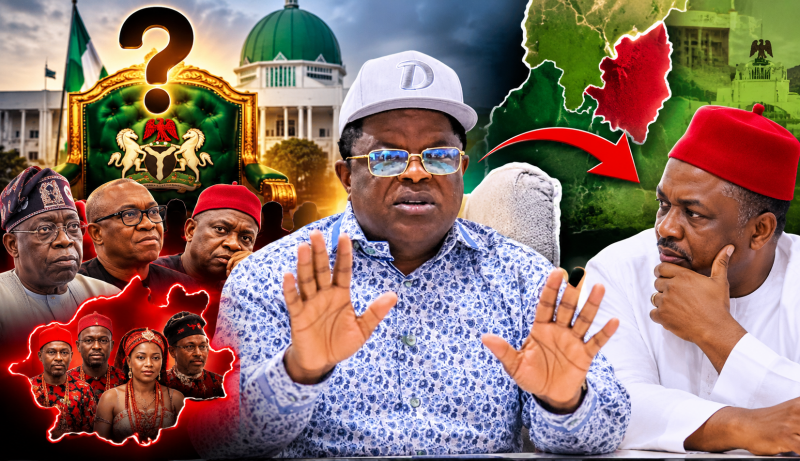
Nigeria’s Minister of Works, David Umahi, has extended his argument that it is not yet the South-East’s turn to produce Nigeria’s president to the politics of his home state, saying Ebonyi South should similarly wait before producing another governor and announcing plans to persuade opposition politician Ifeanyi Chukwuma Odii to step down from the 2027 governorship contest.
Umahi made the latest remarks on Tuesday, September 29, 2026, while addressing political stakeholders from the Ohaozara, Onicha and Ivo Federal Constituency at Osborne Hotel in Uburu, Ohaozara Local Government Area of Ebonyi State. The former governor argued that existing political rotation arrangements should be respected as Nigeria and Ebonyi move towards the 2027 general elections.
Odii, popularly known as Anyi Chuks, is from Ebonyi South and was the Peoples Democratic Party governorship candidate in the 2023 election. Umahi, who is also from Ebonyi South, governed the state for eight years between 2015 and 2023 before Francis Nwifuru, from Ebonyi North, succeeded him.
Umahi told the gathering that he intended to personally speak with Odii about his political ambition. “I will be the one to go and talk to the governorship candidate of the Peoples Democratic Party, PDP, Ifeanyi Odii,” he said, according to a report of the meeting.
He linked the proposed intervention directly to his argument about political rotation. According to Umahi, the same principle behind his opposition to a South-East presidential bid in 2027 should apply to politicians seeking the Ebonyi governorship from the southern senatorial district.
“When I say it is not the turn of the South-East to produce the President, I am likewise saying that it is not yet the turn of the people of Ebonyi South to govern the state,” Umahi said.
The remarks closely follow comments Umahi made in Benin City on September 24 while attending the Federal Government’s “Operation Rescue Benin-Asaba Road” event. There, he argued that although the South-East would eventually produce a Nigerian president, 2027 should not be regarded as the region’s opportunity to do so.
“What we are saying is that it is not the turn of Igbos yet,” Umahi said in Benin. He added that the South-East would “one day” produce a president but maintained that the present political opportunity belonged to President Bola Tinubu.
Those remarks placed Umahi directly in the continuing political debate surrounding former Anambra State governor Peter Obi, who is positioning himself in national opposition politics ahead of 2027.
Umahi also responded to comparisons between himself and Obi. He questioned claims that Obi was politically or professionally superior to him and said any comparison should examine their family backgrounds, intellectual capacities, records as governors and contributions to the South-East.
The disagreement, however, involves more than the political fortunes of individual candidates. At its centre is the controversial Nigerian practice of “zoning” or rotation, under which political parties and politicians sometimes seek to distribute major offices among different geographical areas.
Nigeria’s Constitution does not prescribe a rotational sequence under which the presidency must pass among the six geopolitical zones. Presidential candidates instead contest elections subject to constitutional requirements, while political parties and political blocs may separately adopt zoning arrangements.
Umahi’s argument therefore represents a political position on rotation rather than a constitutional rule determining whether Peter Obi, another South-Eastern candidate or a candidate from any particular region can contest the presidency.
A similar distinction applies in Ebonyi State.
Ebonyi has three senatorial districts — North, Central and South — and arguments over governorship rotation have influenced the state’s politics for years. Sam Egwu, from Ebonyi North, governed between 1999 and 2007. Martin Elechi, from Ebonyi Central, succeeded him and served from 2007 until 2015. Umahi, from Ebonyi South, then governed from 2015 to 2023.
Nwifuru’s emergence in 2023 returned the governorship to Ebonyi North. Supporters of that rotational arrangement consequently argue that allowing him to complete a second term would preserve the sequence that has operated among the three districts.
The same argument featured prominently before the 2023 election. Umahi rejected suggestions in December 2022 that he secretly supported Odii and said at the time that neither Ebonyi South nor Central should produce his immediate successor. He backed Nwifuru, then the APC candidate from Ebonyi North.
Odii nevertheless contested the 2023 election on the PDP platform. The governorship contest therefore demonstrated that zoning arrangements, even when strongly promoted by political leaders, do not prevent candidates from other districts from seeking office.
The renewed debate is significant because Nwifuru is expected to seek another term in 2027, while Odii is emerging as an opposition challenger. Umahi’s promise to approach Odii about stepping aside consequently places the Works Minister firmly behind continuity in the state’s current political arrangement.
Whether Odii accepts such an appeal remains his decision. No constitutional provision requires a qualified governorship candidate from Ebonyi South to withdraw simply because another senatorial district currently occupies the governorship.
Umahi’s comments about the presidency have generated criticism from opponents who reject his interpretation of political rotation. Some critics argue that because the South-East has not produced an elected president during Nigeria’s Fourth Republic, which began in 1999, the region should not be told to wait while another southern president seeks re-election.
Umahi takes a different position. He has argued that Tinubu’s presidency should be considered part of the wider South’s turn rather than solely that of the South-West and that the South-East should pursue the presidency after Tinubu completes a potential second term. In an October 2025 interview, he explicitly argued that the region should wait until after 2027.
Peter Obi’s camp has previously rejected the idea that individual political leaders can determine whose turn it is to become president. Obi’s representatives have argued that voters ultimately decide who occupies the presidency through elections and that candidates should be assessed by the electorate. That position contrasts with Umahi’s emphasis on continuity and regional political understandings.
The disagreement therefore presents Nigerians with two distinct questions ahead of 2027: the constitutional right of candidates to contest elections and the political practice of negotiating power among regions.
For Ebonyi voters, a similar argument is developing around Nwifuru and Odii. Umahi believes the state should preserve its rotational arrangement and allow the current political cycle to continue. Those who oppose that position remain free to argue that voters, rather than an informal zoning formula, should determine who becomes governor.
What Umahi has now done is connect the two debates publicly. His message is consistent: he believes political offices should follow an understood rotational sequence and that neither the South-East at the presidential level nor Ebonyi South at the state level should claim the relevant office in 2027.
But the final decisions will not be Umahi’s alone. Political parties will determine their candidates according to their rules and primaries, while eligible Nigerians will ultimately cast ballots in the presidential and governorship elections.
As campaigning intensifies towards 2027, the argument over “whose turn” it is is therefore likely to remain an important part of political debate in both Ebonyi State and the wider South-East.
📩 Stone Reporters News | 🌍 stonereportersnews.com
✉️ info@stonereportersnews.com | 📘 Facebook: Stone Reporters News | 🐦 X (Twitter): @StoneReportNew | 📸 Instagram: @stonereportersnews
Add comment
Comments