

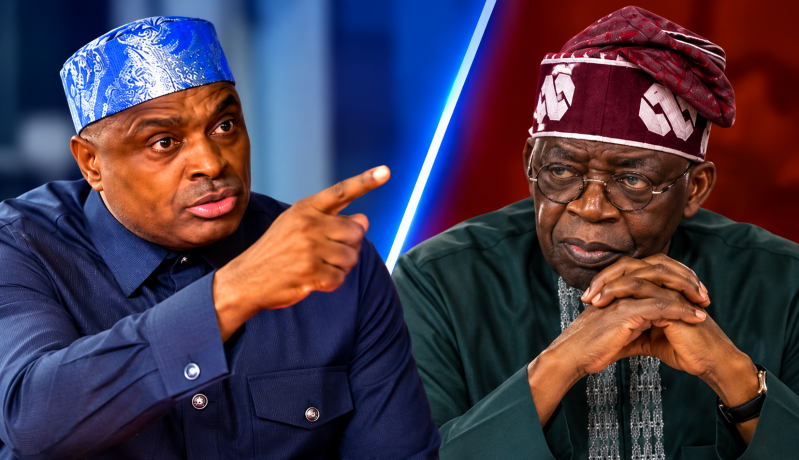
Kenneth Okonkwo, spokesman for African Democratic Congress presidential candidate Atiku Abubakar, has accused President Bola Tinubu’s administration of practising what he called “voodoo economics,” questioning official inflation figures and alleging that the government is using statistics to present a more favourable picture of Nigeria’s economy than citizens experience in their daily lives.
Okonkwo made the remarks during an appearance on Channels Television’s Politics Today, where he criticised the economic record of the All Progressives Congress-led Federal Government. His comments were reported on Wednesday, September 30, 2026, amid intensifying political debate over the economy ahead of Nigeria’s 2027 general election.
“Nigerians, what I am telling you is that whatever comes out of APC, don’t believe it. The more you look, the less you see,” Okonkwo said. He disputed claims that inflation was declining and argued that increases in fuel and transportation costs were inconsistent with the economic improvement being presented by the government.
Okonkwo particularly questioned how inflation could be falling while Nigerians continued to experience increases in the prices of essential goods and services.
He referred to higher petrol prices and their impact on transportation, arguing that transport costs feed into the prices businesses charge for moving goods around the country.
“What kind of voodoo economics is that when you know that transport is at the root of everything?” he asked.
Okonkwo went further by accusing the administration of manipulating economic statistics to disguise what he described as poor performance.
“The worst thing that this government is doing is not only that they are not performing; they are now writing figures to cover it,” he said.
The allegation that government officials are manipulating inflation figures has not been independently established. Nigeria’s official inflation statistics are produced by the National Bureau of Statistics, and no verified evidence reviewed for this report demonstrates that the latest figures were fabricated to conceal economic conditions.
The latest official Consumer Price Index report presents a more complicated economic picture than the political exchange suggests.
According to the National Bureau of Statistics, Nigeria’s headline inflation rate stood at 15.39 percent in August 2026, marginally lower than the 15.43 percent recorded in July.
Food inflation remained considerably higher at 19.57 percent year-on-year, while headline inflation increased by 0.71 percent on a month-to-month basis during August.
The figures are based on Nigeria’s rebased Consumer Price Index. The NBS updated the CPI framework from the previous 2009 reference structure, adopting 2023 as the weight reference period and 2024 as the price reference period.
The revised basket covers 934 product varieties across 13 divisions, reflecting changes in Nigerian household consumption patterns.
That methodological change is important when comparing current inflation figures with rates exceeding 30 percent recorded under the previous CPI framework. Figures produced under different base periods cannot simply be treated as directly equivalent without accounting for the methodological changes.
There is also an important distinction between falling inflation and falling prices.
A reduction in the inflation rate does not necessarily mean that goods and services have become cheaper. Inflation measures the rate at which the overall price level changes. Prices can therefore continue increasing while the inflation rate declines if they are increasing more slowly than during the comparable previous period.
This distinction helps explain why Nigerians can continue experiencing expensive food, transportation, housing and other necessities even while official year-on-year inflation moderates.
Okonkwo's argument reflects that gap between statistical inflation and households' experience of the price level, but his assertion that declining inflation is inherently incompatible with rising prices is economically incomplete. Inflation can fall while the general price level continues to rise.
The International Monetary Fund has similarly described Nigeria's economic situation as mixed. In its 2026 assessment, the IMF said reforms implemented over the previous three years had improved some macroeconomic outcomes and strengthened resilience, while acknowledging that economic conditions remained difficult for many Nigerians.
The IMF estimated that Nigeria's economy grew by about four percent in 2025 and projected approximately 4.1 percent growth for 2026. At the same time, it said higher food and transportation costs continued to weigh on households and economic activity.
The organisation also highlighted the country's persistent social challenges, estimating that 63 percent of Nigerians were living below the national poverty line and that about 27 million people faced food insecurity during the latter part of 2025.
Those indicators demonstrate why improving macroeconomic statistics do not automatically translate into immediate improvements in household living standards.
Okonkwo has previously made similar arguments while criticising Tinubu's removal of the petrol subsidy.
During another Channels Television interview in August, he said Nigeria should not permanently maintain a petrol subsidy but argued that Tinubu removed it without first creating conditions capable of protecting Nigerians from severe economic disruption.
President Tinubu announced during his inauguration on May 29, 2023, that the petrol subsidy regime was ending. The policy was followed by sharp increases in pump prices and contributed to higher transportation and production costs.
The administration has defended subsidy removal as necessary to eliminate a costly fiscal burden and redirect government resources. Finance Minister and Coordinating Minister of the Economy Wale Edun and other officials have repeatedly argued that reforms undertaken since 2023 are laying the foundations for greater economic stability.
Government officials have also pointed to improving growth, revenue and inflation indicators as evidence that reforms are producing results, while acknowledging the hardship experienced during the transition.
The opposition disputes that assessment.
Okonkwo's comments form part of the economic argument being advanced by Atiku's political camp as the former vice-president positions himself for another presidential contest. The ADC side has criticised the cost of petrol, the purchasing power of the naira and the wider cost of living under Tinubu.
That political context makes separating measurable economic indicators from campaign claims increasingly important.
Official statistics show that headline inflation has moderated significantly from the rates recorded before the CPI rebasing, but Nigerians continue to face elevated prices. Those two realities are not necessarily contradictory.
Likewise, dissatisfaction with the cost of living does not by itself establish that government statistics have been manipulated.
The stronger test of Nigeria's economic performance will involve several indicators rather than inflation alone: real household incomes, employment, food affordability, poverty, economic growth, exchange-rate stability and whether wages increase sufficiently to restore purchasing power lost during recent years.
Okonkwo's description of Tinubu's policies as “voodoo economics” therefore represents an opposition politician's assessment rather than an objective economic classification.
His broader challenge, however, reflects a genuine issue confronting the government: convincing Nigerians that improvements appearing in macroeconomic indicators are translating into meaningful improvements in everyday living conditions.
As campaigning towards 2027 intensifies, competing interpretations of Nigeria's economic record are likely to become central to the contest between Tinubu's administration and opposition parties. For voters, distinguishing political rhetoric from verifiable economic data will remain essential to assessing those competing claims.
📩 Stone Reporters News | 🌍 stonereportersnews.com
✉️ info@stonereportersnews.com | 📘 Facebook: Stone Reporters News | 🐦 X (Twitter): @StoneReportNew | 📸 Instagram: @stonereportersnews
Add comment
Comments