

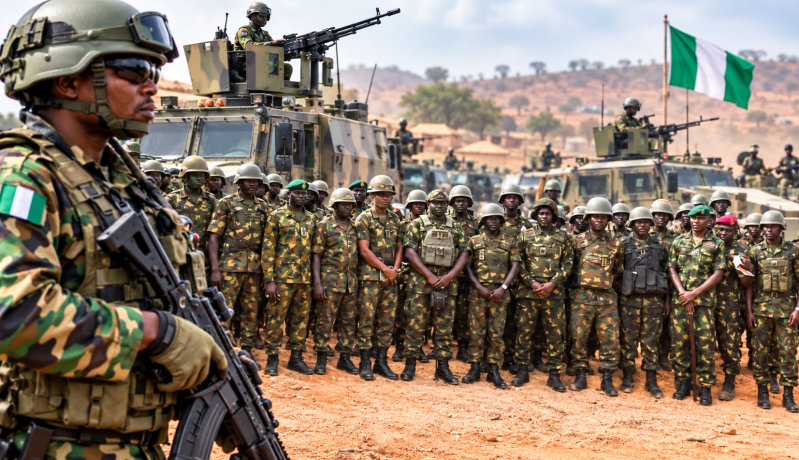
The Nigerian Army has expanded its permanent military presence in Zamfara State by operationalising two infantry battalions in Bakura and Anka, strengthening security coverage in communities that have faced years of bandit attacks, kidnappings and other forms of armed violence.
The Army operationalised the 12 Infantry Battalion in Bakura and 28 Infantry Battalion in Anka on Monday, September 28, 2026, according to an operational report on military activities across the country. The new formations are expected to strengthen existing operations against armed groups in Zamfara and improve the military’s ability to respond to threats across affected communities.
The Acting Commander of 1 Brigade represented the General Officer Commanding 8 Division during the operationalisation and charged troops assigned to the new formations to remain steadfast in confronting insecurity within their areas of responsibility.
The deployment forms part of the Nigerian Army’s broader effort to increase its operational footprint in the North-West, where armed groups have carried out mass kidnappings, attacks on villages, cattle rustling and killings over several years.
Zamfara remains one of the states most affected by the security crisis.
Military operations in the state currently fall within the wider activities of the Joint Task Force North-West, Operation Fansan Yamma, which conducts operations against armed groups across Zamfara and neighbouring states.
The establishment of additional battalions means troops can be positioned closer to vulnerable communities instead of depending entirely on forces travelling considerable distances from existing military formations when attacks occur.
That geographical presence could be particularly important in rural Zamfara, where difficult terrain, large distances between settlements and poor road networks can complicate rapid responses to attacks.
The Army has not publicly stated the exact number of soldiers assigned to the two newly operationalised battalions, and the term “battalion” should therefore not be interpreted as confirmation of a particular troop strength.
The development comes as security forces continue conducting operations across Zamfara.
On September 27, troops of Operation Fansan Yamma foiled two separate abduction attempts and rescued 10 people in Maru and Tsafe Local Government Areas.
In Maru, troops responded after armed men abducted villagers from Kade Daba village in Kanoma District. Soldiers engaged the attackers and initially rescued three victims before further searches resulted in the recovery of another person.
In a separate operation around Tsafe, troops responded to another kidnapping incident and rescued six people. The operations illustrate the continuing threat facing residents despite sustained military deployments across the state.
Bakura, where one of the newly operationalised battalions is located, has previously featured in military operations against armed groups. Defence authorities reported operations across Bakura and several other Zamfara local government areas earlier in 2026 as security forces maintained pressure on suspected terrorist and bandit networks.
Anka has similarly experienced serious security challenges.
In May, troops operating around the Bagega-Kawaye axis in Anka Local Government Area reportedly killed five suspected terrorists and rescued 31 kidnapped victims during an operation against armed groups.
The decision to strengthen troop presence in these areas therefore reflects an existing pattern of military operations rather than the beginning of security activity in the affected communities.
Kaura Namoda, which has also experienced repeated attacks, already has a military presence.
In August, troops stationed at the Forward Operating Base in Kasuwan Daji, Kaura Namoda Local Government Area, fought armed attackers who attempted to penetrate the military position. According to the military account, troops responded with firepower, received reinforcements and pursued the attackers, while kidnapped civilians were subsequently rescued.
This distinction is important because reports describing the latest Army action as the activation of three new battalions in Bakura, Kaura Namoda and Anka could create the impression that three separate battalions were newly established at the same time.
The operational report reviewed for this story specifically identifies 12 and 28 Infantry Battalions in Bakura and Anka as the formations operationalised on September 28. It does not identify a third newly activated infantry battalion in Kaura Namoda.
The expansion in Zamfara is also taking place alongside a wider restructuring of Army formations across the North-West.
In neighbouring Kebbi State, the Army recently operationalised the 28 Armoured Brigade and Garrison in Birnin Kebbi, alongside the 281 Tank Battalion in Yauri and 381 Artillery Regiment in Kaoje.
The Chief of Army Staff, Lieutenant General Waidi Shaibu, said through his representative that the new formations were intended to expand the Army’s operational footprint, improve command and control and shorten response times to security threats across the region.
For communities in Zamfara, however, the significance of the new battalions will ultimately be measured by changes on the ground.
Residents in affected areas have endured kidnappings for ransom, attacks on farming communities and disruptions to commercial and agricultural activities. Military bases located closer to vulnerable areas can improve response capacity, but establishing formations alone does not automatically eliminate armed groups operating across forests and remote rural terrain.
Effective security will depend on intelligence gathering, mobility, cooperation between communities and security agencies, adequate equipment and sustained operations capable of preventing attackers from simply relocating to less-protected areas.
The economic consequences are equally important.
Zamfara has a large rural population dependent on agriculture, livestock and local commerce. Persistent insecurity can prevent farmers from reaching their land, disrupt transportation and force residents to abandon communities.
Restoring security therefore has implications extending beyond military operations. Communities require conditions in which farmers can cultivate their land, traders can move between markets and children can attend schools without persistent fear of attacks or abduction.
The Army has repeatedly urged residents to provide credible information about suspicious movements and activities, describing cooperation between communities and security forces as an important part of counterterrorism and anti-banditry operations.
Operation Fansan Yamma has also emphasised that military action is accompanied by engagement with communities and other non-kinetic measures aimed at restoring stability across the North-West.
The latest deployments consequently represent another stage in Nigeria’s continuing attempt to establish a stronger security presence in areas where armed groups have exploited difficult terrain and limited state presence.
For residents of Bakura and Anka, the immediate expectation will be that having dedicated Army formations closer to their communities translates into faster intervention when threats emerge and greater pressure on armed groups.
Whether that expectation is realised will become clearer through security conditions in the months ahead.
For now, what has been officially confirmed is that the Nigerian Army has operationalised two infantry battalions in Bakura and Anka as part of its expanding security architecture in Zamfara, while existing troops continue operations in Kaura Namoda and other parts of the state.
📩 Stone Reporters News | 🌍 stonereportersnews.com
✉️ info@stonereportersnews.com | 📘 Facebook: Stone Reporters News | 🐦 X (Twitter): @StoneReportNew | 📸 Instagram: @stonereportersnews
Add comment
Comments