

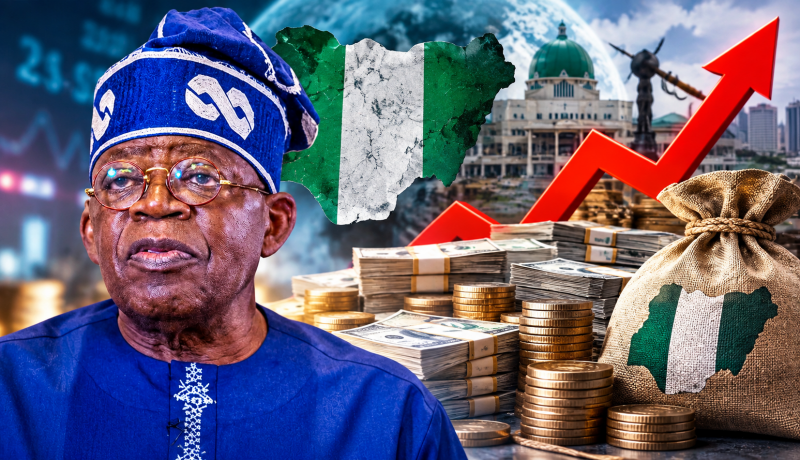
Nigeria’s external public debt has risen by approximately $11.36 billion in three years, climbing from $43.16 billion in June 2023 to $54.52 billion by June 2026, according to figures released by the Debt Management Office, bringing renewed attention to the country’s borrowing, debt servicing obligations and the use of externally sourced funds.
The latest DMO figures, released in Abuja in September 2026, show that Nigeria’s total public debt stood at ₦166.79 trillion, equivalent to $120.93 billion, as of June 30. External debt accounted for $54.52 billion, while domestic debt amounted to $66.41 billion. The figures cover the Federal Government, the 36 states and the Federal Capital Territory.
The comparison with June 2023 is significant because President Bola Tinubu assumed office on May 29 that year. At June 30, 2023, the DMO recorded Nigeria’s external debt at approximately $43.16 billion.
By June 30, 2026, it had reached $54.52 billion, representing an increase of approximately $11.36 billion, or 26.3 percent, over the three-year period.
The figures establish how much the outstanding external debt stock changed, but they should not be interpreted to mean that the Tinubu administration simply borrowed $11.36 billion in new money and added all of it to Nigeria’s liabilities.
Public debt stocks change through several mechanisms. Governments obtain new loans and receive disbursements from previously approved facilities while simultaneously repaying principal on existing obligations. Consequently, the difference between two debt-stock figures represents the net outcome of those movements rather than the total amount of loans contracted during the period.
The latest figures nevertheless demonstrate that Nigeria owed substantially more to external creditors in dollar terms by mid-2026 than it did shortly after Tinubu entered office.
Nigeria’s external creditors include multilateral institutions such as the World Bank Group and African Development Bank, bilateral lenders and holders of government securities issued on international capital markets.
The Tinubu administration has continued accessing external financing as part of its economic programme.
The World Bank has approved several major financing packages for Nigeria since 2023, including facilities supporting economic reforms, power-sector improvements, education, healthcare and social programmes. Nigeria has also returned to international capital markets through Eurobond issuance.
Government officials maintain that borrowing is used to finance budget deficits, infrastructure and development programmes while supporting reforms intended to strengthen economic growth and public finances.
Critics, however, have increasingly questioned the pace of debt accumulation and whether Nigerians are seeing sufficient improvements in infrastructure and public services to justify additional borrowing.
That debate has intensified because debt must ultimately be serviced from government revenue.
The size of a country’s debt is therefore only one measure of sustainability. Economists and debt managers also examine government revenue, interest payments, maturity profiles, foreign-exchange earnings and the purposes for which borrowed money is used.
External debt creates an additional consideration because much of it must be serviced in foreign currencies.
When the naira weakens, the domestic-currency cost of meeting dollar and other foreign-currency obligations can rise even when the dollar value of the underlying debt has not changed.
Exchange rates are also important when interpreting Nigeria’s latest overall debt figures.
The DMO valued the June 2026 external debt using the Central Bank of Nigeria’s official exchange rate of approximately ₦1,379.18 to the dollar. At that rate, external debt was valued at about ₦75.20 trillion.
Domestic debt stood at approximately ₦91.59 trillion, representing 54.91 percent of the total public debt portfolio, while external obligations accounted for the remaining 45.09 percent.
The Federal Government remains responsible for the overwhelming majority of Nigeria’s public debt.
According to the latest DMO figures, Federal Government obligations amounted to approximately ₦152.77 trillion. State governments and the Federal Capital Territory collectively accounted for about ₦14.01 trillion.
The increase has also continued more recently.
External debt rose from approximately $46.98 billion in June 2025 to $54.52 billion in June 2026, an increase of about $7.54 billion within one year.
Total public debt, measured in dollars, reached $120.93 billion by June 2026, compared with $99.66 billion one year earlier.
The government’s borrowing strategy has become a political issue ahead of the 2027 general election, with opposition politicians questioning the growth in public debt and demanding greater accountability for how borrowed funds are spent.
The Tinubu administration, meanwhile, has defended its wider economic reform programme, arguing that measures introduced since 2023 are intended to improve government finances, attract investment and establish stronger foundations for economic growth.
Assessing the debt increase therefore requires more than comparing two headline figures.
Borrowing can support economic development when financing productive infrastructure, education, healthcare and investments capable of increasing future economic output. But rising debt becomes more difficult to manage when government revenue is insufficient, debt-servicing costs consume resources needed elsewhere or borrowed funds fail to generate lasting economic benefits.
For Nigerians, the central question is consequently not only how much the country owes but what additional borrowing has achieved.
New roads, reliable electricity, better schools, functioning healthcare facilities and stronger economic productivity can provide measurable evidence of the value created through public borrowing. Where such outcomes are absent, rising debt can instead leave future budgets carrying repayment obligations without corresponding improvements in national productive capacity.
Transparency is therefore critical.
Citizens need accessible information showing which loans have been approved, how much has actually been disbursed, the interest and repayment conditions attached to them, what projects they finance and whether those projects are delivering their intended results.
There is also an important distinction between Nigeria’s external public debt reported by the DMO and broader measures of a country’s external indebtedness. International organisations can publish figures using different definitions that include additional categories of private or short-term external liabilities. Comparisons should therefore use the same definition and data source.
Using the DMO’s public-debt series provides a consistent comparison: approximately $43.16 billion in external public debt at June 2023 and $54.52 billion at June 2026.
That translates into an increase of about $11.36 billion over three years.
The figures alone do not establish whether each borrowing decision was beneficial or wasteful. That requires examining individual loans, their terms and the projects or programmes financed with them.
They do, however, establish an important fact about Nigeria’s public finances: three years after Tinubu entered office, the country’s outstanding external public debt was about 26 percent higher in dollar terms than it was at the end of June 2023.
As the Federal Government considers further external financing, scrutiny is likely to focus increasingly on debt sustainability, repayment capacity and whether additional borrowing produces improvements Nigerians can see in their economy and public services.
The challenge for policymakers is therefore not simply limiting or expanding borrowing. It is ensuring that every additional obligation taken on by the country can be justified by its economic or developmental value and managed without placing an unsustainable burden on future public finances.
📩 Stone Reporters News | 🌍 stonereportersnews.com
✉️ info@stonereportersnews.com | 📘 Facebook: Stone Reporters News | 🐦 X (Twitter): @StoneReportNew | 📸 Instagram: @stonereportersnews
Add comment
Comments