

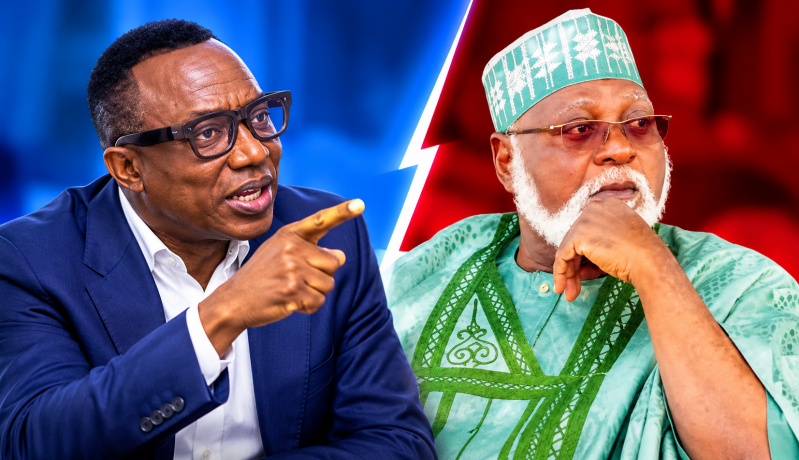
Nigerian activist and African Action Congress politician Omoyele Sowore has criticised former Head of State General Abdulsalami Abubakar’s appearance in promotional material by an Indian hospital following knee replacement surgery, describing the episode as a reflection of Nigeria’s longstanding struggle to provide healthcare capable of retaining prominent patients at home.
The controversy emerged on September 29, 2026, after Sowore shared promotional material featuring the retired general, who served as Nigeria’s military Head of State between June 1998 and May 1999. The material was connected with Shalby Hospitals, an Indian healthcare group where Abubakar recently received treatment.
Available information indicates that Abubakar underwent total knee replacement surgery at Krishna Shalby Hospital in Ahmedabad, India. Shalby subsequently featured the former Nigerian leader in promotional material highlighting its treatment of international patients.
Sowore seized on the development to renew his criticism of Nigeria’s political leadership and the condition of the country's healthcare system.
“This is former Nigerian Head of State, General Abdulsalami Abubakar, being used in a hospital advert after undergoing knee replacement surgery in India,” Sowore wrote.
He argued that Nigerian leaders who occupied positions of authority had opportunities to develop medical institutions capable of providing advanced healthcare domestically but had failed to establish a system sufficiently trusted by many members of the political elite.
Sowore said the result was that some former leaders continued travelling overseas for medical treatment as they grew older, while foreign hospitals could then highlight their presence as evidence of their international medical services.
He described the situation as “a tragic indictment of decades of failed leadership and neglect of Nigeria’s healthcare system.”
Sowore also referred to President Bola Tinubu in his criticism, suggesting that a hospital in France could someday similarly feature the Nigerian president in its promotional material.
That comment was political rhetoric rather than evidence about Tinubu's healthcare arrangements and should be understood in the context of Sowore's broader criticism of Nigerian leaders seeking medical treatment abroad.
The immediate controversy nevertheless touches on a longstanding public-policy debate in Nigeria: medical tourism.
For decades, Nigerians who can afford overseas healthcare have travelled to countries including India, the United Kingdom, United States, Germany and Turkey for specialist procedures, diagnosis and treatment.
India has become a particularly prominent destination because of its combination of specialist hospitals, internationally marketed healthcare services and costs that can be lower than comparable treatment in some Western countries.
Nigeria itself has orthopaedic surgeons and hospitals capable of carrying out knee replacement procedures. The National Orthopaedic Hospital in Igbobi, Lagos, is among the country's established specialist institutions, while other public and private hospitals also provide advanced orthopaedic services.
The existence of those services means Abubakar's decision to receive treatment in India does not establish that knee replacement surgery is unavailable in Nigeria.
Patients may choose hospitals for numerous reasons, including recommendations from doctors, previous medical relationships, specialist expertise, personal confidence, cost, availability and individual preference.
There has been no verified public evidence that Abubakar was medically compelled to travel to India because no Nigerian hospital could perform the procedure.
That distinction is important when assessing Sowore's criticism.
His argument is primarily political: that Nigeria's leadership over successive decades should have created a healthcare system sufficiently developed and trusted that senior political figures would routinely receive specialised treatment domestically.
Abubakar has not been shown to have done anything unlawful by travelling abroad for medical care, and patients generally retain the right to decide where they receive treatment.
The controversy instead concerns what such decisions by prominent Nigerians may indicate about public confidence in the domestic healthcare system.
Nigeria has invested in specialist hospitals and medical training, but the health sector continues to face challenges including inadequate equipment in some public facilities, infrastructure gaps, funding constraints and the migration of medical professionals.
Successive governments have promised to reduce medical tourism by improving specialist healthcare.
The issue becomes particularly sensitive when serving public officials travel abroad at public expense. In Abubakar's case, however, no verified evidence reviewed for this report establishes that the Nigerian government paid for his latest treatment in India.
It would therefore be inaccurate to describe his surgery as publicly funded without evidence.
There is also no indication that Shalby Hospitals' use of Abubakar in its promotional material was itself improper.
Healthcare providers routinely publicise testimonials or visits by prominent patients where appropriate permissions have been obtained. No verified information reviewed for this report establishes whether Abubakar was paid for the appearance, received free treatment in exchange for publicity or entered into a commercial endorsement agreement with the hospital.
Those possibilities should not be assumed.
What can be established is that Shalby personnel publicly acknowledged hosting Abubakar and his family for treatment, expressing appreciation for the confidence placed in the hospital.
The promotional use of his treatment subsequently attracted attention in Nigeria largely because of Abubakar's status as a former national leader.
Abubakar assumed power following the death of military ruler General Sani Abacha in 1998 and supervised Nigeria's transition from military rule to civilian government. He handed power to elected President Olusegun Obasanjo on May 29, 1999.
Since leaving office, he has remained active in peace and democratic initiatives and serves as chairman of Nigeria's National Peace Committee, which works with political parties and candidates to encourage peaceful elections.
His public standing consequently makes his choice of overseas healthcare more politically visible than the decisions of ordinary private citizens.
The debate generated by the hospital material has produced different perspectives.
Critics share Sowore's view that repeated overseas treatment by Nigerian political leaders demonstrates insufficient confidence in healthcare institutions developed under successive governments.
Others argue that medical treatment remains a personal matter and that Nigerians, including former leaders, should be free to obtain healthcare wherever they believe they will receive the most appropriate treatment.
Those positions are not necessarily mutually exclusive. An individual can possess the right to choose overseas healthcare while the frequency with which prominent Nigerians exercise that option can still generate legitimate debate about investment in the domestic health system.
The broader policy question is therefore less about whether Abubakar should personally have travelled to India and more about what Nigeria would need to do to make its hospitals competitive destinations for advanced treatment.
That includes sustained investment in specialist equipment, medical research, training, hospital management and working conditions capable of retaining highly skilled doctors, nurses and other healthcare professionals.
It also requires building confidence among patients who have the financial ability to choose between Nigerian and overseas facilities.
Sowore's description of the episode as evidence of “failed leadership” remains his political assessment rather than an independently established factual conclusion.
The underlying event, however, is confirmed: the former Nigerian Head of State received knee replacement treatment in India and subsequently appeared in promotional material associated with the hospital that treated him.
That image has now become part of a much larger Nigerian conversation about medical tourism, political leadership and whether the country's healthcare institutions receive the investment and confidence necessary to compete with hospitals abroad.
📩 Stone Reporters News | 🌍 stonereportersnews.com
✉️ info@stonereportersnews.com | 📘 Facebook: Stone Reporters News | 🐦 X (Twitter): @StoneReportNew | 📸 Instagram: @stonereportersnews
Add comment
Comments