

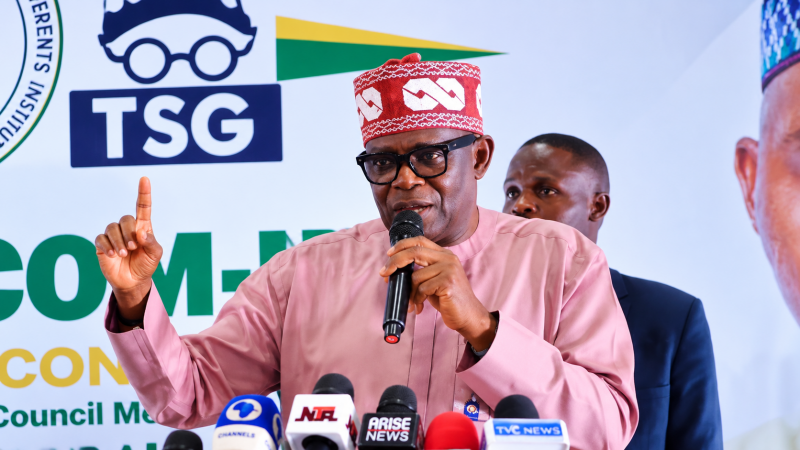
House of Representatives member James Abiodun Faleke has praised President Bola Tinubu’s administration over its education policies, saying initiatives introduced by the Federal Government are creating opportunities for students from less-privileged families and reducing some of the financial pressures associated with obtaining an education.
Faleke, who represents Ikeja Federal Constituency in the House of Representatives, made the remarks while addressing participants at a conference involving members of governing councils of tertiary institutions. He urged education stakeholders to communicate government initiatives to Nigerians and ensure that the intended benefits reach students and communities.
The lawmaker specifically highlighted the Nigerian Education Loan Fund and Federal Government interventions supporting technical and vocational education.
According to Faleke, the student loan programme has opened opportunities for young Nigerians from families that may otherwise struggle to finance tertiary education.
“For the first time, technical students are receiving allowances in Nigeria. This is a major achievement,” Faleke said.
His comments form part of a wider argument by supporters of the Tinubu administration that its education interventions are making tertiary and technical education more accessible, particularly for Nigerians who face financial difficulties.
The administration established NELFUND as a mechanism through which eligible students can access interest-free loans to finance their education.
Under the programme, institutional charges and upkeep are treated separately. Approved institutional charges are paid to participating institutions on behalf of beneficiaries, while eligible students who request upkeep support receive money directly into their personal accounts.
This distinction has recently become particularly important following political arguments over the programme.
Former Kogi West senator Dino Melaye questioned how the government could claim to be paying students’ school fees while beneficiaries were receiving ₦20,000, describing NELFUND as a “haven of corruption.”
However, the ₦20,000 figure cited in that controversy refers to the monthly upkeep component rather than the total amount provided for institutional charges.
Recent disbursements demonstrate how the institutional component operates.
Niger Delta University confirmed receiving approximately ₦126.07 million from NELFUND to cover institutional charges for 1,125 students for the 2025/2026 academic session.
Dennis Osadebay University in Delta State similarly acknowledged receiving about ₦30.04 million for 139 students.
Those payments were made to the universities rather than distributed as ₦20,000 payments to individual beneficiaries.
NELFUND Managing Director Akintunde Sawyerr has also said the agency uses electronic payments to institutions and beneficiaries so that disbursements can be tracked.
The University of Abuja has separately reported positive experiences from beneficiaries of the programme.
Students interviewed about NELFUND said payment of institutional charges and monthly upkeep had reduced pressure on their families and allowed them to concentrate more effectively on their studies.
One student, Chinonye Chucks, said beneficiaries could study without constantly worrying about school fees and other academic expenses because institutional charges were being handled while students received upkeep support.
Such accounts provide context for Faleke’s argument that the programme is benefiting students from financially disadvantaged backgrounds.
Vice-President Kashim Shettima has made a similar argument.
During a September meeting with University of Abuja management, Shettima described NELFUND as providing financial relief to children from less-privileged backgrounds and said its combination of institutional payments and monthly upkeep was intended to remove financial barriers to higher education.
The government has consequently presented NELFUND as one of the major social interventions introduced under Tinubu.
However, Faleke’s broader praise of the Tinubu administration remains a political assessment rather than an independently measurable conclusion that it is Nigeria’s “best ever” government.
Whether one administration is the best in the country’s history depends on the criteria used and involves political judgment. It cannot be established solely from the existence or performance of one programme.
The measurable question is whether the education initiatives Faleke highlighted exist, how many people have benefited and whether payments promised under the programmes are actually reaching students and institutions.
Evidence confirms that NELFUND has made substantial payments to tertiary institutions and individual beneficiaries.
The Federal Government’s own May 2026 assessment of its performance said about 1.5 million students had benefited from NELFUND and approximately ₦79 billion had been disbursed for tuition-related institutional charges and upkeep allowances across universities, polytechnics and colleges of education. Those figures represented the government’s published assessment at that point and should be understood as administration-reported data.
Faleke also drew attention to technical education.
His statement that technical students are receiving allowances relates to the Federal Government’s effort to expand Technical and Vocational Education and Training as an alternative pathway for Nigerians seeking practical and employment-oriented skills.
The wider objective is to reduce financial barriers while encouraging more young Nigerians to obtain technical qualifications required in sectors where skilled workers are needed.
Faleke urged members of governing councils to help Nigerians understand these initiatives rather than allowing information about government programmes to remain within official institutions.
For parents, the most significant element of the NELFUND programme is its potential to reduce the immediate financial burden of tertiary institutional charges.
It does not, however, mean that university education has become universally free in Nigeria.
NELFUND is fundamentally a student loan programme. Money paid for eligible beneficiaries constitutes financing that is subject to the programme’s repayment framework rather than a blanket government grant eliminating education costs for every Nigerian student.
Not every Nigerian student automatically receives NELFUND support, and parents whose children are not beneficiaries may continue to be responsible for institutional charges and other education expenses.
This means statements suggesting that Nigerian parents generally “don’t have to worry about paying school fees” require qualification.
For approved NELFUND beneficiaries, institutional charges can be paid directly to their schools, reducing the immediate burden on their families. That should not be expanded into a claim that every Nigerian parent has been relieved of school-fee responsibilities.
The programme has also attracted opposition criticism.
Atiku Abubakar’s political camp has argued that loans should not be presented as equivalent to making education affordable and has proposed reviewing NELFUND and introducing debt forgiveness for qualifying beneficiaries if elected.
Supporters of the administration counter that access to financing prevents students from abandoning their education simply because their families cannot immediately raise institutional fees.
These competing positions reflect a legitimate policy debate over whether higher education should primarily be financed through government expenditure, student loans or a combination of different funding mechanisms.
Faleke has clearly taken the position that the current interventions represent significant progress.
The available evidence supports the narrower factual elements behind his argument: NELFUND is paying approved institutional charges, beneficiaries are receiving upkeep allowances, and the Federal Government has introduced support for technical and vocational students.
Whether those achievements make Tinubu’s administration the “best ever” remains a political opinion rather than a fact a news organisation can independently establish.
For students and parents, the more useful measure will be whether the programmes remain adequately funded, payments arrive consistently, eligible applicants can access support without unnecessary barriers and beneficiaries ultimately obtain education and skills that improve their economic opportunities.
Faleke’s remarks therefore add another voice to the growing political debate over Tinubu’s education record, with supporters pointing to student loans and technical-training allowances as evidence of progress while opponents continue questioning affordability, implementation and the long-term implications of financing education through loans.
📩 Stone Reporters News | 🌍 stonereportersnews.com
✉️ info@stonereportersnews.com | 📘 Facebook: Stone Reporters News | 🐦 X (Twitter): @StoneReportNew | 📸 Instagram: @stonereportersnews
Add comment
Comments