

Published by Oravbiere Osayomore Promise.
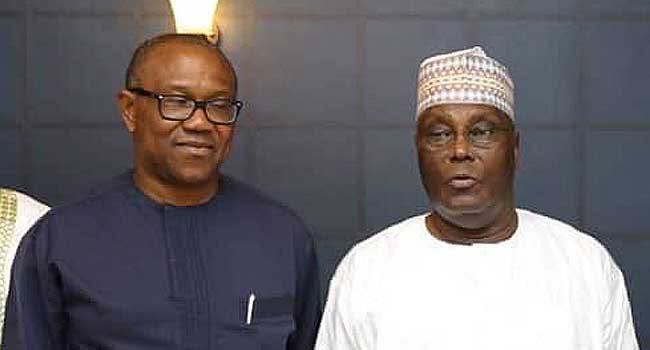
Former Anambra State Governor and Nigeria Democratic Congress (NDC) presidential aspirant, Mr Peter Obi, has dismissed mounting speculation that he is deliberately avoiding political competition with former Vice President Atiku Abubakar ahead of the 2027 presidential election. Speaking on Friday, May 22, 2026, in Cape Town, South Africa, on the sidelines of the Spier Dialogue 2026, a pan-African governance forum, Obi offered a forceful rebuttal to suggestions of a rift, describing Atiku as a “respected leader” and “elder brother” with whom he shares one of the closest political bonds he has. “There are very few human beings who are as close as I am to Atiku. So I can’t be running from him. This man is my very respected leader and elder brother. I don’t run from him. Never. It has nothing to do with running from anybody. I’ve never run from anybody. I just believe that I do things differently,” Obi said.
The remarks come after a turbulent period in their political relationship, which began with high hopes for a formidable opposition coalition against President Bola Tinubu. On January 1, 2026, Obi formally joined the African Democratic Congress (ADC), a move Atiku had welcomed and described as a “landmark moment” in opposition coalition‑building. The two men, alongside other opposition figures, had jointly adopted the ADC as a platform to present a united front in the 2027 election. That alliance, however, disintegrated within months amid unresolved internal conflicts, leadership disagreements and persistent legal disputes that Obi said had distracted the party from addressing the pressing national issues of insecurity, unemployment and economic hardship.
Obi has consistently maintained that his departure from the ADC was not rooted in personal differences with Atiku or the party’s chairman, former Senate President David Mark. Instead, he pointed to what he called a “litigation‑driven” political culture that had overwhelmed the party’s capacity to focus on governance and policy. According to Obi, the ADC had become entangled in endless court cases and internal wrangling, making it an unviable vehicle for the kind of transformative leadership he believes Nigeria urgently needs. In May 2026, Obi and former Kano State Governor Rabiu Kwankwaso defected to the Nigeria Democratic Congress (NDC), a younger party that has since positioned itself as a fresh opposition alternative. The NDC’s leadership, headed by former Bayelsa State Governor Senator Seriake Dickson, has welcomed the duo and has already zoned its presidential ticket to the South for a single four‑year term, a move widely interpreted as favouring Obi’s candidacy.
Obi’s emergence as the sole NDC presidential aspirant was confirmed on May 19, 2026, after the party closed the sale of expression of interest and nomination forms. No other aspirant purchased the forms, making Obi the party’s presumptive flag‑bearer pending the formal primary. His clearance by the NDC National Screening Committee, chaired by former Ebonyi State Governor Senator Sam Egwu, was announced days earlier. Despite the seamless internal process, the collapse of the ADC coalition has fuelled speculation that Obi is avoiding a direct showdown with Atiku, who remains a leading candidate on the ADC ticket alongside former Rivers State Governor Rotimi Amaechi and economist Muhammed Hayatu‑Deen. Both men are now expected to face each other across opposing platforms in the 2027 presidential race, a prospect Obi appears to welcome rather than shun.
Addressing the speculation more broadly, Obi stressed that his political decisions are not driven by fear of any individual but by his conviction that Nigeria requires competent and accountable leadership. He said democracy thrives on open participation and healthy political competition, and that his focus remains on issues affecting ordinary Nigerians, including the economy, insecurity, unemployment and governance challenges, rather than on personal rivalry. “I just believe that I do things differently,” he reiterated.
Atiku has not publicly commented on Obi’s Cape Town remarks. However, the former vice president has previously dismissed reports that he had stepped aside from active politics, describing such claims as “a calculated lie.” The ADC has screened Atiku alongside Amaechi and Hayatu‑Deen for its presidential ticket, setting up what promises to be a competitive primary of its own. Meanwhile, President Tinubu secured an overwhelming victory in the APC presidential direct primary on May 24, 2026, polling 277,192 votes in Bayelsa State alone, where his only challenger, Mr Stanley Osifo, received just five votes.
Political observers have interpreted Obi’s intervention as an attempt to reset the narrative around his defection and to reassure supporters who may be confused by the rapidly shifting opposition landscape. The “Obidient” movement, a grassroots coalition that propelled Obi to third place in the 2023 presidential election, has itself experienced factional tensions, with one splinter group announcing Obi’s “expulsion” from the movement. Yet Obi continues to command significant goodwill among young Nigerians and civil society groups who view him as a corruption‑fighting, fiscally prudent alternative to the established political order.
As the 2027 election cycle gathers momentum, Obi and Atiku will now campaign on competing platforms, potentially splitting the opposition vote and benefiting the ruling APC. Whether the two men can eventually reconcile their ambitions into a single coalition before the general election remains an open question. For now, Obi’s message from Cape Town is clear: his departure from the ADC was a matter of principle, not a retreat. “I’ve never run from anybody,” he said. And he is not about to start.
📩 Stone Reporters News | 🌍 stonereportersnews.com
✉️ info@stonereportersnews.com | 📘 Facebook: Stone Reporters News | 🐦 X (Twitter): @StoneReportNew | 📸 Instagram: @stonereportersnews
Add comment
Comments