

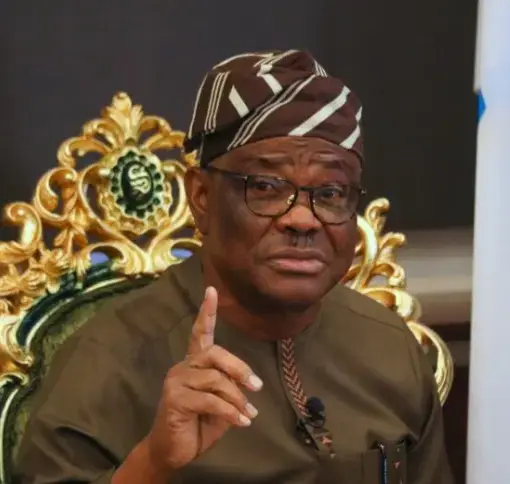
Nigeria’s Minister of the Federal Capital Territory, Nyesom Wike, has said the Nigeria national football team have been forgiven by Nigerians after receiving assurances that the team remains committed to returning to football’s biggest stage.
Wike made the remarks on Wednesday, June 24, 2026, during the commissioning of the Kuje–Gwagwalada Road project in Abuja, where former Super Eagles captain Joseph Yobo was among dignitaries present. The event, which was primarily focused on infrastructure development in the Federal Capital Territory, also turned into a moment of reflection on Nigeria’s football disappointment after the national team failed to qualify for the 2026 FIFA World Cup.
Speaking before attendees, Wike expressed deep disappointment over Nigeria’s absence from the ongoing World Cup, saying many Nigerians remain hurt that a country with such rich football history and abundant talent is missing from the tournament.
He said it was painful to watch nations with less football pedigree compete on the global stage while Nigeria, a country known for producing elite football talent, failed to secure qualification. Wike noted that many Nigerian players are active in top European leagues, making the failure even harder for supporters to accept.
Addressing Yobo directly, Wike said: “We have congratulated one of our stars, Joseph Yobo. But let me use this medium through you to tell the Super Eagles we are not happy.”
He continued by saying that while many people applauded Yobo at the event, he deliberately withheld applause because the pain of Nigeria’s World Cup absence remained fresh.
According to Wike, he spends hours watching the World Cup and finds it frustrating to see countries he described as lesser-known on football’s global stage participating while Nigeria watches from home.
“I watch the World Cup and see countries I have never heard of qualifying to play, and I am sitting down watching them for hours,” Wike said, underscoring the emotional weight of Nigeria’s failure to qualify.
Nigeria’s failure to reach the 2026 tournament triggered widespread criticism from fans, football analysts and former players. The Super Eagles, three-time African champions and six-time World Cup participants, were widely expected to qualify, especially after FIFA expanded the tournament to 48 teams.
Despite the expansion, Nigeria fell short during the African qualification campaign. Their hopes of reaching the World Cup were eventually ended after a disappointing playoff exit, leaving millions of supporters frustrated and raising serious questions about coaching, administration and squad management.
The team’s failure sparked broader national conversations about the state of Nigerian football, including concerns over technical planning, player commitment and the structure of football governance.
Yobo, one of Nigeria’s most respected former internationals and a key figure in the country’s football history, has remained influential within football circles and is often viewed as a bridge between past and present generations of players.
According to Wike, Yobo later informed him—on Thursday, June 25, 2026—that he had delivered the message of public disappointment to the players and received a positive response from them.
“Joseph Yobo told me yesterday he has communicated our message to the Super Eagles and they promised that Nigeria will qualify and play in the subsequent World Cups,” Wike said.
He then added in a lighter but symbolic tone: “Super Eagles, your sins are forgiven.”
The remark drew laughter and applause, but it also reflected a broader sentiment among Nigerian supporters—anger over missed opportunities, yet continued belief in the team’s ability to recover.
Football remains one of the strongest unifying forces in Nigeria, cutting across ethnic, religious and political lines. Major tournaments involving the Super Eagles often shape national mood, making failures especially painful for supporters.
Wike’s comments capture both the disappointment and enduring hope of millions of Nigerians who still believe the Super Eagles can rebuild and return stronger in future qualification campaigns.
Analysts say the path forward for Nigerian football will require more than public forgiveness. Many argue that structural reforms, stronger football administration, youth development and technical stability will be essential if the country is to reclaim its place among football’s elite.
For now, Wike’s message appears to reflect a national consensus: Nigerians remain disappointed by the World Cup miss, but many are willing to look ahead—provided the Super Eagles prove they have learned from the failure.
📩 Stone Reporters News | 🌍 stonereportersnews.com
✉️ info@stonereportersnews.com | 📘 Facebook: Stone Reporters News | 🐦 X (Twitter): @StoneReportNew | 📸 Instagram: @stonereportersnews
Add comment
Comments