

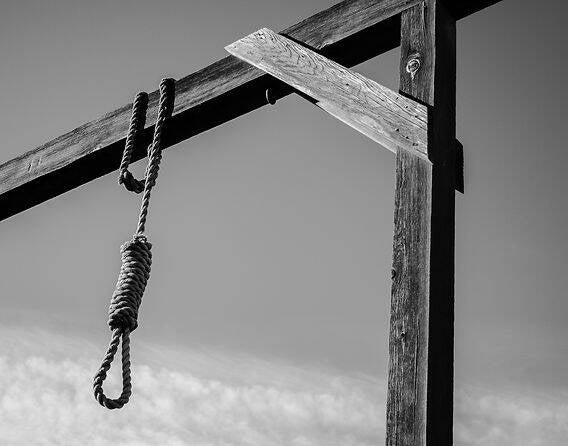
The Federal High Court in Abuja has sentenced Alkali Yarima, also known as La’ari, a member of the terrorist group Boko Haram, to death by hanging for his role in the deadly attacks on Maiduguri in 2015. The judgment marks a significant development in Nigeria’s ongoing prosecution of terrorism-related cases.
The ruling was delivered on Friday, June 26, 2026, by Justice James Omotosho, who found Yarima guilty on multiple terrorism charges brought by the Federal Government. The case formed part of broader efforts by Nigerian authorities to hold members of extremist groups accountable for years of violence in the North-East.
Court records showed that Yarima, who is from Lawanti area in Mafa Local Government Area, was charged in a seven-count terrorism case marked FHC/KNJ/CR/971/2026. Prosecutors said he was an active member of Boko Haram between 2009 and 2015, the period during which the insurgent group intensified attacks across Borno State and surrounding areas.
According to the prosecution, Yarima embraced the ideology, or “Da’awah,” of Mohammed Yusuf, the founder of Boko Haram, and continued to operate within the proscribed group. The Federal Government argued that his activities violated provisions of the Terrorism (Prevention Amendment) Act, 2013, under which he was prosecuted.
The court heard that beyond his membership in Boko Haram, Yarima also travelled to an Arab country to receive training in arms and weapons handling in preparation for terrorist operations. Justice Omotosho ruled that this constituted conduct preparatory to terrorism and handed him life imprisonment on count six.
In addition to the death sentence, the court imposed several prison terms on other counts. Yarima received 35 years’ imprisonment on count one, 30 years on count five, and 10 years each on counts two, three and four. The death penalty was specifically tied to count seven, which concerned his direct participation in the 2015 attacks on Maiduguri.
The 2015 attacks on Maiduguri were among a series of violent assaults carried out by Boko Haram during the peak of the insurgency in north-eastern Nigeria. At the time, Maiduguri—widely regarded as the epicentre of the conflict—faced repeated bombings, suicide attacks and coordinated raids that claimed numerous civilian and military lives while forcing thousands from their homes.
Nigeria’s battle against Boko Haram has lasted for more than a decade, with the insurgency causing widespread devastation across Borno State, Yobe State, and Adamawa State. The conflict has killed tens of thousands of people and displaced millions, according to humanitarian agencies.
The trial was initially conducted at the terrorism court in Kainji, Niger State, before being concluded in Abuja. The relocation formed part of judicial arrangements for handling terrorism-related cases under enhanced security conditions.
Following the judgment, Lateef Fagbemi, who led the Federal Government’s prosecution team, said Nigeria remained determined to eliminate terrorism and improve national security.
“We will fight with every inch of our blood to ensure that we make Nigeria a safe place for everybody,” Fagbemi said after the ruling.
The verdict is being seen as one of the notable recent convictions in Nigeria’s anti-terror prosecutions, reinforcing the government’s message that those found guilty of acts of terrorism will face the full weight of the law.
📩 Stone Reporters News | 🌍 stonereportersnews.com
✉️ info@stonereportersnews.com | 📘 Facebook: Stone Reporters News | 🐦 X (Twitter): @StoneReportNew | 📸 Instagram: @stonereportersnews
Add comment
Comments