

Published by Oravbiere Osayomore Promise.
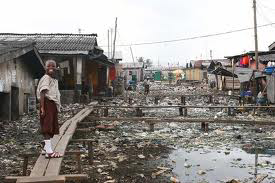
The Lagos metropolis, a sprawling city of over 20 million inhabitants, is choking on the byproducts of its own relentless vitality. From the elite estates of Lekki to the bustling markets of the mainland, a mounting crisis of environmental pollution—spanning sewage discharge, airborne toxins, plastic waste, and industrial noise—is triggering widespread alarm among residents and civil society. In May 2026 alone, as the wet season begins, communities across the state have witnessed the state government's aggressive enforcement actions against major polluters even as grassroots activists decry the persistent health hazards that disproportionately affect the urban poor.
One of the starkest examples of this crisis unfolded in Lekki's upscale Pinnock Beach Estate. After months of abatement notices, the Lagos State Wastewater Management Office, acting on a directive from Commissioner for Environment Tokunbo Wahab, sealed the estate on 7 May 2026. Authorities had documented the deliberate pumping of untreated sewage via a machine directly into a canal, causing a pervasive stench, environmental degradation, and health risks for aquatic life. “After several warnings and abatement notices, the Lagos State Wastewater Management Office, on Thursday 7th May, 2026, sealed-off Pinnock Beach Estate, Osapa London, Lekki, Lagos, over deliberate discharge of untreated sewage via pumping machine into the canal,” Wahab stated. The same operation targeted a residence at 28 Amodu Street in Itire, Surulere, after residents complained of raw sewage flowing into their neighbourhood. Authorities shut Vintage Heights Estate and another property in Ajah for similar violations, where sewage had blocked public drains, contributing to offensive odours and environmental nuisance. These actions formed part of a broader crackdown on wastewater violations across the state.
While visible pollution draws immediate attention, the invisible menace of noise and air pollution affects millions daily. The Lagos State Environmental Protection Agency (LASEPA) recorded 3,300 noise pollution complaints in 2025 alone, topping a total of 8,437 environmental grievances. In early 2026, LASEPA escalated its enforcement, sealing the Power Exploits Ministry International, Kafe Mall, and other establishments in Satellite Town and Ejigbo for excessive noise. In another round of enforcement in April, the agency shut down the Mountain of Fire Ministries, Assemblies of God Church, Wise FM radio station, and several poultry businesses and gas plants across Oregun, Ikeja GRA, and Agege for violating noise and air pollution standards. The General Manager of LASEPA, Babatunde Ajayi, stated that the enforcement followed a series of ignored warnings. In a parallel effort to tackle air pollution, LASEPA has installed more than 150 air quality monitors, aiming for 200 by year's end, and is converting Agege bakeries from firewood and coal to gas.
The industrial corridor of Apapa demonstrated the acute danger of oil spills following a tanker accident on Liverpool Bridge. When the truck overturned, spilling thousands of litres of Automotive Gas Oil (AGO) over the side of the elevated highway, a crowd of desperate residents gathered not to flee, but to harvest the toxic runoff with buckets and jerrycans. It was an image of survival that illustrated the deepest level of vulnerability: the chemical exposure that followed, as diesel soaked into the soil and evaporated into the air, added to an array of hydrocarbons already damaging the fragile ecosystem beneath the bridge.
Perhaps the most ubiquitous symbol of Lagos's pollution, however, is plastic. An environmental advocate, Friday Oku, attributed the worsening plastic pollution to poor policy implementation. “Lagos alone is estimated to generate between 50 million and 60 million discarded sachet water nylons daily, worsening environmental pollution and flooding across the state,” Oku said. This waste, often left to clog drainage systems, has more than aesthetic consequences. A trader at Oshodi Market, Mrs. Taiwo Adeyemi, lamented that blocked gutters cause floodwaters to enter her shop with every rainfall. In low-income communities, the lack of formal collection leads to residents burning the plastic, exposing families to toxic smoke. Moreover, the inability of the state to provide safe water infrastructure has led to a water crisis, forcing many to dig boreholes that are often contaminated by the same environmental degradation they seek to escape. In August 2025, a Lagos official warned that poor sanitation was allowing raw sewage to seep into aquifers. In 2024, the state recorded 4,667 cholera cases, with 134 deaths, directly linked to contaminated drinking water.
The accumulation of these toxic factors has led to a public health disaster at the Lagos-Ogun border. In Ogijo, a community straddling Ikorodu and Ogun East, residents have for years suffered from persistent headaches, abdominal pains, memory loss, seizures, and cognitive decline in children, all linked to lead exposure from illegal battery recycling factories. In December 2025, the Nigerian Senate declared a national public health emergency after noting that lead levels were 186 times above global safety thresholds. As the enforcement actions of May 2026 demonstrate, the Lagos State Government is aware of the scale of the problem and is willing to sanction high-profile violators. Yet for the city's poorest residents, the crisis remains largely unchanged. They live with diesel in their soil, raw sewage in their drains, and lead in their air, as the metropolis struggles to reconcile its ambition with the health of its people.
📩 Stone Reporters News | 🌍 stonereportersnews.com
✉️ info@stonereportersnews.com | 📘 Facebook: Stone Reporters News | 🐦 X (Twitter): @StoneReportNew | 📸 Instagram: @stonereportersnews
Add comment
Comments