

Reported by: Oahimire Omone Precious | Edited by: Oravbiere Osayomore Promise.
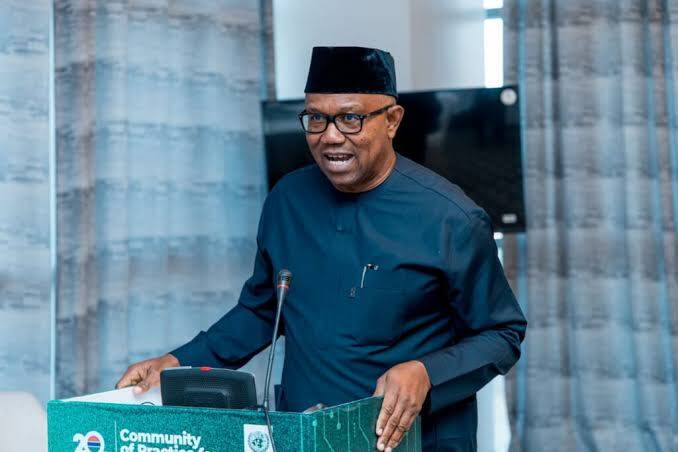
The newly minted presidential candidate of the Nigeria Democratic Congress (NDC), Peter Obi, has launched an audacious challenge against the country's crippling electricity deficit, vowing to raise power generation and distribution by at least 10,000 megawatts within a single four-year term if elected in 2027. The pledge, delivered on Saturday, May 30, 2026, during his formal acceptance of the party's nomination at a special convention in Abuja, immediately became the headline of a sweeping policy address that also promised to confront unemployment, corruption, food insecurity and the collapse of the nation's healthcare infrastructure. Speaking before delegates and party leaders, including NDC National Leader Senator Seriake Dickson and National Chairman Senator Moses Cleopas, Obi did not mince words about the depth of Nigeria's structural failures. "Nigeria today is the nation with the highest number of citizens lacking access to electricity globally," he declared, pointing to a stark and widely acknowledged reality: a country of over 200 million people produces and distributes only about 4,000 megawatts of electricity on a good day, while South Africa and Egypt, with significantly smaller populations, each generate over 40,000 megawatts.
The former Anambra State governor framed Nigeria's electricity crisis as not merely an inconvenience but a fundamental barrier to industrialisation, job creation and national survival. "It is completely unacceptable that a country of over 200 million people generates and distributes only about 4,000 megawatts of electricity while millions of Nigerians still lack access to reliable power," Obi told the gathering. "Countries like South Africa and Egypt, despite having significantly smaller populations, each generate and distribute over 40,000 megawatts. Nigeria is not even producing one-tenth of what those countries generate, and that must change." His 10,000MW target, if achieved, would bring Nigeria's effective generation to approximately 14,000MW—still far below South Africa's current output but representing a tripling of the country's functional capacity. Obi insisted that unlike previous administrations that offered excuses, his government would deliver measurable results. "This is something we have carefully studied, and we are not going to come into government and start making excuses about why it cannot be done," he said.
Obi's power sector promise rested on a diagnosis that has been echoed by multiple government reports and industry analyses. Data from the National Systems Operations indicated that as recently as March 5, 2026, total generation on the national grid stood at only 3,940.53 MW, dragged down by persistent gas supply limitations affecting multiple power stations. While Nigeria has an installed capacity of approximately 13,000 MW, transmission inefficiencies, liquidity constraints and weak contract enforcement have kept effective output stuck between 3,500 MW and 5,500 MW for years. The federal government itself has acknowledged the scale of the problem; the FGN Power Company, in partnership with Ebonyi and Enugu states, announced in April 2026 a plan to add 4,000 MW to the grid over three years. Obi's proposed target would represent a tripling of that ambition.
Beyond electricity, Obi turned to unemployment, delivering a stinging critique of official statistics that he said grossly misrepresent the true scale of the crisis. "The current official unemployment rate of four per cent grossly misrepresents the true situation; actual underemployment and unemployment in Nigeria exceeds 30 per cent, with youth unemployment sitting at over 40 per cent, among the highest globally, necessitating urgent intervention," he said. His remedy centred on the revival of Micro, Small and Medium Enterprises (MSMEs), which he identified as the engine of job creation. "We will address this by aggressively supporting the growth of MSMEs through targeted tax incentives, special interest rates, and accessible funding in sectors such as agriculture, manufacturing, entertainment, sports, and distribution. These improvements will be both measurable and verifiable," Obi pledged. The former governor has consistently rejected the government's official unemployment figures; as he has previously stated, the combined rate of unemployment and underemployment reached 42 per cent as of March 2026, according to data cited by News Central TV.
On corruption, Obi promised Nigerians a "tangible and verifiable reduction" in the abuse of public funds and the baseline costs associated with governance. He vowed that public resources would be managed with absolute transparency, prudence, and accountability "to ensure that every naira spent yields demonstrable value for the citizenry." This echoed his long‑standing critique of excessive government spending, a theme he first elevated during his 2023 presidential campaign.
The NDC candidate also addressed the deepening food security crisis. Citing projections that over 35 million Nigerians could face acute hunger despite the country's vast agricultural potential, Obi declared: "We have absolutely no justification for being among the world's hungriest nations." He promised to shift Nigeria from a consumption‑driven economy to a production‑based one through large‑scale agricultural investment. On healthcare, he set specific targets: expand health insurance coverage from about 10 per cent to over 20 per cent within four years, raise healthcare spending to at least 10 per cent of GDP, and ensure that every one of Nigeria's 8,809 political wards has a functional primary healthcare centre. On education, he pledged increased investment in schools, teacher training, technology and vocational skills development, describing human capital as "the foundation of national transformation."
The convention, which was monitored by officials of the Independent National Electoral Commission (INEC), saw Senator Victor Umeh move the motion for Obi's adoption, seconded by former Deputy Senate President Ovie Omo‑Agege. Delegates ratified the decision through a voice vote, formally confirming Obi as the NDC's flagbearer for the 2027 presidential election. National Leader Senator Seriake Dickson presented the party's flag to Obi, describing it as "a symbol of victory for Nigerians," while National Chairman Senator Moses Cleopas declared that the NDC had recorded significant growth within three months of its registration and was now positioned to offer Nigerians a credible alternative.
As the 2027 campaign gathers momentum, Obi's 10,000MW pledge sets a defining marker for his candidacy. Whether the target is achievable within a single four‑year term remains an open question, but the former governor's willingness to commit to a specific, quantifiable goal—and to compare Nigeria's performance unfavourably with that of South Africa and Egypt—represents a departure from the vague aspirational language that has characterised much of Nigeria's political discourse. For a nation that has endured decades of power outages, industrial stagnation, and youth unemployment that has driven millions to despair, Obi's promise is not merely a policy plank; it is a measure of whether the opposition can finally offer what the ruling party has so conspicuously failed to deliver: a credible plan to turn the lights on.
📩 Stone Reporters News | 🌍 stonereportersnews.com
✉️ info@stonereportersnews.com
📘 Facebook: Stone Reporters News
🐦 X (Twitter): @StoneReportNew
📸 Instagram: @stonereportersnews
Add comment
Comments