

Reported by: Ijeoma G | Edited by: Oravbiere Osayomore Promise.
A devastating cholera outbreak has swept through Borno State over the past month, killing at least 40 people and infecting more than 3,000 others across 139 communities in seven local government areas, official data confirmed on Tuesday, 2 June 2026. The outbreak, which first emerged on 1 May and was confirmed three days later, has overwhelmed health facilities in the state capital, Maiduguri, forcing some patients to be treated on bare floors in overcrowded isolation tents and prompting Governor Babagana Umara Zulum to order the immediate distribution of free drugs, medical consumables and hygiene materials to treatment centres across the state. The figures represent a sharp escalation from an epidemiological summary released on 27 May, which had reported 27 deaths and 2,715 infections, meaning that within just three days the death toll rose by ten and more than 285 new cases were recorded. With the rainy season now fully underway, health officials have warned that contaminated water sources, open defecation and poor waste disposal are fuelling the rapid spread of the disease.
The seven affected local government areas are Maiduguri Metropolitan Council (MMC), Jere, Mafa, Konduga, Monguno, Ngala and Magumeri. According to the Executive Secretary of the Borno State Contributory Healthcare Management Agency (BOSCHMA), Dr Saleh Abba Kaza, Maiduguri Metropolitan Council remains the epicentre of the outbreak, accounting for more than half of all reported cases. “Maiduguri Metropolitan Council has the highest incidence, recording more than 2,000 cases, followed by Jere with over 1,000,” Kaza stated in a public health advisory on Saturday, 30 May. He described the situation as a “serious health crisis” with a case fatality rate of about one per cent, adding that the state’s health infrastructure had become overwhelmed and that “immediate collective action is essential”.
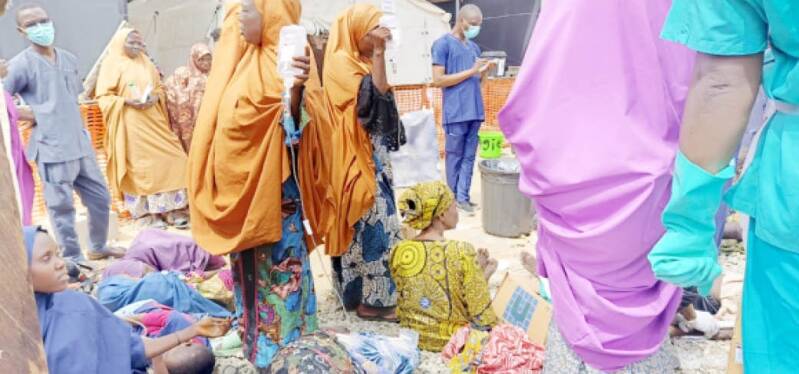
At the Brigadier-General Abba Kyari General Hospital in the Ngaranam area of Maiduguri, a correspondent who visited the treatment centre observed that patients were being treated on bare floors because the influx of people seeking care had far outstripped the facility’s capacity. Trampoline treatment tents, designed to isolate patients and stop the spread of the disease, were filled mostly with women and young children. A health worker who did not want to be named told Daily Trust: “We don’t have the actual number of patients, but on an average, from morning to this time, we received over 40 cases today. You can see how the facility is overstretched. The outbreak this year has been severe.”
Residents in cholera‑endemic areas such as Shehuri Budum, Limanti, Shokari and Gamboru told reporters that many people had died before they could reach a hospital. Modu Sheriff, a relative of a patient at the Ngaranam isolation centre, said: “He vomited twice and started having diarrhoea. We took him to a chemist, but the nurse advised that we should come here. He is now under treatment.” Another resident, Malam Abubakar Makah, who lost his mother to cholera in the Shokari area, said: “She started vomiting, then came diarrhoea. Before we could do anything, she gave up. As I’m talking to you, a child has died while six of our neighbours are already infected.” Families of cholera patients argued that the official figures may be significantly lower than the actual toll, saying that many victims are still dying at home without being registered.
In response to the escalating crisis, Governor Zulum has directed the permanent secretary of the Ministry of Health and Human Services, Dr Shettima Maina Mohammed, to oversee the immediate distribution of cholera drugs, medical consumables and hygiene materials to health facilities free of charge. The permanent secretary announced that the state government had already activated an Incident Management System, established dedicated treatment centres at the Emergency and Infectious Disease Hospital in Njimtilo and an infectious disease camp with over 1,000 beds at Ngarannam, and launched community sensitisation campaigns in Maiduguri Metropolitan Council and Jere Local Government Area. Water, sanitation and hygiene (WASH) materials such as chlorine tablets, disinfectants and sprayers have also been deployed to affected communities to strengthen prevention efforts.
The Shehu of Borno, Alhaji Abubakar Ibn Umar Garbai El‑Kanemi, has pledged the support of traditional institutions in raising awareness across communities and directed traditional leaders to educate their people on better hygiene practices. The World Health Organisation, UNICEF, Médecins Sans Frontières (MSF), Save the Children and other partners have been supporting the state’s response, but health officials have conceded that the window for containment is narrowing. Dr Saleh Abba Kaza attributed the outbreak largely to poor water, sanitation and hygiene conditions, including the contamination of pipe‑borne water sources and dams, as well as the persistence of open defecation in some communities. “With the rainy season already underway, waste materials and human excreta may be washed into residential areas, increasing the risk of transmission,” he warned.
Authorities have urged residents to chlorinate drinking water, maintain proper sanitation practices, dispose of waste appropriately and ensure regular handwashing with soap, particularly before meals and after using the toilet. They have also appealed for early reporting of symptoms such as vomiting and watery diarrhoea to the nearest healthcare facility, warning against self‑medication or treatment by unqualified persons. While efforts are being made to secure cholera vaccines, officials have stressed that vaccination is not a substitute for adherence to proper water, sanitation and hygiene practices.
With the rainy season expected to intensify in the coming weeks and the number of cases continuing to climb, the Borno State Government has called for a sustained, community‑led response to contain the outbreak. As of 2 June 2026, the latest official figures showed 4,204 suspected cases and 39 confirmed deaths, reflecting a spike of 274 new cases recorded in a single 24‑hour period. For the families who have already lost loved ones, however, the statistics offer no comfort. As one resident of Shokari put it: “We know what happened here some years back; that’s why everyone is afraid. We pray that such calamity should not be repeated. Many people died.”
📩 Stone Reporters News | 🌍 stonereportersnews.com
✉️ info@stonereportersnews.com
📘 Facebook: Stone Reporters News
🐦 X (Twitter): @StoneReportNew
📸 Instagram: @stonereportersnews
Add comment
Comments