

Reported by: Ijeoma G | Edited by: Oravbiere Osayomore Promise.
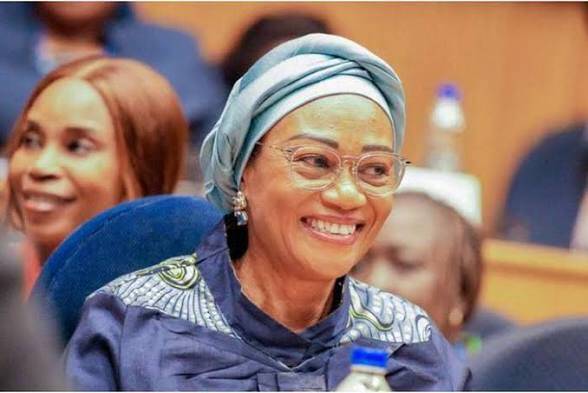
In a video that went viral on 25th of June 2026, Nigeria’s First Lady, Senator Oluremi Tinubu, has triggered a firestorm of public outrage after advising struggling citizens to venture into roadside petty trading—such as frying akara (bean cakes), roasting corn, and selling kuli-kuli (peanut cakes)—as a viable survival strategy in the face of the country’s deepening economic crisis. The remarks, delivered in defence of the administration’s micro-grant initiatives, have ignited fierce condemnation, with critics quickly contrasting her low-budget survival advice with the multi-trillion-naira megaprojects being executed by her husband’s administration, most notably the controversial 700-kilometre Lagos-Calabar Coastal Highway.
Speaking on the presidency’s approach to poverty alleviation and small-scale empowerment, the First Lady suggested that citizens do not need massive capital to uplift themselves economically. “To start akara business doesn’t take a lot of money. To start roasting corn or kuli-kuli doesn’t take much,” Senator Tinubu stated. “We have encouraged Nigerians as best as we could, we have given people a grant, I also gave to several others”. While the presidency frames these micro-grants as accessible lifelines for the informal sector, the recommendation that citizens rely on roadside food vending has been widely slammed as insensitive, given the severe inflation currently eroding the purchasing power of millions of Nigerians.
The core of the public anger lies in the sharp policy and lifestyle disconnect between Nigeria’s ruling class and the citizens they govern. President Bola Tinubu’s administration continues to prioritise capital-intensive infrastructure, pouring trillions of naira into the coastal highway project and other elite administrative expenses, while citizens hit by the removal of fuel subsidies, electricity tariff hikes, and the floating of the naira are being told to find solace in subsistence-level trading. Social commentators and citizens have pointed out the stark irony: the administration expects the population to survive on the margins of the economy by selling snacks by the roadside, while the state apparatus commands vast financial resources.
Economic analysts have also noted that the First Lady’s comments overlook the brutal realities of the modern Nigerian marketplace. Due to skyrocketing inflation, the cost of essential ingredients—such as vegetable oil, gas, charcoal, beans, and corn—has tripled, making even these “low-capital” businesses increasingly difficult for ordinary Nigerians to start or sustain. As market data shows, a bag of beans now hovers around N90,000, a jerrican of vegetable oil easily crosses N65,000, and a standard 12.5kg cooking gas cylinder sits at a crushing average of N19,652. The very items needed to start these “low-capital” businesses are out of reach for the target beneficiaries of the First Lady’s micro-grants.
The First Lady’s comments came just days after she announced a N100 million grant for 2,000 women petty traders in Benue State under the Renewed Hope Initiative (RHI). Each beneficiary received N50,000 to boost their economic activities. She also commissioned a Community ICT Training Centre in Ihugh, Vandeikya LGA, built through a partnership between the Renewed Hope Initiative and the National Information Technology Development Agency (NITDA). However, critics argue that such micro-grants, while well-intentioned, are quickly swallowed by hyper-inflation and do little to address the structural failures driving poverty. As one editorial put it, “A nation cannot trade its way out of poverty through roadside snacks”.
The backlash has been particularly fierce given the contrast between the First Lady’s advice and the administration’s spending priorities. The Lagos-Calabar Coastal Highway project, estimated to cost trillions of naira, has been a focal point of criticism, with many Nigerians questioning why the government can find billions for concrete but only crumbs for the masses. Critics have labelled the First Lady’s remarks a “let them eat akara” philosophy—a Nigerian twist on the infamous Marie Antoinette quote—that exposes a profound, systemic disconnect between the ruling class and the struggling population. As public discontent grows, the First Lady’s remarks are being cited by critics as a prime example of a perceived lack of empathy and a deepening disconnect between the economic policies of the Aso Rock Villa and the daily survival struggles on the Nigerian street.
📩 Stone Reporters News | 🌍 stonereportersnews.com
✉️ info@stonereportersnews.com | 📘 Facebook: Stone Reporters News | 🐦 X (Twitter): @StoneReportNew | 📸 Instagram: @stonereportersnews
Add comment
Comments