

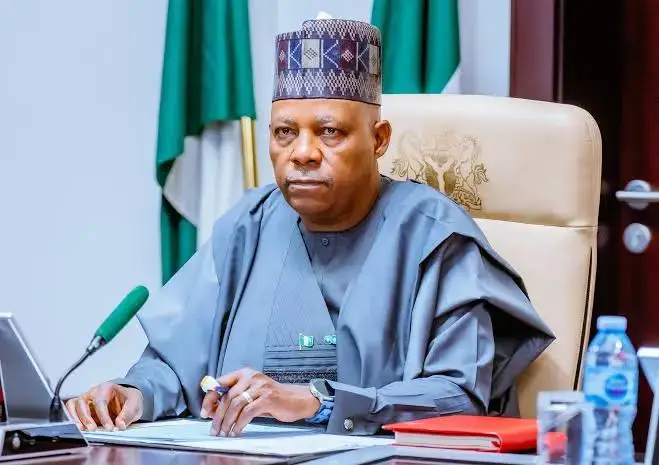
Vice President Kashim Shettima has directed the immediate activation of a national early warning and coordination platform to strengthen Nigeria’s preparedness against flooding, as authorities warn of increasing rainfall and heightened flood risks across several parts of the country.
On Thursday, June 25, 2026, at the Presidential Villa, Shettima issued the directive during a meeting of the Anticipatory Action Task Force, where senior government officials, emergency responders, and humanitarian partners reviewed the country’s readiness for the peak of the rainy season.
The Vice President, who chairs the task force, instructed the National Emergency Management Agency (NEMA), the task force, and other relevant institutions to move beyond reactive emergency response and adopt a proactive disaster prevention strategy.
He said the administration of President Bola Ahmed Tinubu was committed to reducing disaster-related losses through early intervention, stronger coordination, and faster deployment of resources to vulnerable communities.
According to Shettima, the country must abandon the long-standing pattern of waiting until floods cause destruction before mobilising assistance, stressing that preparedness must now become central to national disaster management.
He ordered immediate technical consultations to operationalise the proposed Fusion and Trigger Room within NEMA, describing it as a critical national coordination hub for flood monitoring, forecasting, data consolidation, trigger activation, and emergency decision-making.
In a statement issued by Stanley Nkwocha, Shettima said the new coordination platform would serve as the backbone of anticipatory action, enabling agencies to detect warning signs earlier and respond before disasters escalate.
“We are called to act early, to reduce losses before they multiply, and to protect vulnerable communities before crises unfold around them,” the Vice President said during the meeting.
He added that the success of anticipatory action depends heavily on speed, readiness, and efficient inter-agency collaboration, particularly in a country where flooding has repeatedly displaced thousands and destroyed infrastructure.
Shettima also directed all relevant agencies and technical teams to review their budgets within already approved allocations and align implementation plans with immediate flood preparedness priorities.
He stressed that resources approved for preparedness must be released without administrative delays, warning that bureaucratic bottlenecks could undermine emergency response before it even begins.
“To wait until disaster strikes before releasing what we have already approved is to defeat the very purpose of acting early,” he said, calling for faster release and deployment of intervention funds.
The Vice President emphasised that federal action alone would not be enough to effectively manage flooding across Nigeria’s diverse terrain.
He called on state governors and subnational institutions to take ownership of flood preparedness measures in their respective jurisdictions, noting that local implementation would determine how effective national coordination becomes.
“Federal coordination on its own will never be sufficient,” Shettima said, urging state governments to actively participate in prevention planning and emergency response.
Nigeria faces seasonal flooding almost every year, particularly during periods of heavy rainfall, with riverine and low-lying communities often suffering the worst impacts.
Flooding has remained one of the country’s most devastating natural disasters, frequently leading to loss of life, destruction of homes, displacement of residents, crop losses, and severe economic disruption.
The urgency of the current intervention is shaped partly by the devastating floods experienced in recent years, including the 2022 disaster that affected dozens of states and displaced more than a million people.
At the meeting, Bernard Doro, Minister of Humanitarian Affairs and Poverty Reduction, described government approval of funding for anticipatory flood action as timely and necessary.
He said implementation should be centrally coordinated using the national social register and digital payment systems to ensure vulnerable households receive targeted support quickly.
Doro noted that collaboration with state governments would be essential to guarantee accurate beneficiary identification and effective intervention delivery.
Also speaking at the meeting, Mohamed Fall, the United Nations Resident and Humanitarian Coordinator in Nigeria, praised the Federal Government’s decision to fund anticipatory action.
Fall described the move as a strong demonstration of political commitment and national ownership in addressing climate-related risks.
According to him, Nigeria’s approach could serve as a model for other African countries facing similar environmental threats.
“Whenever Nigeria does something of this magnitude, it serves as a blueprint for the rest of the continent,” he said.
Meanwhile, Zubaida Abubakar Umar, Director-General of NEMA, said the intervention fund approved by the National Economic Council would help reduce loss of lives and livelihoods.
She said NEMA had already issued early warning alerts to at-risk areas and was prioritising vulnerable communities identified through hazard mapping and risk assessments.
According to Umar, communities with histories of severe flooding are receiving heightened monitoring as rainfall intensity increases.
The National Economic Council recently approved an ₦83.2 billion intervention fund to support anticipatory action against flooding nationwide.
The funding is expected to support early warning systems, relief logistics, emergency coordination, and preventive interventions in high-risk communities.
As meteorological forecasts point to heavier rainfall in the coming months, authorities say preparedness over the next few weeks could prove critical in determining the scale of impact across Nigeria.
For Nigeria’s emergency managers, the central message from Thursday’s meeting was clear: flood response must begin before the waters rise.
📩 Stone Reporters News | 🌍 stonereportersnews.com
✉️ info@stonereportersnews.com | 📘 Facebook: Stone Reporters News | 🐦 X (Twitter): @StoneReportNew | 📸 Instagram: @stonereportersnews
.
Add comment
Comments