

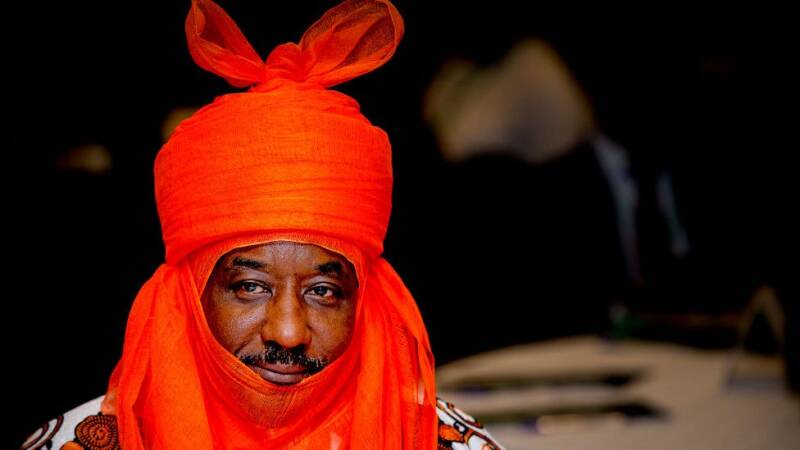
The Muhammadu Sanusi II, Emir of Kano and former Governor of the Central Bank of Nigeria, has warned West African leaders against rushing the launch of the proposed ECO common currency, saying monetary union cannot succeed without strong economies, fiscal discipline, credible institutions, and genuine political commitment.
On Thursday, June 25, 2026, at a policy dialogue in Abuja titled “ECO Currency and Monetary Integration in West Africa: Implications for Nigeria,” organised by the National Institute for Legislative and Democratic Studies> (NILDS), Sanusi said the Economic Community of West African States remains far from meeting the conditions required for a successful monetary union.
Sanusi said that although the ECO project has the potential to lower transaction costs, improve cross-border trade, expand markets, and strengthen the global competitiveness of West African economies, such benefits would only materialise if the currency is built on sound economic realities rather than political ambition.
“A currency is only as strong as the economy behind it,” Sanusi told participants, stressing that history has repeatedly shown that successful monetary unions are founded on economic convergence, institutional credibility, and shared prosperity—not aspiration alone.
He argued that Africa can no longer afford to remain economically fragmented at a time when other regions are deepening cooperation and integrating markets to improve productivity and competitiveness.
According to Sanusi, the fragmentation of African markets continues to weaken the continent’s bargaining power in global trade and investment discussions.
He noted that West Africa alone possesses enormous economic potential, with an estimated population of about 450 million people and a combined gross domestic product of nearly $900 billion.
However, he said the central challenge is transforming that large population into productive economic agents with purchasing power capable of driving industrial growth and regional trade.
Sanusi drew attention to the region’s youthful demographic, describing it as either a powerful economic asset or a dangerous liability depending on policy choices.
“These children have been born. These youths are alive. We are not going to bury them,” he said, arguing that governments must decide whether to integrate young people into productive sectors or allow unemployment to fuel insecurity.
He warned that failure to create economic opportunities for millions of youths could worsen problems such as banditry, terrorism, violent crime, and social instability across the region.
The former central bank governor said a common currency could significantly improve investor confidence by creating a larger unified market without currency conversion barriers.
He explained that investors often prefer larger integrated economic zones because they reduce transaction friction and offer easier movement of capital, labour, and goods.
According to him, a single West African market with one currency and minimal trade barriers would be more attractive than fragmented national markets such as Nigeria, Ghana, or Sierra Leone operating separately.
Despite this, Sanusi stressed that a common currency should be viewed as the final outcome of a much broader integration process—not the starting point.
He described monetary union as the top of a pyramid built upon several deeper foundations.
Those foundations, he said, include political commitment, strong institutions, financial integration, trade integration, labour mobility, fiscal discipline, and macroeconomic convergence.
While the common currency often attracts the most public attention, Sanusi said it is actually the last and most difficult stage of regional integration.
He identified political trust among member states as the single most important factor in the success of the ECO project.
Sanusi warned that current tensions between ECOWAS and the Alliance of Sahel States (AES)—comprising Niger, Burkina Faso, and Mali—could seriously undermine regional integration efforts.
Referring to recent diplomatic strains, he said meaningful monetary cooperation would be difficult when trust between governments has broken down.
“You cannot be talking about a common currency with Niger, Burkina Faso and Mali when you are threatening them with force in their internal matters,” he said.
According to Sanusi, politics remains the dominant force shaping international economic relations, and unresolved political disputes can destroy even well-designed economic frameworks.
He urged ECOWAS leaders to prioritise reconciliation and dialogue with the three Sahel states.
Sanusi said regional unity remains essential for long-term prosperity and security in West Africa.
“The unity of West Africa is sacrosanct,” he said, insisting disputes should be resolved within a united ECOWAS framework.
Drawing comparisons with Europe, Sanusi said the Euro did not emerge overnight.
He explained that Europe first achieved substantial convergence in inflation control, fiscal discipline, and institutional standards before introducing the euro.
According to him, Germany and France served as the early pillars of that monetary system before expansion to other countries.
Sanusi also rejected the idea that policymakers must choose between strong institutions and strong leadership.
He argued that both are essential because institutions can be weakened by poor leadership.
According to him, true leadership is not about arbitrary power but about respect for law and institutional processes.
Using law enforcement and the judiciary as examples, he said strong leadership means applying rules fairly and consistently rather than exercising raw authority.
Sanusi mounted a strong defence of central bank independence, describing monetary stability as essential for sustainable growth.
Recalling his tenure as CBN governor, he said former Presidents Umaru Musa Yar'Adua and Goodluck Jonathan respected the autonomy of the apex bank.
He recounted explaining to Jonathan why excessive money creation to artificially lower interest rates would fuel inflation and weaken the naira.
“You cannot print money and have stable prices,” he said.
Sanusi warned central banks against becoming tools for unchecked government spending.
He also criticised excessive public borrowing, warning that rising debt obligations could threaten development and fiscal sustainability.
According to him, Nigeria must improve transparency in borrowing and ensure accountability in how borrowed funds are spent.
Presenting economic data, Sanusi said West Africa remains poorly positioned for a common currency.
He noted that intra-ECOWAS trade accounts for only about 10 to 12 percent of total trade, compared with nearly 60 percent within the European Union.
That gap, he argued, shows the region has not yet built the level of economic integration needed to justify surrendering monetary independence.
Sanusi concluded that the real goal of the ECO project should not simply be the launch of a shared currency, but the creation of a more prosperous, connected, and globally competitive West Africa.
His message to ECOWAS leaders was clear: build the economic foundations first, and let the common currency come last.
📩 Stone Reporters News | 🌍 stonereportersnews.com
✉️ info@stonereportersnews.com | 📘 Facebook: Stone Reporters News | 🐦 X (Twitter): @StoneReportNew | 📸 Instagram: @stonereportersnews
Add comment
Comments