

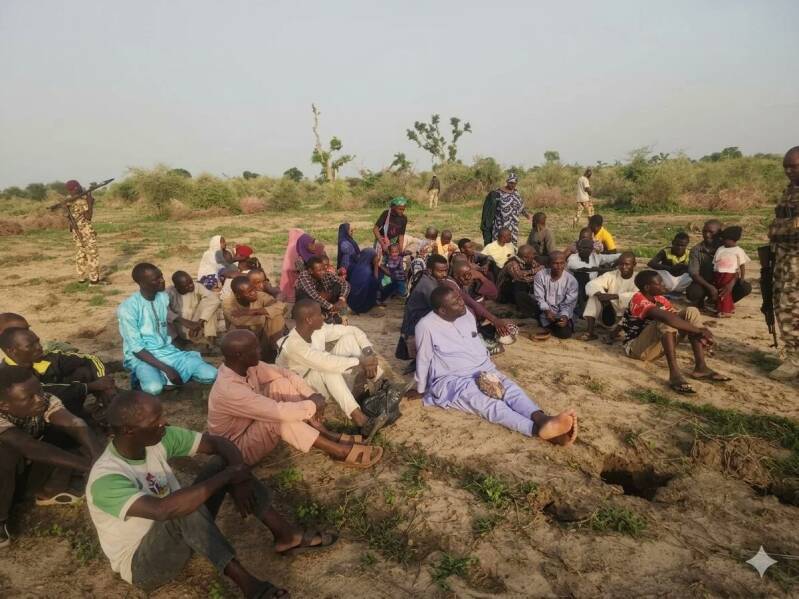
Troops of the Nigerian Army under Operation HADIN KAI have rescued 53 civilians and recovered eight vehicles after dismantling a suspected terrorist roadblock mounted by insurgents linked to Islamic State West Africa Province and Jama'atu Ahlis Sunna Lidda'awati wal-Jihad along a key route in Borno State, in one of the latest counter-insurgency operations in Nigeria’s troubled northeast.
The operation took place at about 3:45 p.m. on Wednesday, June 24, 2026, along the Buratai–Kamuya road in Biu Local Government Area, when troops of the 135 Special Forces Battalion under Sector 2 of Operation HADIN KAI, deployed at Dutse Kura (Echo 1), detected suspicious insurgent activity through surveillance systems. The operation was later confirmed in a statement issued in Maiduguri by Captain Mohammed Goni.
According to Captain Goni, the insurgents had mounted an illegal roadblock on the highway, effectively trapping civilian motorists and passengers travelling through the corridor, a route frequently used by traders, farmers, transport operators, and residents moving between communities in southern Borno.
Military sources said the terrorists attempted to temporarily seize control of the road, using the blockade to halt vehicles and create panic among road users, a tactic frequently employed by insurgent groups to abduct civilians, loot supplies, or ambush security personnel.
Immediately after the suspicious movement was detected, a Quick Reaction Force (QRF) was mobilised to intercept the attackers before they could consolidate their position or inflict mass casualties on trapped civilians.
The troops rapidly advanced toward the location and pursued the insurgents toward the Mangari–Dora general area, where contact was made and an exchange of gunfire followed.
Captain Goni said the soldiers engaged the insurgents in a fierce firefight, applying sustained pressure that forced the terrorists to retreat in confusion.
The military said the attackers were unable to withstand the offensive and fled from the scene, abandoning their roadblock and retreating deeper into surrounding terrain.
Following the successful engagement, troops moved in to secure the area and assess the situation around the abandoned blockade.
During the operation, soldiers successfully rescued 53 civilians who had either been intercepted or trapped by the insurgents during the road blockade.
Security sources disclosed that the rescued civilians comprised 48 adults — 20 males and 28 females — as well as five children, highlighting the vulnerability of ordinary commuters travelling through conflict-prone roads in Borno.
Many of the rescued civilians were reportedly travelling for daily economic activities, including farming, local trade, and inter-community transport, when they encountered the insurgent blockade.
Military personnel also recovered eight vehicles that had been seized or abandoned during the incident.
The recovered vehicles included commercial transport vehicles and private automobiles that had been stopped when the insurgents blocked movement on the road.
After the rescue, troops escorted the civilians and vehicles to safer locations to ensure no further attacks occurred during evacuation.
Soldiers also dominated the area and carried out extended clearance patrols along likely terrorist withdrawal routes.
According to the military, additional search operations were conducted after the firefight, though no further contact with insurgents was reported.
The Buratai–Kamuya axis has strategic significance because it connects multiple communities in southern Borno and serves both civilian and security movement.
Road ambushes and temporary blockades have become a recurring tactic among insurgent groups in northeastern Nigeria, especially in remote corridors where militants can exploit terrain and limited surveillance.
ISWAP and JAS remnants have increasingly relied on mobility-based attacks, including roadside ambushes, kidnappings, and improvised explosive devices, to disrupt military logistics and terrorise local populations.
This latest incident underscores the continued threat posed by insurgent factions despite years of military operations across the Lake Chad region.
Operation HADIN KAI, which replaced the former Operation Lafiya Dole in 2021, remains Nigeria’s principal counter-insurgency campaign against Boko Haram and affiliated extremist groups in the northeast.
The operation focuses on degrading insurgent networks, reclaiming territories, protecting civilians, and restoring normal economic life in conflict-affected communities.
Despite major military gains over the years, Borno remains the epicentre of Nigeria’s long-running insurgency, with several rural communities still vulnerable to periodic raids and attacks.
The insurgency, which began more than a decade ago, has killed thousands, displaced millions, and caused widespread humanitarian devastation across Borno, Yobe State, and Adamawa State.
Military analysts say one of the biggest challenges remains securing long stretches of rural roads that insurgents exploit for hit-and-run operations.
The use of surveillance systems in this operation proved critical, allowing troops to identify the threat before the situation escalated further.
Security experts note that intelligence-led response continues to be one of the most effective tools in counter-insurgency warfare.
The rescue of all 53 civilians without reported fatalities among them is being viewed as a significant operational success for troops in the theatre.
The operation also provided reassurance to communities that security forces remain actively engaged in protecting vulnerable transport corridors.
Military authorities have continued to urge residents to report suspicious movement, unusual gatherings, or possible insurgent activity to security agencies.
For civilians in Borno, safe movement along highways remains essential for survival, access to healthcare, trade, and farming.
The latest rescue operation serves as another reminder that while insurgent capabilities have been weakened, the security situation in parts of northeastern Nigeria remains fragile.
For now, the Nigerian Army says its offensive against ISWAP and JAS will continue, with intensified surveillance and rapid-response operations aimed at denying terrorists freedom of movement across the region.
📩 Stone Reporters News | 🌍 stonereportersnews.com
✉️ info@stonereportersnews.com | 📘 Facebook: Stone Reporters News | 🐦 X (Twitter): @StoneReportNew | 📸 Instagram: @stonereportersnews
Add comment
Comments