

Reported by: Oahimire Omone Precious | Edited by: Oravbiere Osayomore Promise.
The Malala Fund has called for a paradigm shift from symbolic male support to deliberate, measurable and accountable male allyship in the fight for girls' education in Nigeria, launching a landmark report that exposes the gap between widespread endorsement of girls' schooling and the systemic barriers that continue to keep millions of girls out of classrooms across the north.
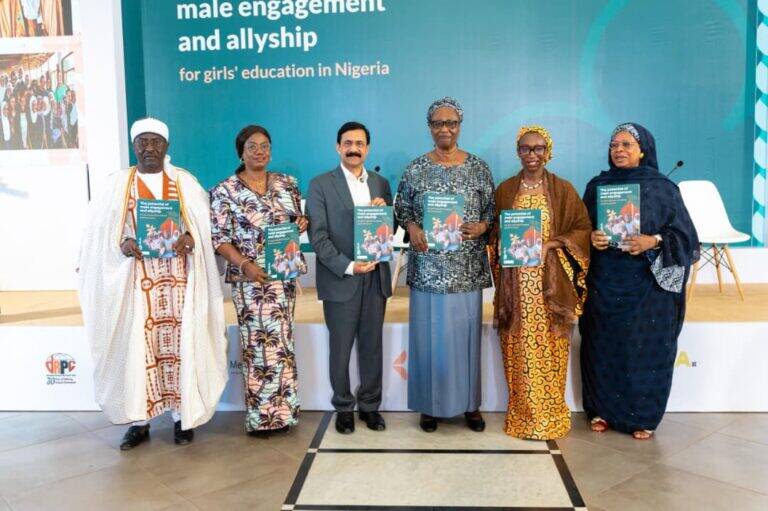
Titled 'The Potential of Male Engagement and Allyship for Girls' Education in Nigeria', the report was unveiled on Wednesday, June 24, 2026, at a high-level event in Abuja attended by educators, community influencers, traditional and religious leaders, activists, civil society actors, and international donors. The study, commissioned by the Malala Fund and produced by the Development Research and Projects Centre (dRPC) in partnership with MenEngage Nigeria, reviewed 385 sources on gender equality programmes, analysed 28 flagship girls' education schemes, and interviewed 63 practitioners, including programme managers, government officials, male champions, and members of the non-profit network MenEngage Nigeria.
Presenting the report, dRPC Executive Director Dr Judith-Ann Walker defined male allyship as "the practice of men and boys leveraging their privilege, influence, and community authority to dismantle barriers, advocate for equal learning opportunities, and champion girls' safety and enrollment in school". She stressed that many intervention projects on girls' education include men largely as "gatekeepers, participants, or visible supporters with little clarity around what should change in their attitude or behaviour".
The report's findings are grounded in sobering statistics. According to the 2024 Nigeria Demographic and Health Survey cited in the report, girls' net school attendance rate has declined to only 38 per cent in the northeast and 43 per cent in the northwest, with a national average of 47 per cent. The situation is compounded by the prevalence of child marriage, with the 2022 Multiple Indicator Cluster Survey recording under-18 marriage rates of 55 per cent in the northeast and 60 per cent in the northwest, against a national average of 34 per cent. More than 3.7 million women in Nigeria aged between 20 and 24 were married off before turning 18, a practice that severely disrupts education and prospects.
Walker noted that in northern Nigeria, fathers and husbands often make the final decision about whether a girl enrols, stays in, or leaves school, with traditional and religious leaders setting the terms of what is locally acceptable. Male educators and policymakers, she added, shape whether schools are safe and responsive to girls, making male engagement a veritable tool for eliminating the gender barriers hindering the girl child's ability to exercise her right to education.
Malala Fund CEO Nabila Aguele, speaking at the launch, stressed that "male engagement cannot be an afterthought. It cannot be symbolic endorsement or simply a matter of having more men in the room. It must be intentional, strategic and measured by the difference it makes to girls' lives". She added that while girls remain at the centre of conversations about education, many decisions affecting their futures are often made by men — fathers, community leaders and policymakers. "The question is whether they will reinforce these barriers or work to dismantle them," she said.
Malala Fund co-founder Ziauddin Yousafzai, whose own advocacy was shaped by witnessing educational opportunities denied to his sisters in Pakistan, delivered a keynote address that underscored the urgency of the moment. He described girls' education in Northern Nigeria as being in crisis due to multiple barriers — poverty, insecurity and restrictive gender norms. "Men have a key role because many of the final decisions affecting girls are made by them. Change in the hearts and minds of men are therefore crucial," he said. "We do not need to call men out; we need to call them in. Men should not be viewed as part of the problem alone, but as part of the solution".
Yousafzai acknowledged that support for girls' education among influential men in Northern Nigeria is increasing, but warned that such support remains largely symbolic and insufficient for lasting change. "There is widespread endorsement of girls' education, but endorsement alone is not enough. Allyship must move beyond words and become active support, active advocacy and active accountability," he said. He urged policymakers and development partners to strengthen monitoring systems and establish clear indicators for measuring the impact of male engagement initiatives, insisting that "the standard should not be how many men participate in programmes. The standard should be whether more girls are in school, staying in school and completing their education".
The report, which also called for policy advocacy around girls' education to feature intentional "male champions" and follow-through on implementation, noted that work to engage men at the community level requires better support and clear strategies to shift unhealthy social norms. For organisations engaging men on girls' education, the report noted the need to set clear indicators for measuring what works, for whom, and under what conditions.
The launch event brought together Nigeria's Minister of State for Education, Suwaiba Said Ahmad, alongside other key stakeholders. The report's recommendations are expected to inform the Malala Fund's ongoing work in Nigeria, which includes supporting local organisations to domesticate national school re-entry guidelines across states, promoting education as a strategy against child marriage, and advocating for gender-responsive education financing. As Aguele put it, "We want to see resources reaching the girls who need them most and accountability mechanisms that ensure commitments translate into action".
📩 Stone Reporters News | 🌍 stonereportersnews.com
✉️ info@stonereportersnews.com | 📘 Facebook: Stone Reporters News | 🐦 X (Twitter): @StoneReportNew | 📸 Instagram: @stonereportersnews
Add comment
Comments