

Reported by: Oahimire Omone Precious | Edited by: Oravbiere Osayomore Promise.
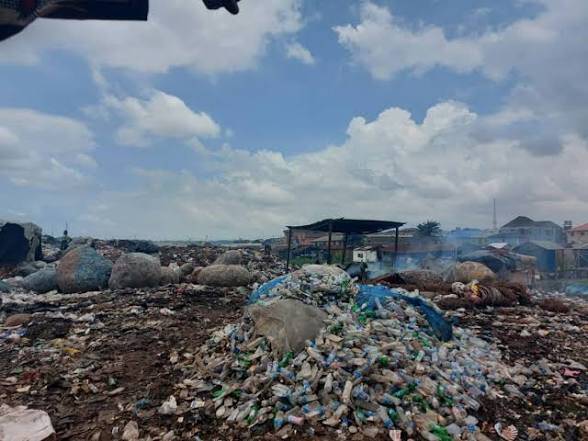
Lagos State Commissioner for Environment and Water Resources, Tokunbo Wahab, has issued a frank apology to residents over the worsening waste evacuation crisis that has left heaps of refuse littering roads, markets, and drainage channels across the metropolis, acknowledging that the past three to four months have been "very bad" for waste collection.
Speaking on Friday, June 26, 2026, during an interview on Arise TV's 'The Morning Show', Wahab did not mince words about the scale of the problem. "Let me start by apologising to Lagosians. The past three, four months have been very bad with respect to waste collection, but we didn't just get there overnight," he said. "I won't play the ostrich by not admitting we had a challenge. Are we fixing it? Yes". His mea culpa came as residents took to social media to vent their frustration over delays in waste evacuation, with some complaining that it takes weeks for waste to be collected from their communities, raising serious concerns over public health and environmental sanitation.
The crisis had escalated to the point where Governor Babajide Sanwo-Olu issued a direct order for round-the-clock evacuation of waste across the state to clear refuse heaps on roads and other public spaces. The governor's directive, however, drew criticism from political opponents, including Labour Party's 2023 governorship candidate Gbadebo Rhodes-Vivour, who described it as an admission of failure by the administration. Wahab defended the government's record, pointing out that Lagos generates approximately 13,000 tonnes of waste daily, with the Lagos Waste Management Authority (LAWMA) and Private Sector Participants (PSPs) evacuating about 418,500 tonnes in May 2026 alone — an average of roughly 13,200 tonnes per day.
Wahab admitted that some communities have experienced delays due to a combination of factors, including poor road access, underperforming operators, rising operational costs, and weak payment compliance by residents. He disclosed that 442 PSP operators were active across Lagos in May, while 27 routes were under review for service improvement, and that LAWMA received 474 complaints and service requests during the month as part of efforts to identify weak points in the system. The agency also clears about 3,000 black spots daily across 57 routes, targeting illegal dumping points such as road medians, market edges, bus stops and open spaces. In 2025, the state recorded 1,023 incidents of illegal dumping, with 447 cases referred for prosecution.
But Wahab insisted that the root of the problem runs deeper than operational hiccups. He argued that Lagos can no longer sustain its decades-old linear waste disposal model of simply collecting and dumping refuse at landfill sites. "For decades, we had practised a linear waste system. We just pick waste and we dump. Olusosun and Solous were the outskirts of Lagos. We all went to build around them," he said. With Lagos occupying just 0.4 per cent of Nigeria's total land mass — about 3,355 square kilometres — the commissioner stressed that the old model is simply unsustainable. "We can't sustain that. We don't even have the land," he declared.
The solution, according to Wahab, lies in transitioning from a "pick-and-dump" approach to a circular waste economy that treats waste as a resource rather than refuse. He cited recent investments in waste-to-energy initiatives, including a biodigester facility at the Ecocircuit centre, which converts food waste to energy. The state is also developing a larger waste-to-energy facility expected to process about 4,250 tonnes of waste daily. Additionally, ongoing infrastructure projects include the construction of Transfer Loading Stations and Material Recovery Facilities in Ikorodu and Badagry to facilitate waste sorting, recycling and recovery. The Ikosi Fruit Market Biodigester project, funded and piloted by C-40, has also been commissioned to convert organic waste into biogas, electricity and fertiliser.
While admitting that some residents have not received the level of service they deserve, Wahab insisted that the government is not standing still and is implementing reforms designed to move Lagos from a traditional "collect-and-dump" model to a modern circular economy approach. "We had a challenge and we are fixing it," he said, reaffirming the government's commitment to strengthening waste management systems and ensuring cleaner, healthier neighbourhoods for all residents. In April, the Lagos government also returned the monthly environmental sanitation exercise after a decade-long hiatus, following a court ruling that had halted it in November 2016.
For the millions of Lagosians who have endured the sight and smell of uncollected refuse, the commissioner's apology may offer some reassurance. But as Wahab himself acknowledged, the road to a cleaner Lagos will require more than words — it will demand a fundamental rethink of how Nigeria's largest city manages its waste, and the political will to see that transformation through.
📩 Stone Reporters News | 🌍 stonereportersnews.com
✉️ info@stonereportersnews.com | 📘 Facebook: Stone Reporters News | 🐦 X (Twitter): @StoneReportNew | 📸 Instagram: @stonereportersnews
Add comment
Comments