

Reported by: Ijeoma G | Edited by: Oravbiere Osayomore Promise.
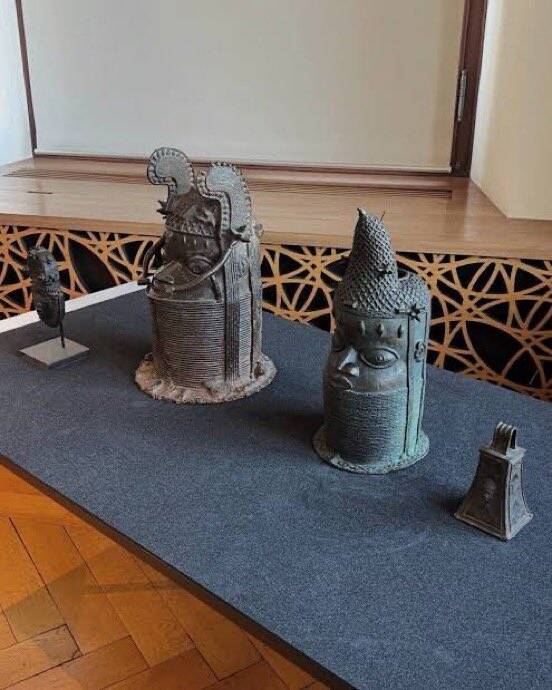
Swiss authorities on Monday, June 29, 2026, officially returned 18 Benin Bronzes to Nigeria in a landmark ceremony at the National Museum in Lagos, marking yet another significant victory in the country's decades-long campaign to reclaim its cultural heritage looted during the colonial era.
The artefacts, which include royal and religious objects created at the royal court of the Kingdom of Benin from the 16th century onwards, were formally received by the National Commission for Museums and Monuments (NCMM) on behalf of the Federal Government. The handover ceremony was attended by Switzerland’s Federal Councillor Elisabeth Baume-Schneider and Nigeria’s Minister of Art, Culture, Tourism and the Creative Economy, Hannatu Musa Musawa, who signed a bilateral agreement on the transfer of cultural property, reinforcing cooperation between both countries to combat illicit trafficking and facilitate the return of stolen cultural items.
Among the 18 artefacts returned, 14 were restituted by the Ethnographic Museum at the University of Zurich, two by Museum Rietberg Zurich, and two by the Musée d’Ethnographie de Genève (MEG). The restitution followed years of collaborative provenance research under the Benin Initiative Switzerland, which confirmed that the objects were most likely looted during the British punitive expedition of 1897, when British forces attacked and burned Benin City, carting away thousands of priceless sculptures, plaques, and ceremonial objects.
Among the artefacts returned is a Benin Eroro, a four-sided ceremonial bell that played a central role in royal rites, political functions, and battle. Its pyramidal face is decorated with depictions of deceased kings and queens, and its toll was believed to invoke ancestral spirits. Also returned was a container for herbs and medicines depicting the head of Ofoe, a divine emissary of the deity Ogie’uwu, which balances on three legs without a torso.
In addition to the 18 Benin Bronzes, Switzerland also returned a bronze bracelet and four archaeological monoliths from Nigeria’s Niger Delta region, which had been seized during criminal proceedings in Switzerland and subsequently transferred to the state.
Speaking at the ceremony, Nigeria’s Culture Minister, Hannatu Musa Musawa, described the restitution as the return of “evidence of civilisation that already mastered bronze casting to a standard of technical, artistic and extremely intricate sophistication” before colonisation. She called on “every single nation holding African heritage” to emulate Switzerland’s example.
Swiss Federal Councillor Elisabeth Baume-Schneider acknowledged the painful history behind the artefacts, stating: “The artefacts returned today carry a painful history. Many of them left the Kingdom of Benin, their place of origin, as a result of violence, looting and deeply unequal power relations.” Alice Hertzog, director of the Ethnographic Museum at the University of Zurich, added: “They never should have been in Switzerland in the first place. They have graced our exhibition halls, they featured on our posters and in our publications. We have cared for them. We have preserved them, but they were never ours to keep.”
Some of the returned artefacts will be displayed at the National Museum in Lagos, while the vast majority will be transferred to Edo State and temporarily housed at the Oba Ovonramwen Storage facility at the National Museum in Benin City, under the care of the NCMM. The NCMM has announced plans to establish a world-class gallery to display all recently returned Benin Artefacts, which will include not only the Swiss returns but also the 113 Benin Bronzes returned from the Netherlands last year and expected returns from Cambridge.
The restitution forms part of a broader effort to address historical injustice, while creating the basis for long-term cultural partnership between Switzerland and Nigeria. The bilateral agreement signed during the ceremony establishes a legal framework for cooperation aimed at preventing the illicit trafficking of cultural property, facilitating the return of unlawfully exported cultural objects, and strengthening the exchange of information, expertise and best practices.
Nigeria has been at the forefront of the global campaign for the restitution of African artefacts looted during the colonial era, and Monday’s ceremony marks another significant step forward in that ongoing struggle. With hundreds more Benin Bronzes still scattered across museums and private collections worldwide, the pressure continues to mount on Western institutions to follow Switzerland’s lead and return what was never theirs to keep.
📩 Stone Reporters News | 🌍 stonereportersnews.com
✉️ info@stonereportersnews.com | 📘 Facebook: Stone Reporters News | 🐦 X (Twitter): @StoneReportNew | 📸 Instagram: @stonereportersnews
Add comment
Comments